
HSP90 Antibody (16F1) - BSA Free
Novus Biologicals, part of Bio-Techne | Catalog # NBP1-97506

![Western Blot: HSP90 Antibody (16F1) [NBP1-97506]](https://resources.bio-techne.com/images/products/HSP90-Antibody-16F1-Western-Blot-NBP1-97506-img0001.jpg "Western Blot: HSP90 Antibody (16F1) [NBP1-97506]")
Scientific images may be resized, cropped, or adjusted for brightness or contrast for presentation purposes. These updates are limited to presentation and do not affect the underlying scientific interpretation of the data. Where available, additional source data may be provided upon request.
Key Product Details
Species Reactivity
Validated:
Human, Mouse, Rat, Porcine, Bovine, Canine, Chicken, Drosophila, Fish, Guinea Pig, Invertebrate, Mammal, Opossum, Plant, Primate, Rabbit, Sheep, Xenopus
Cited:
Human, Mouse
Applications
Validated:
Immunohistochemistry, Immunohistochemistry-Paraffin, Western Blot, Immunoprecipitation
Cited:
Western Blot
Label
Unconjugated
Antibody Source
Monoclonal Rat IgG2A Clone # 16F1
Format
BSA Free
Concentration
Please see the vial label for concentration. If unlisted please contact technical services.
Product Specifications
Immunogen
Native human Hsp90.
Reactivity Notes
Opossum, Mussel, Beluga
Clonality
Monoclonal
Host
Rat
Isotype
IgG2A
Scientific Data Images for HSP90 Antibody (16F1) - BSA Free
Western Blot: HSP90 Antibody (16F1) [NBP1-97506]
Western Blot: HSP90 Antibody (16F1) [NBP1-97506] - Lane 1: MW marker, Lane 2: HSP90 native protein, Lane 3: HSP90b recombinant protein, Lane 4: HSP90alpha recombinant protein, Lane 5: HeLa (HS), Lane 6: L-929 (HS), Lane 7: Rat-2 (HS), Lane 8:RK-13 (HS).![Immunohistochemistry-Paraffin: HSP90 Antibody (16F1) [NBP1-97506]](https://resources.bio-techne.com/images/products/HSP90-Antibody-16F1-Immunohistochemistry-Paraffin-NBP1-97506-img0002.jpg "Immunohistochemistry-Paraffin: HSP90 Antibody (16F1) [NBP1-97506]")
Immunohistochemistry-Paraffin: HSP90 Antibody (16F1) [NBP1-97506]
Immunohistochemistry-Paraffin: HSP90 Antibody (16F1) [NBP1-97506] - Analysis of human spleen tissue stained with HSP90, mAb (16F1) at 10ug/ml.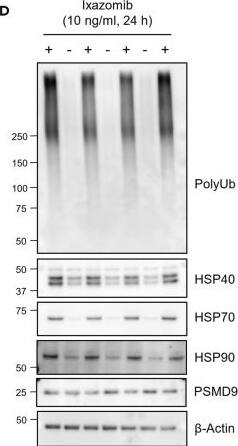
Western Blot: HSP90 Antibody (16F1) - BSA Free [NBP1-97506] -
Ixazomib increases heat-shock proteins (HSPs) in mouse Schwann cellsImmortalized mouse Schwann cells treated with either 10 μg/mL Ixazomib (Ixa) or dimethyl sulfoxide (DMSO) for 24 h were subjected to isobaric tags for relative and absolute quantitation-mass spectrometry (iTRAQ-MS) proteomics.(A) Overview of the 66 significantly changed proteins (false discovery rate [FDR]-corrected p < 0.05) in four Ixazomib (Ixa) groups as compared with three DMSO groups. The heatmap represents the log2 (fold change [FC]) of the differentially expressed proteins in each group. The color key from blue to red represents the log2 (FC) from low to high. See Tables S3A and S3B for details.(B) Enrichment analysis of differentially expressed proteins. The vertical axis represents the pathway category and the horizontal axis represents the enrichment score [–log10 (P)] of the pathway. See Table S3C for details.(C) Volcano plot representing log10 (FDR) as a function of log2 (FC). The proteins identified with an FDR-value <0.05 and >1.0-fold are highlighted in red (up-regulated) or blue (down-regulated), with the dotted lines representing the boundary for identification.(D) Immunoblotting analyses using antibodies against poly-ubiquitin (polyUb), HSP40, HSP70, HSP90, and proteasome modulator 9 (PSMD9).(E) Quantification of relative protein amounts in (D). beta-Actin was used for internal control. Unpaired t test. Data are represented As means +/- SEM. ns, not significant, ∗p < 0.05, ∗∗p < 0.01, N = 3 for untreated (DMSO), and 4 for Ixazomib. Image collected and cropped by CiteAb from the following open publication (https://linkinghub.elsevier.com/retrieve/pii/S258900422301074X), licensed under a CC-BY license. Not internally tested by Novus Biologicals.Applications for HSP90 Antibody (16F1) - BSA Free
Application
Recommended Usage
Immunohistochemistry
1:10-1:500
Immunohistochemistry-Paraffin
1:10-1:500
Immunoprecipitation
1:10-1:500
Western Blot
1:1000
Formulation, Preparation, and Storage
Purification
Protein G purified
Formulation
PBS (pH 7.2) and 50% Glycerol
Format
BSA Free
Preservative
0.09% Sodium Azide
Concentration
Please see the vial label for concentration. If unlisted please contact technical services.
Shipping
The product is shipped with polar packs. Upon receipt, store it immediately at the temperature recommended below.
Stability & Storage
Store at -20C. Avoid freeze-thaw cycles.
Background: HSP90
Long Name
Heat Shock Protein 90
Alternate Names
FLJ31884, Heat shock 86 kDa, heat shock 90kD protein 1, alpha, heat shock 90kD protein 1, alpha-like 4, heat shock 90kD protein, alpha-like 4, heat shock 90kDa protein 1, alpha, heat shock protein 90kDa alpha (cytosolic), class A member 1, heat shock protein HSP 90-alpha, Hsp89, Hsp90, HSP90AHSP86, HSP90N, HSPC1HSP 86, HSPCAHSP89A, HSPCAL1, HSPCAL4, HSPN, LAP2, Renal carcinoma antigen NY-REN-38
Gene Symbol
HSP90AA1
Additional HSP90 Products
Product Documents for HSP90 Antibody (16F1) - BSA Free
Product Specific Notices for HSP90 Antibody (16F1) - BSA Free
This product is for research use only and is not approved for use in humans or in clinical diagnosis. Primary Antibodies are guaranteed for 1 year from date of receipt.
Loading...
Loading...
Loading...
Loading...