Immunohistochemistry-Paraffin: BIN2 Antibody [NBP2-48690]
Immunohistochemistry-Paraffin: BIN2 Antibody [NBP2-48690] - Staining of human liver.
Immunohistochemistry-Paraffin: BIN2 Antibody [NBP2-48690]
Immunohistochemistry-Paraffin: BIN2 Antibody [NBP2-48690] - Staining of human bone marrow shows high expression.
Immunohistochemistry-Paraffin: BIN2 Antibody [NBP2-48690]
Immunohistochemistry-Paraffin: BIN2 Antibody [NBP2-48690] - Staining of human pancreas shows low expression as expected.
Immunohistochemistry-Paraffin: BIN2 Antibody [NBP2-48690]
Immunohistochemistry-Paraffin: BIN2 Antibody [NBP2-48690] - Staining of human lymph node.
Western Blot: BIN2 Antibody - BSA Free [NBP2-48690] -
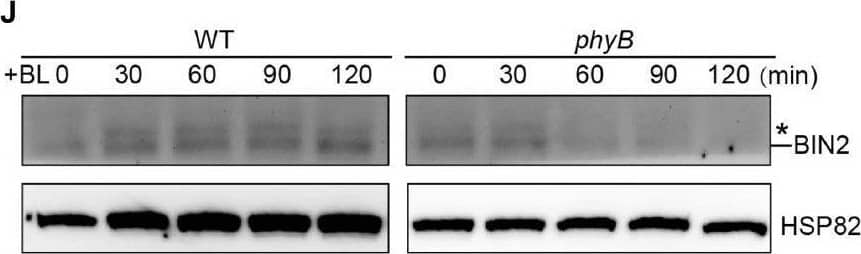
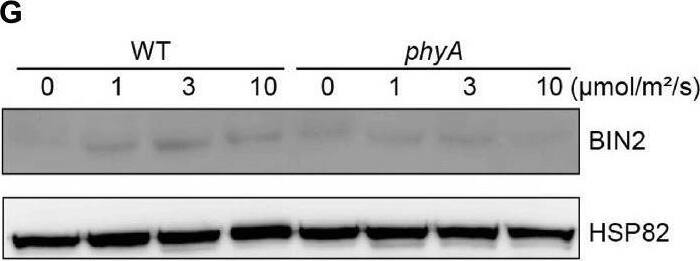
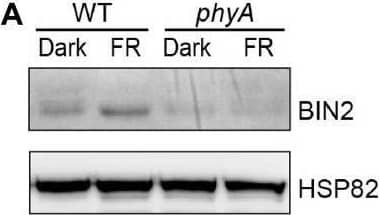
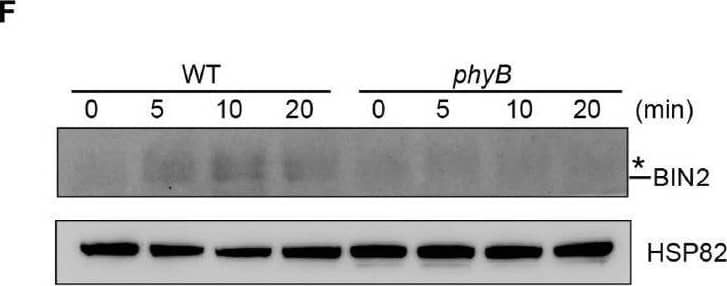
phyA and phyB mediate far-red and red lights inhibition of BL-induced degradation of BIN2 protein. (A,B) Western blotting assays showing phyA- and phyB-mediated far-red or red light inhibition of degradation of BIN2 protein. WT, phyA and phyB mutant seedlings were grown on MS plates in continuous darkness (DK) or far-red light (FR, 1 μmol/m2/s) (A) or red light (R, 50 μmol/m2/s) (B) for 5 days. (C,D) RT-qPCR assays showing the regulation of BIN2 expression by phyA or phyB in (A,B). Data correspond to the mean and standard deviation from three technical replicates. (E,F) Western blotting assays showing the effects of different exposure times of far-red or red light on the degradation of BIN2 protein. WT, phyA and phyB mutant seedlings were grown on MS plates in darkness for 5 days, and then exposed to far-red light (10 μmol/m2/s) (E) or red light (50 μmol/m2/s) (F) for the indicated lengths of time. (G,H) Western blot assays showing the effects of far-red or red light intensity on the degradation of BIN2 protein. WT, phyA and phyB mutant seedlings were grown on MS plates in darkness for 5 days, and then exposed to the indicated light intensities of far-red (G) or red light (H) for 6 h. (I,J) Western blot assays showing the effects of phyA or phyB on the BL-induced degradation of BIN2 protein. WT, phyA and phyB mutant seedlings were grown on MS plates supplemented with 2 μM BRZ in darkness for 5 days, and then treated with 1 μM BL, and then exposed to far-red (10 μmol/m2/s) (I) or red light (50 μmol/m2/s) (J) for the indicated lengths of time. Image collected and cropped by CiteAb from the following open publication (https://pubmed.ncbi.nlm.nih.gov/35432407), licensed under a CC-BY license. Not internally tested by Novus Biologicals.
Western Blot: BIN2 Antibody - BSA Free [NBP2-48690] -
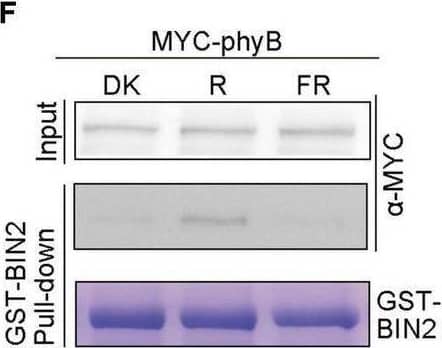
phyA and phyB interact with BIN2. (A,B) His pull-down assays showing the interactions of phyA-N, phyA-C (A), phyB-N and phyB-C (B) with BIN2. GST-BIN2 served as a bait. His-TF-phyA-N, His-TF-phyA-C, His-TF-phyB-N, His-TF-phyB-C, and His-TF served as preys. The preys were detected with alpha-His antibody. (C,D) Split-LUC assays showing the interactions of phyA (C) and phyB (D) with BIN2. The vectors expressing nLUC and/or cLUC served as negative controls. (E,F) Semi-in vivo GST pull-down assays showing far-red and red light-dependent interactions of phyA (E) and phyB (F) with BIN2, respectively. GST-BIN2 served as a bait. The protein extracts prepared from phyA-YFP-OX and Myc-phyB-OX seedlings served as preys. phyA-YFP-OX and Myc-phyB-OX seedlings were grown in dark for 5 days, and then exposed to far-red light (FR, 10 μmol/m2/s) and red light (R, 50 μmol/m2/s) for 30 min, respectively. Image collected and cropped by CiteAb from the following open publication (https://pubmed.ncbi.nlm.nih.gov/35432407), licensed under a CC-BY license. Not internally tested by Novus Biologicals.
Western Blot: BIN2 Antibody - BSA Free [NBP2-48690] -
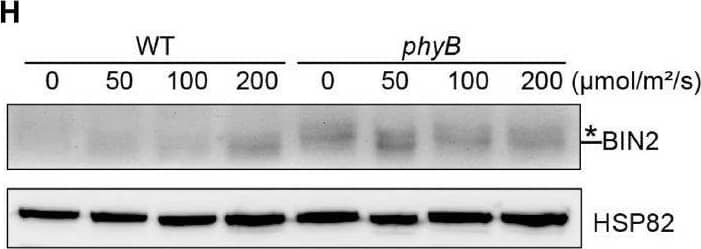
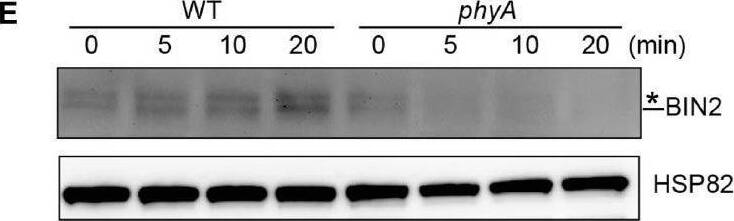
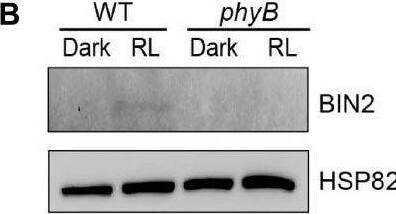
phyA and phyB mediate far-red and red lights inhibition of BL-induced degradation of BIN2 protein. (A,B) Western blotting assays showing phyA- and phyB-mediated far-red or red light inhibition of degradation of BIN2 protein. WT, phyA and phyB mutant seedlings were grown on MS plates in continuous darkness (DK) or far-red light (FR, 1 μmol/m2/s) (A) or red light (R, 50 μmol/m2/s) (B) for 5 days. (C,D) RT-qPCR assays showing the regulation of BIN2 expression by phyA or phyB in (A,B). Data correspond to the mean and standard deviation from three technical replicates. (E,F) Western blotting assays showing the effects of different exposure times of far-red or red light on the degradation of BIN2 protein. WT, phyA and phyB mutant seedlings were grown on MS plates in darkness for 5 days, and then exposed to far-red light (10 μmol/m2/s) (E) or red light (50 μmol/m2/s) (F) for the indicated lengths of time. (G,H) Western blot assays showing the effects of far-red or red light intensity on the degradation of BIN2 protein. WT, phyA and phyB mutant seedlings were grown on MS plates in darkness for 5 days, and then exposed to the indicated light intensities of far-red (G) or red light (H) for 6 h. (I,J) Western blot assays showing the effects of phyA or phyB on the BL-induced degradation of BIN2 protein. WT, phyA and phyB mutant seedlings were grown on MS plates supplemented with 2 μM BRZ in darkness for 5 days, and then treated with 1 μM BL, and then exposed to far-red (10 μmol/m2/s) (I) or red light (50 μmol/m2/s) (J) for the indicated lengths of time. Image collected and cropped by CiteAb from the following open publication (https://pubmed.ncbi.nlm.nih.gov/35432407), licensed under a CC-BY license. Not internally tested by Novus Biologicals.
Western Blot: BIN2 Antibody - BSA Free [NBP2-48690] -
phyA and phyB mediate far-red and red lights inhibition of BL-induced degradation of BIN2 protein. (A,B) Western blotting assays showing phyA- and phyB-mediated far-red or red light inhibition of degradation of BIN2 protein. WT, phyA and phyB mutant seedlings were grown on MS plates in continuous darkness (DK) or far-red light (FR, 1 μmol/m2/s) (A) or red light (R, 50 μmol/m2/s) (B) for 5 days. (C,D) RT-qPCR assays showing the regulation of BIN2 expression by phyA or phyB in (A,B). Data correspond to the mean and standard deviation from three technical replicates. (E,F) Western blotting assays showing the effects of different exposure times of far-red or red light on the degradation of BIN2 protein. WT, phyA and phyB mutant seedlings were grown on MS plates in darkness for 5 days, and then exposed to far-red light (10 μmol/m2/s) (E) or red light (50 μmol/m2/s) (F) for the indicated lengths of time. (G,H) Western blot assays showing the effects of far-red or red light intensity on the degradation of BIN2 protein. WT, phyA and phyB mutant seedlings were grown on MS plates in darkness for 5 days, and then exposed to the indicated light intensities of far-red (G) or red light (H) for 6 h. (I,J) Western blot assays showing the effects of phyA or phyB on the BL-induced degradation of BIN2 protein. WT, phyA and phyB mutant seedlings were grown on MS plates supplemented with 2 μM BRZ in darkness for 5 days, and then treated with 1 μM BL, and then exposed to far-red (10 μmol/m2/s) (I) or red light (50 μmol/m2/s) (J) for the indicated lengths of time. Image collected and cropped by CiteAb from the following open publication (https://pubmed.ncbi.nlm.nih.gov/35432407), licensed under a CC-BY license. Not internally tested by Novus Biologicals.
Western Blot: BIN2 Antibody - BSA Free [NBP2-48690] -
phyA and phyB mediate far-red and red lights inhibition of BL-induced degradation of BIN2 protein. (A,B) Western blotting assays showing phyA- and phyB-mediated far-red or red light inhibition of degradation of BIN2 protein. WT, phyA and phyB mutant seedlings were grown on MS plates in continuous darkness (DK) or far-red light (FR, 1 μmol/m2/s) (A) or red light (R, 50 μmol/m2/s) (B) for 5 days. (C,D) RT-qPCR assays showing the regulation of BIN2 expression by phyA or phyB in (A,B). Data correspond to the mean and standard deviation from three technical replicates. (E,F) Western blotting assays showing the effects of different exposure times of far-red or red light on the degradation of BIN2 protein. WT, phyA and phyB mutant seedlings were grown on MS plates in darkness for 5 days, and then exposed to far-red light (10 μmol/m2/s) (E) or red light (50 μmol/m2/s) (F) for the indicated lengths of time. (G,H) Western blot assays showing the effects of far-red or red light intensity on the degradation of BIN2 protein. WT, phyA and phyB mutant seedlings were grown on MS plates in darkness for 5 days, and then exposed to the indicated light intensities of far-red (G) or red light (H) for 6 h. (I,J) Western blot assays showing the effects of phyA or phyB on the BL-induced degradation of BIN2 protein. WT, phyA and phyB mutant seedlings were grown on MS plates supplemented with 2 μM BRZ in darkness for 5 days, and then treated with 1 μM BL, and then exposed to far-red (10 μmol/m2/s) (I) or red light (50 μmol/m2/s) (J) for the indicated lengths of time. Image collected and cropped by CiteAb from the following open publication (https://pubmed.ncbi.nlm.nih.gov/35432407), licensed under a CC-BY license. Not internally tested by Novus Biologicals.
Western Blot: BIN2 Antibody - BSA Free [NBP2-48690] -
phyA and phyB mediate far-red and red lights inhibition of BL-induced degradation of BIN2 protein. (A,B) Western blotting assays showing phyA- and phyB-mediated far-red or red light inhibition of degradation of BIN2 protein. WT, phyA and phyB mutant seedlings were grown on MS plates in continuous darkness (DK) or far-red light (FR, 1 μmol/m2/s) (A) or red light (R, 50 μmol/m2/s) (B) for 5 days. (C,D) RT-qPCR assays showing the regulation of BIN2 expression by phyA or phyB in (A,B). Data correspond to the mean and standard deviation from three technical replicates. (E,F) Western blotting assays showing the effects of different exposure times of far-red or red light on the degradation of BIN2 protein. WT, phyA and phyB mutant seedlings were grown on MS plates in darkness for 5 days, and then exposed to far-red light (10 μmol/m2/s) (E) or red light (50 μmol/m2/s) (F) for the indicated lengths of time. (G,H) Western blot assays showing the effects of far-red or red light intensity on the degradation of BIN2 protein. WT, phyA and phyB mutant seedlings were grown on MS plates in darkness for 5 days, and then exposed to the indicated light intensities of far-red (G) or red light (H) for 6 h. (I,J) Western blot assays showing the effects of phyA or phyB on the BL-induced degradation of BIN2 protein. WT, phyA and phyB mutant seedlings were grown on MS plates supplemented with 2 μM BRZ in darkness for 5 days, and then treated with 1 μM BL, and then exposed to far-red (10 μmol/m2/s) (I) or red light (50 μmol/m2/s) (J) for the indicated lengths of time. Image collected and cropped by CiteAb from the following open publication (https://pubmed.ncbi.nlm.nih.gov/35432407), licensed under a CC-BY license. Not internally tested by Novus Biologicals.
Western Blot: BIN2 Antibody - BSA Free [NBP2-48690] -
phyA and phyB mediate far-red and red lights inhibition of BL-induced degradation of BIN2 protein. (A,B) Western blotting assays showing phyA- and phyB-mediated far-red or red light inhibition of degradation of BIN2 protein. WT, phyA and phyB mutant seedlings were grown on MS plates in continuous darkness (DK) or far-red light (FR, 1 μmol/m2/s) (A) or red light (R, 50 μmol/m2/s) (B) for 5 days. (C,D) RT-qPCR assays showing the regulation of BIN2 expression by phyA or phyB in (A,B). Data correspond to the mean and standard deviation from three technical replicates. (E,F) Western blotting assays showing the effects of different exposure times of far-red or red light on the degradation of BIN2 protein. WT, phyA and phyB mutant seedlings were grown on MS plates in darkness for 5 days, and then exposed to far-red light (10 μmol/m2/s) (E) or red light (50 μmol/m2/s) (F) for the indicated lengths of time. (G,H) Western blot assays showing the effects of far-red or red light intensity on the degradation of BIN2 protein. WT, phyA and phyB mutant seedlings were grown on MS plates in darkness for 5 days, and then exposed to the indicated light intensities of far-red (G) or red light (H) for 6 h. (I,J) Western blot assays showing the effects of phyA or phyB on the BL-induced degradation of BIN2 protein. WT, phyA and phyB mutant seedlings were grown on MS plates supplemented with 2 μM BRZ in darkness for 5 days, and then treated with 1 μM BL, and then exposed to far-red (10 μmol/m2/s) (I) or red light (50 μmol/m2/s) (J) for the indicated lengths of time. Image collected and cropped by CiteAb from the following open publication (https://pubmed.ncbi.nlm.nih.gov/35432407), licensed under a CC-BY license. Not internally tested by Novus Biologicals.
Western Blot: BIN2 Antibody - BSA Free [NBP2-48690] -
phyA and phyB mediate far-red and red lights inhibition of BL-induced degradation of BIN2 protein. (A,B) Western blotting assays showing phyA- and phyB-mediated far-red or red light inhibition of degradation of BIN2 protein. WT, phyA and phyB mutant seedlings were grown on MS plates in continuous darkness (DK) or far-red light (FR, 1 μmol/m2/s) (A) or red light (R, 50 μmol/m2/s) (B) for 5 days. (C,D) RT-qPCR assays showing the regulation of BIN2 expression by phyA or phyB in (A,B). Data correspond to the mean and standard deviation from three technical replicates. (E,F) Western blotting assays showing the effects of different exposure times of far-red or red light on the degradation of BIN2 protein. WT, phyA and phyB mutant seedlings were grown on MS plates in darkness for 5 days, and then exposed to far-red light (10 μmol/m2/s) (E) or red light (50 μmol/m2/s) (F) for the indicated lengths of time. (G,H) Western blot assays showing the effects of far-red or red light intensity on the degradation of BIN2 protein. WT, phyA and phyB mutant seedlings were grown on MS plates in darkness for 5 days, and then exposed to the indicated light intensities of far-red (G) or red light (H) for 6 h. (I,J) Western blot assays showing the effects of phyA or phyB on the BL-induced degradation of BIN2 protein. WT, phyA and phyB mutant seedlings were grown on MS plates supplemented with 2 μM BRZ in darkness for 5 days, and then treated with 1 μM BL, and then exposed to far-red (10 μmol/m2/s) (I) or red light (50 μmol/m2/s) (J) for the indicated lengths of time. Image collected and cropped by CiteAb from the following open publication (https://pubmed.ncbi.nlm.nih.gov/35432407), licensed under a CC-BY license. Not internally tested by Novus Biologicals.