Immunohistochemistry: 53BP1 Antibody - BSA Free [NB100-305]
Immunohistochemistry: 53BP1 Antibody [NB100-305] - Immunohistochemical staining of placental villi with 53BP1 Antibody (Catalog #NB100-305) at 40X magnification.
Western Blot: 53BP1 AntibodyBSA Free [NB100-305]
Western Blot: 53BP1 Antibody [NB100-305] - Western blot of whole cell lysate (20 ug/lane) from U2Os cells resolved on a 3 to 8 percent trisacetate gel. A band appears at approximately the theoretical molecular weight of 214 kDa.
Immunocytochemistry/ Immunofluorescence: 53BP1 Antibody - BSA Free [NB100-305]
Immunocytochemistry/Immunofluorescence: 53BP1 Antibody [NB100-305] - HCC1937 cells (human) were treated with PARPi for 96 h. Nuclei are stained in blue (DAPI) and 53BP1 antibody (foci in green). ICC/IF image submitted by a verified customer review.
Flow Cytometry: 53BP1 Antibody - BSA Free [NB100-305]
Flow Cytometry: 53BP1 Antibody [NB100-305] - An intracellular stain was performed on Ntera2 cells with 53BP1 Antibody NB100-305 (blue) and a matched isotype control NBP2-24891 (orange). Cells were fixed with 4% PFA and then permeabilized with 0.1% saponin. Cells were incubated in an antibody dilution of 1.0 ug/mL for 30 minutes at room temperature, followed by Rabbit IgG (H+L) Cross-Adsorbed Secondary Antibody, Dylight 550 (SA5-10033, Thermo Fisher).
Immunocytochemistry/ Immunofluorescence: 53BP1 Antibody - BSA Free [NB100-305]
Immunocytochemistry/Immunofluorescence: 53BP1 Antibody [NB100-305] - Paraformaldehyde (4%) fixed Saos-2 cells (human osteosarcoma cell line) were stained with anti-53BP1 antibody followed by Alexa Fluor 488 secondary antibody. ICC/IF image submitted by a verified customer review.
Immunocytochemistry/ Immunofluorescence: 53BP1 Antibody - BSA Free [NB100-305]
Immunocytochemistry/Immunofluorescence: 53BP1 Antibody [NB100-305] - Ntera2 cells were fixed in 4% paraformaldehyde for 10 minutes and permeabilized in 0.5% Triton X-100 in PBS for 5 minutes. The cells were incubated with anti- NB100-305 at 2 ug/mL overnight at 4C and detected with an anti-rabbit DyLight 488 (Green) at a 1:1000 dilution for 60 minutes. Alpha tubulin (DM1A) NB100-690 was used as a co-stain at a 1:1000 dilution and detected with an anti-mouse DyLight 550 (Red) at a 1:1000 dilution. Nuclei were counterstained with DAPI (Blue). Cells were imaged using a 100X objective and digitally deconvolved.
Flow Cytometry: 53BP1 Antibody - BSA Free [NB100-305]
Flow Cytometry: 53BP1 Antibody [NB100-305] - An intracellular stain was performed on HeLa cells with 53BP1 Antibody (Catalog #NB100-305AF488) (blue) and a matched isotype control (orange). Cells were fixed with 4% PFA and then permeabilized with 0.1% saponin. Cells were incubated in an antibody dilution of 5 ug/mL for 30 minutes at room temperature. Both antibodies were conjugated to Alexa Fluor 488.
Western Blot: 53BP1 Antibody - BSA Free [NB100-305] -
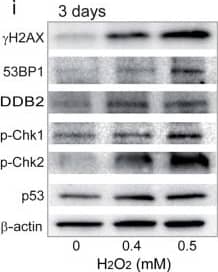
Western Blot: 53BP1 Antibody - BSA Free [NB100-305] - DNA damage & DNA damage responses upon H2O2 challenge. a, c, e, g Confocal images showing the basal region of the organ of Corti cultures treated with either culture medium alone (a, e) or containing 0.5 mM H2O2 (c, g) for 5 h before being maintained in culture medium alone for 3 days. The samples were then immunolabeled for myosin 7A (red, a, c, e, g), gammaH2AX (green, a & c) & 53BP1 (green, e & g). Scale bars: a, c, e & g = 10 μm. b, d, f, h Higher magnification images of representative OHC & IHC nuclei from all conditions tested. Scale bar = 2.5 μm. i Representative Western blot analysis using antibodies against gammaH2AX, 53BP1, DDB2, p-Chk1, p-Chk2, p53, & beta-actin in whole cochlear extracts. j, k Histograms representing the levels of gammaH2AX, 53BP1, DDB2, p-Chk1, p-Chk2, & p53 in control & in 0.4 & 0.5 mM H2O2-exposed groups (n = 6 cochleae per condition). beta-Actin served as a loading control. Data are expressed as mean ± SEM. One-way ANOVA test followed by post hoc Tukey’s test (*P ≤ 0.04, **P ≤ 0.01, ***P ≤ 0.001 vs. H2O2 0 mM). All experiments were performed in triplicate Image collected & cropped by CiteAb from the following publication (https://pubmed.ncbi.nlm.nih.gov/30693443), licensed under a CC-BY license. Not internally tested by Novus Biologicals.
Western Blot: 53BP1 Antibody - BSA Free [NB100-305] -
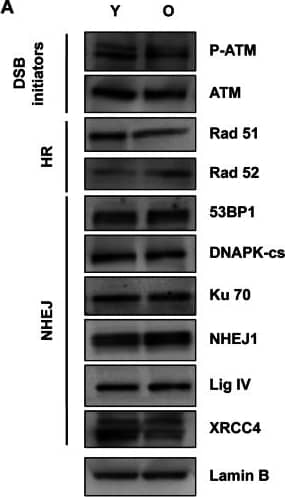
Western Blot: 53BP1 Antibody - BSA Free [NB100-305] - Assessment of satellite cell radiosensitivity & DNA repair pathways w/ age.(A–B) Expression of major proteins involved in homologous recombination & non-homologous end joining detected using WB. Protein nuclear extracts prepared from activated satellite cells 72 hrs post muscle injury. Lamin B used as loading control. (A) Representative images of WBs. (B) Quantification using Image J software. Data represents mean +/− SEM, n = 3 to 5 (n = a pool of muscles from 3 mice), 2-tailed unpaired Student's t-test, no significant difference. (C) Graphical representation of data from Table S1. Gene expression of old relative to young satellite cells presented as fold change w/ a 95 % confidence interval for the 12 genes w/ a statistically significant relative expression, n = 3 mice per group, two-tailed unpaired Student's t-test, *: p value<0.05. Dotted line represents young level. BER: Base Excision Repair, NER: Nucleotide-Excision Repair; MR: Mismatch Repair, DRR: DNA Repair Related. (D–E) Satellite cells freshly isolated from uninjured (D) or 72 hrs after injury (E) muscle of C57BL/6 young & old mice, & of young SCID mice. Cells plated at low density, irradiated at indicated Gray (Gy) doses, & cultured for 10 days. Myogenic colonies formed by irradiated cells quantified & represented relative to ir respective non-irradiated controls. On average, 178, 77, & 228 myogenic colonies scored per mouse for young, old, & SCID uninjured non-irradiated respectively & 67, 34, & 91 myogenic colonies scored per mouse for young, old, & SCID injured non-irradiated respectively. Data represent mean +/− SEM, n = 3 to 4 mice per group, two-tailed unpaired Student's t-test, a, b or c: p value<0.05, (a: young vs old, b: young vs SCID, c: old versus SCID). Image collected & cropped by CiteAb from the following publication (https://pubmed.ncbi.nlm.nih.gov/23704914), licensed under a CC-BY license. Not internally tested by Novus Biologicals.
Knockdown Validated: 53BP1 Antibody - BSA Free [NB100-305] -
PARP1-dependent end joining repairs the resected DSBs in 53BP1- or RIF1-depleted G1 cellsA. HeLa cells harboring pEJ were treated with the indicated siRNAs for 24h and PARP1 was then inhibited by adding 1μM olaparib 2h before transfection with I-SceI-expressing vector. The percentages of GFP+ cells were measured after 48h as indication for end joining efficiency. PARP1-EJ was measured as the percent of suppressed end joining after PARP1 inhibition. B. Representative micrographs for gammaH2AX foci at 8h post 2Gy in A549 cells after depletion of either 53BP1 or RIF1 proteins in the presence or absence of olaparib. Nuclei were counterstained with CenpF to determine G1 (CenpF−) cells. C. Quantitation of gammaH2AX foci number at the indicated time points in CenpF− G1 cells. D. Left panel: Western blot showing an efficient siRNA-mediated knockdown of the indicated individual or combined proteins. Right panel: Asynchronous A549 cells were treated with colcemid (0.2μg/ml) for 1h pre-2Gy and the number of gammaH2AX foci was monitored in CenpF− G1 cells after the indicated treatment conditions. At least 50 nuclei were counted. (**) indicates P < 0.001. In all cases, the number of foci measured in non-irradiated cells was subtracted (relative). Shown are the mean +/-SEM for three independent experiments. CTR: control, Olap: olaparib, sc: scrambled RNA, si53: si53BP1, and siR: siRIF1. Image collected and cropped by CiteAb from the following open publication (https://pubmed.ncbi.nlm.nih.gov/27494840), licensed under a CC-BY license. Not internally tested by Novus Biologicals.
Knockdown Validated: 53BP1 Antibody - BSA Free [NB100-305] -
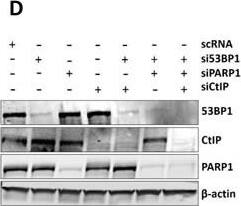
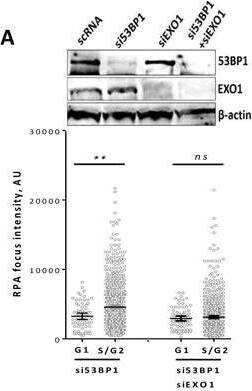
CtIP and MRE11 but not EXO1 are required for end resection in 53BP1-depleted G1 cellsA. A549 cells were treated as in Figure 4 with the indicated siRNAs and efficient knockdown of 53BP1 and/or EXO1 was confirmed by Western blot (upper panel). Lower panel: The focus intensity of RPA was measured in 53BP1- and/or EXO1- depleted cells at 2h post-2Gy in G1 and S/G2. B. Immunoblots showing efficient siRNA-mediated knockdown of CtIP and/or 53BP1 (upper panel), MRE11 and/or 53BP1 (middle panel), or PLK3 and/or 53BP1 (lower panel). (C & D) Quantitation of the percentage of G1 cells with more than three C. RPA or D. CtIP foci after the indicated treatments. At least 50 nuclei were counted. (**) indicates P < 0.001, and (ns) means P > 0.05. Shown are the mean +/-SEM for three independent experiments. Image collected and cropped by CiteAb from the following open publication (https://pubmed.ncbi.nlm.nih.gov/27494840), licensed under a CC-BY license. Not internally tested by Novus Biologicals.
Immunocytochemistry/ Immunofluorescence: 53BP1 Antibody - BSA Free [NB100-305] -
The production of DSBs depends on Top1 degradation in CPT-treated quiescent cells. (A–C) Serum-starved WI38 hTERT cells were co-transfected with siRNAs against cullin 3 and cullin 4B or against a control sequence and then treated with DMSO (−CPT) or 25 μM CPT (+CPT) for 1 h. (A and B) Western blotting of the indicated proteins. alphaTubulin: loading control. (C) Number of gammaH2AX foci per nucleus from one representative experiment (246–348 nuclei were analyzed for each treatment) out of three. ***P < 0.001. (D and E) Serum-starved WI38 hTERT cells were treated with DMSO or MG132 (50 μM) for 1 h before exposure to 0.8 Gy IR. One hour post-irradiation, cells were co-stained for gammaH2AX (green) and 53BP1 (red). (D) Representative pictures. (E) Number of gammaH2AX foci per nucleus from one representative experiment (162–180 nuclei were analyzed for each treatment) out of three. Ns: not significant. (F and G) U2OS EV28 cells were treated with DMSO or MG132 (10 μM) for 1 h before the addition of ethanol (untreated) or 300 nM 4-hydroxitamoxifen (4OHT) for 4 h to express AsiSI in the nucleus (42). (F) Representative pictures of cells co-stained for gammaH2AX (green) and 53BP1 (red). (G) ChIP analysis using an anti-gamma H2AX antibody (black) or a non-immune antibody (IgG, gray). Enrichment was assessed by QPCR amplification using primers proximal to two AsiSI sites located inside two genes (Gene I: SFRS6, Gene II: CCD47) and primers distal to an AsiSI site (Control). Enrichment was normalized to the maximum recovery for each experiment (means +/- SEM, n = 3). Ns: not significant; *P < 0.05. In the microscopic images, nuclear contours, identified by DAPI staining (not shown), are indicated by dashed lines. Bars: 10 μm. Image collected and cropped by CiteAb from the following open publication (https://pubmed.ncbi.nlm.nih.gov/26578593), licensed under a CC-BY license. Not internally tested by Novus Biologicals.
Immunocytochemistry/ Immunofluorescence: 53BP1 Antibody - BSA Free [NB100-305] -
53BP1/RIF1 work epistatically to counteract BRCA1/CtIP-mediated end resection to regulate DSB repair pathway choiceA. HeLa cells harboring pGC were treated with the indicated siRNAs before transfection with I-SceI-expressing vector to induce DSBs. After 48h, the percentage of GFP+ cells was measured as an indication for HR efficiency. B.-D. Asynchronous A549 cells were treated with the indicated siRNAs before irradiation with 2Gy and CtIP B. and RPA foci C. were monitored at 2h while RAD51 D. foci were enumerated at 4h. E. Left panel: representative photos for the colocalization between 53BP1 and RIF1 foci in A549 cells at 2h after 2Gy. Right panel: quantitation of 53BP1, RIF1 or colocalized foci in the absence (DMSO) or presence of ATM inhibitor (ATMi). F. Left panel: representative micrographs for 53BP1 or RIF1 foci in irradiated cells after depletion of either proteins. Right panel: quantitation of experiments presented in the left panel. At least 100 nuclei were counted. In all cases, the number of foci measured in non-irradiated cells was subtracted (relative). Shown are the mean +/-SEM for three independent experiments. sc: scrambled RNA, si53: si53BP1, siR: siRIF1, siB: siBRCA1, and siC: siCtIP. Image collected and cropped by CiteAb from the following open publication (https://pubmed.ncbi.nlm.nih.gov/27494840), licensed under a CC-BY license. Not internally tested by Novus Biologicals.
Immunocytochemistry/ Immunofluorescence: 53BP1 Antibody - BSA Free [NB100-305] -
Exosomes modulate the repair of DNA DSBs in irradiated recipient cells.(A) Number of 53BP1 foci in BHY cells 1 hour after irradiation with 0 and 2 Gy and transfer of BHY exosomes isolated 24 hours after irradiation with 0 and 6 Gy [n = 5]. (B) Representative images of 53BP1 foci in BHY cells 6 hours after 2 Gy and transfer of BHY exosomes isolated 24 hours after irradiation with 0, 3, 6 or 9 Gy (53BP1 foci green, nuclei blue). (C) Number of 53BP1 foci in BHY cells 6 hours after 2 Gy and transfer of BHY exosomes isolated 24 and 48 hours after irradiation [n1 (control; EXO 0 Gy 24 h; EXO 6 Gy 24 h) = 6, n2 (EXO 0 Gy 48 h; EXO 3 Gy; EXO 6 Gy 48 h; EXO 9 Gy) = 3]. (D) Number of 53BP1 foci in FaDu cells 6 hours after 2 Gy and transfer of FaDu exosomes [n = 3]. (E) Number of 53BP1 foci in FaDu cells 6 hours after 2 Gy and transfer of BHY exosomes [n = 3]. (F) Number of 53BP1 in BHY cells after 2 Gy and transfer of destabilized BHY exosomes. Exosomes from BHY cells isolated 24 hours after irradiation with 0 and 6 Gy were treated with RNase A or a mixture of Triton and Trypsin [n1 (control; intact) = 6; n2 (RNase A 5 μg/μl) = 2; n3 (RNase A 400 μg/μl; Triton + Trypsin) = 3]. For all experiments the +/- SD was shown and p-values calculated on control were considered to be significant if * p < 0.05 and highly significant ** if p < 0.01, while ▲ p < 0.05 and ▲▲ p < 0.01 indicate significant differences to EXO 0 Gy. Image collected and cropped by CiteAb from the following open publication (https://pubmed.ncbi.nlm.nih.gov/27006994), licensed under a CC-BY license. Not internally tested by Novus Biologicals.
Immunocytochemistry/ Immunofluorescence: 53BP1 Antibody - BSA Free [NB100-305] -
Inhibition of ACLY exacerbates radiation induced DNA damage in HNSCC cells and impairs homologous recombination. (A,B) UM-SCC-6 (A) and UT-SCC-5 (B) cells were treated with 5 uM BMS303141 for 6 h and irradiated with 2, 4, or 6 Gy. Survival was determined by colony formation assay. (C,D) Quantification of cells positive for 53BP1 foci (>5 53BP1 foci/nucleus in a single plane of view) in UM-SCC-6 (C) and UT-SCC-5 (D) cells. Shown are mean percentages of three biological replicates. Immunofluorescent representative images of examples of UM-SCC-6 or UT-SCC-5 cells, 24 h post irradiation, with or without 5 uM BMS303141 pre-treatment. Nuclei in blue, 53BP1 foci in red. (E) Homologous recombination assay. U2OS cells have been stably transfected with a construct containing a GFP gene containing a I-SceI restriction site (SceGFP) as well as a stop codon at the same site. Upon transfection with an I-SceI encoded plasmid, a double strand break is induced at the I-SceI site. Repair of this break via homologous recombination occurs through utilization of the internal GFP (iGFP) fragment downstream of the SceGFP. Successful homologous recombination results in the restoration of a functional GFP gene. (F) U2OS DRGFP cells were treated for 6 h with 5 uM BMS303141 or 5 uM BO2 (Rad51 inhibitor), and transfected with pCBASceI plasmid. 48 h post transfection, cells were harvested and the GFP positive fraction was determined using flow cytometry. Representative images from flow cytometry experiments are shown on the right, with DMSO Sce- as a negative control, and 5 uM B02 Sce+ as a positive control. In the graph, data are shown from two biological replicates. Image collected and cropped by CiteAb from the following open publication (https://pubmed.ncbi.nlm.nih.gov/31817870), licensed under a CC-BY license. Not internally tested by Novus Biologicals.
Immunocytochemistry/ Immunofluorescence: 53BP1 Antibody - BSA Free [NB100-305] -
53BP1/RIF1 work epistatically to counteract BRCA1/CtIP-mediated end resection to regulate DSB repair pathway choiceA. HeLa cells harboring pGC were treated with the indicated siRNAs before transfection with I-SceI-expressing vector to induce DSBs. After 48h, the percentage of GFP+ cells was measured as an indication for HR efficiency. B.-D. Asynchronous A549 cells were treated with the indicated siRNAs before irradiation with 2Gy and CtIP B. and RPA foci C. were monitored at 2h while RAD51 D. foci were enumerated at 4h. E. Left panel: representative photos for the colocalization between 53BP1 and RIF1 foci in A549 cells at 2h after 2Gy. Right panel: quantitation of 53BP1, RIF1 or colocalized foci in the absence (DMSO) or presence of ATM inhibitor (ATMi). F. Left panel: representative micrographs for 53BP1 or RIF1 foci in irradiated cells after depletion of either proteins. Right panel: quantitation of experiments presented in the left panel. At least 100 nuclei were counted. In all cases, the number of foci measured in non-irradiated cells was subtracted (relative). Shown are the mean +/-SEM for three independent experiments. sc: scrambled RNA, si53: si53BP1, siR: siRIF1, siB: siBRCA1, and siC: siCtIP. Image collected and cropped by CiteAb from the following open publication (https://pubmed.ncbi.nlm.nih.gov/27494840), licensed under a CC-BY license. Not internally tested by Novus Biologicals.
Immunocytochemistry/ Immunofluorescence: 53BP1 Antibody - BSA Free [NB100-305] -
RAP1 protects telomeres against DNA damageWestern blotting showing the expression of RAP1 and TRF2 in MRC‐5 cells of different population doublings (PD). Senescent cells (PD 72) were left in culture for at least 4 weeks before harvesting for analysis.ChIP analysis of young (PD 30) and senescent (PD 72) MRC‐5 cells performed with either anti‐RAP1, anti‐TRF2, or an IgG antibody. The immunoprecipitated and input products were loaded into a slot blot membrane and hybridized with a telomere probe, and stripped and hybridized to an Alu probe in order to determine unspecific binding. Quantification was performed by normalizing the telomere signal of the immunoprecipitated to that of the input. Data represent mean +/- SD of three biological replicates.Immunofluorescence detection of 53BP1 (red) and a FISH probe staining telomeres (green) in young (PD 26), pre‐senescent (PD 66), and senescent (PD 72 + 4 weeks) MRC‐5 fibroblasts. The upper graph shows the percentage of telomere co‐localizing with 53BP1 (TIFs). Total DNA damage was measured by immunofluorescence detection of 53BP1. The lower graph shows the total number of 53BP1 foci per nucleus. Approximately 40–50 cells were analyzed per replicate and per condition. Bars represent SEM of two biological replicates.Data information: Statistical analyses were performed using Mann–Whitney U‐test (*P < 0.05; **P < 0.001; ***P < 0.0001). Scale bar = 10 μm.Source data are available online for this figure. Image collected and cropped by CiteAb from the following open publication (https://pubmed.ncbi.nlm.nih.gov/32096305), licensed under a CC-BY license. Not internally tested by Novus Biologicals.