
Choline Acetyltransferase (ChAT) is the enzyme that is responsible for biosynthesis of the neurotransmitter acetylcholine. The majority of acetylcholine is synthesized locally at nerve terminals where ChAT catalyzes the transfer of an acetyl group from acetyl coenzyme A to choline, a process that takes place in a single step. ChAT is expressed by cholinergic neurons in the central nervous system (CNS) and peripheral nervous systems (PNS) (4), which are distributed in many different regions of the brain, spinal chord, and retina and participate in learning, memory, movement, and vision (2,4).
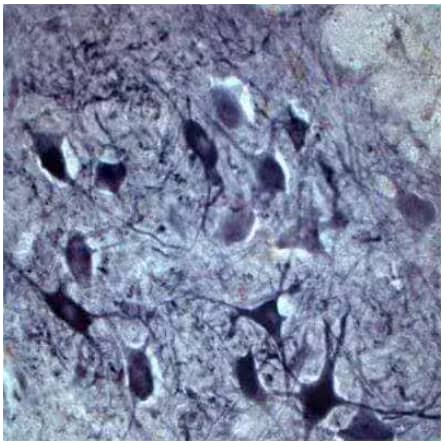
Immunohistochemistry Free-Floating: Choline Acetyltransferase/ChAT Antibody [NB110-89724] - IHC on rat spinal cord using Rabbit antibody to rat, mouse ChAT (choline O-acetyltransferase): whole serum at 1:2000 dilution. Pre-absorption of the antibody with the immunizing peptide completely abolishes the immunostaining (not shown).
ChAT antibody staining is frequently used in morphological studies of cholinergic cell populations. In the mammalian retina, for example, ChAT is expressed by subsets of both amacrine and ganglion cells (2). These ChAT-positive neuronal populations can be identified using anti-ChAT antibodies in the context of immunohistochemical (IHC) assays. When performed in the retina, ChAT IHC produces a characteristic double banded staining pattern in the inner plexiform layer where cholinergic amacrine and ganglion cell dendrites form two distinct synaptic strata (2). One of the Novus (a Bio-Techne brand) ChAT antibodies has been used to quantify cholinergic cell survival in the mammalian retina following protein kinase inhibition in mouse disease models (1). Our ChAT antibodies have also been used in a number of cell culture systems to assess differentiation and survival rates of cholinergic neurons following various manipulations. For instance, the antibody (NBP1-30052) has been used to identify differentiated cholinergic neurons in cell studies aimed at defining a culture-based experimental system that does not rely on primary neurons (3). While another Bio-Techne anti-ChAT antibody (NB110-89724) was used to qualitatively assess survival of cholinergic neurons in spinal cord explants (5).
Bio-Techne offers ChAT reagents for your research needs including:
PMID:
- 21498608
- 9786999
- 23095258
- 10594838
- 23674184
-
Burugula, B. et al. (2011) Curcumin attenuates staurosporine-mediated death of retinal ganglion cells. Invest Ophthalmol Vis Sci 52:4263-4273.
-
Jeon, C.J. et al. (1998) The major cell populations of the mouse retina J Neurosci 18:8936-8946.
-
Liu, J. et al. (2012) Voltage-gated sodium channel expression and action potential generation in differentiated NG108-15 cells BMC Neurosci 132:129.
-
Oda, Y. (1999) Choline acetyltransferase: the structure, distribution and pathologic changes in the central nervous system Pathol Int 49:921-937.
-
Schizas, N. et al. (2014) Hyaluronic acid-based hydrogel enhances neuronal survival in spinal cord slice cultures from postnatal mice J Biomater Appl 28:825-836.