
Recombinant Human VSIG4 Fc Chimera Biotinylated Protein, CF
R&D Systems, part of Bio-Techne | Catalog # BT4646

Discontinued Product
BT4646 has been discontinued.
View all VSIG4 products.
Key Product Details
Source
NS0
Accession #
Structure / Form
Disulfide-linked homodimer. Biotinylated via sugars
Conjugate
Biotin
Applications
Bioactivity
Product Specifications
Source
Mouse myeloma cell line, NS0-derived human VSIG4 protein
| Human
VSIG4 (Arg20-Pro283) Accession # Q9Y279 |
IEGRMD | Human
IgG1 (Pro100-Lys330) |
| N-terminus | C-terminus |
Purity
>95%, by SDS-PAGE visualized with Silver Staining and quantitative densitometry by Coomassie® Blue Staining.
Endotoxin Level
<0.10 EU per 1 μg of the protein by the LAL method.
N-terminal Sequence Analysis
Arg20
Predicted Molecular Mass
56 kDa (unlabeled)
SDS-PAGE
60-77 kDa and 150 - 195 kDa, reducing conditions
Activity
Measured by its binding ability in a functional ELISA.
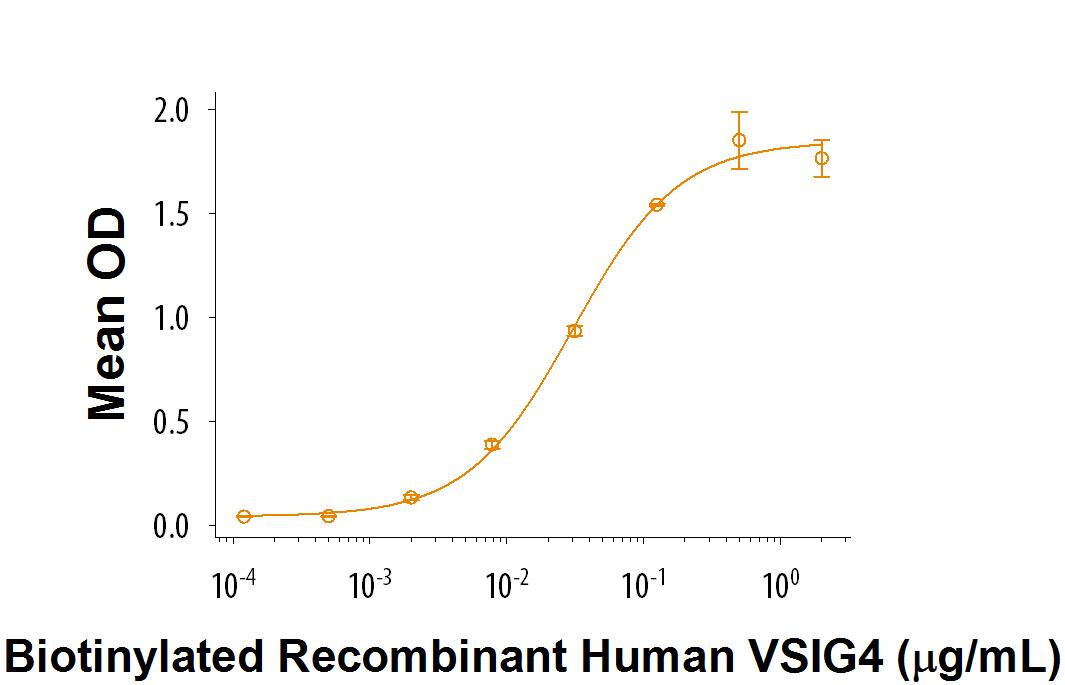
When Human complement component iC3b is immobilized at 0.5 μg/mL,100 μL/well, the concentration of Biotinylated Recombinant Human VSIG4 Fc Chimera that produces 50% of the optimal binding response is 0.015-0.09 μg/mL.
When Human complement component iC3b is immobilized at 0.5 μg/mL,100 μL/well, the concentration of Biotinylated Recombinant Human VSIG4 Fc Chimera that produces 50% of the optimal binding response is 0.015-0.09 μg/mL.
Scientific Data Images for Recombinant Human VSIG4 Fc Chimera Biotinylated Protein, CF
Recombinant Human VSIG4 Fc Chimera Biotinylated Protein Binding Activity
When Human Complement Component iC3b is coated at 0.5 μg/mL, Biotinylated Recombinant Human VSIG4 Fc Chimera (Catalog # BT4646) binds with an ED50 of 0.015-0.09 μg/mL.Formulation, Preparation and Storage
BT4646
| Formulation | Lyophilized from a 0.2 μm filtered solution in PBS with Trehalose. |
| Reconstitution | Reconstitute at 500 μg/mL in PBS. |
| Shipping | The product is shipped at ambient temperature. Upon receipt, store it immediately at the temperature recommended below. |
| Stability & Storage | Use a manual defrost freezer and avoid repeated freeze-thaw cycles.
|
Background: VSIG4
VSIG4 (V-set and immunoglobulin domain containing 4), also known as CRIg and Z39IG, is a 45 kDa, type I transmembrane protein of the B7 family within the Ig superfamily that is expressed only in tissue-resident macrophages (1-4). The gene is located on the X chromosome (2). The human VSIG4 cDNA encodes 399 amino acids (aa) including a 19 aa signal sequence, a 264 aa extracellular domain (ECD) containing a V-type and a C2-type Ig domain, a 21 aa transmembrane domain and a 95 aa cytoplasmic domain (3). The human VSIG4 ECD shares 84% aa identity with canine VSIG4. Within the IgV domain, it shares 90%, 80% and 78% aa identity with bovine, mouse and rat VSIG4, respectively; these animals lack the C2-type domain. Splice isoforms of 321, 305, 272, 201 and 199 aa lack all or part of the cytoplasmic domain, the C2-type Ig domain and/or the transmembrane domain (5). VSIG4 is specifically expressed on macrophages in the thymic medulla, peritoneum, alveoli, synovia, adipose and heart, liver Kupffer cells, placental Hofbauer cells, and atherosclerotic foam cells (1-4, 6-9). It is absent on infiltrating macrophages (8). VSIG4 is a complement receptor that binds C3b and iC3b fragments, internalizes them to recycling endosomes, and is recycled to the cell surface (4, 6). It contributes significantly to innate immunity by binding and phagocytosis of complement-opsonized invading pathogens (4, 8, 10). Binding of either native or recombinant soluble VSIG4 to C3b inhibits complement amplification through the alternative, but not classical, pathway (10, 11). VSIG4 is also a negative regulator of mouse and human T cell activation (2). Although VSIG4 engagement may activate NF kappaB and thus be pro-inflammatory in some cases, many of its activities are important in resolving, rather than initiating, inflammation (1, 2, 7, 10, 11).
References
- He, J.Q. et al. (2008) Mol. Immunol. 4041.
- Vogt, L. et al. (2006) J. Clin. Invest. 116:2817.
- Langnaese, K. et al. (2000) Biochim. Biophys. Acta 1492:522.
- Helmy, K. et al. (2006) Cell 124:915.
- Entrez protein Accession # EAX05393, NP_001093901, CAI42052, CAI4205, EAX05394.
- Tanaka, M. et al. (2008) Clin. Exp. Immunol. 154:38.
- Lee, M-Y. et al. (2006) J. Leukoc. Biol. 80:922.
- Gorgani, N.N. et al. (2008) J. Immunol. 181:7902.
- Walker, M.G. (2002) Biochim. Biophys. Acta 1574:387.
- Wiesmann, C. et al. (2006) Nature 444:217.
- Katschke, K.J. et al. (2007) J. Exp. Med. 204:1319.
Long Name
V-Set and Immunoglobulin Domain Containing 4
Alternate Names
Z39IG
Gene Symbol
VSIG4
UniProt
Additional VSIG4 Products
Product Documents for Recombinant Human VSIG4 Fc Chimera Biotinylated Protein, CF
Product Specific Notices for Recombinant Human VSIG4 Fc Chimera Biotinylated Protein, CF
For research use only
Loading...
Loading...
Loading...
Loading...