
Recombinant Human GALT His-tag Protein, CF
R&D Systems, part of Bio-Techne | Catalog # 11776-GT

Key Product Details
Product Specifications
Source
E. coli-derived human GALT protein
Ser2-Ala379, with an N-terminal Met and 6-His tag
Ser2-Ala379, with an N-terminal Met and 6-His tag
Purity
>95%, by SDS-PAGE visualized with Silver Staining and quantitative densitometry by Coomassie® Blue Staining.
Endotoxin Level
<1.0 EU per 1 μg of the protein by the LAL method.
N-terminal Sequence Analysis
Met
Predicted Molecular Mass
44 kDa
SDS-PAGE
40-45 kDa, under reducing conditions.
Activity
Measured by its ability to hydrolyze UDP-Glucose.
The specific activity is >1400 pmol/min/μg, as measured under the described conditions.
The specific activity is >1400 pmol/min/μg, as measured under the described conditions.
Scientific Data Images for Recombinant Human GALT His-tag Protein, CF
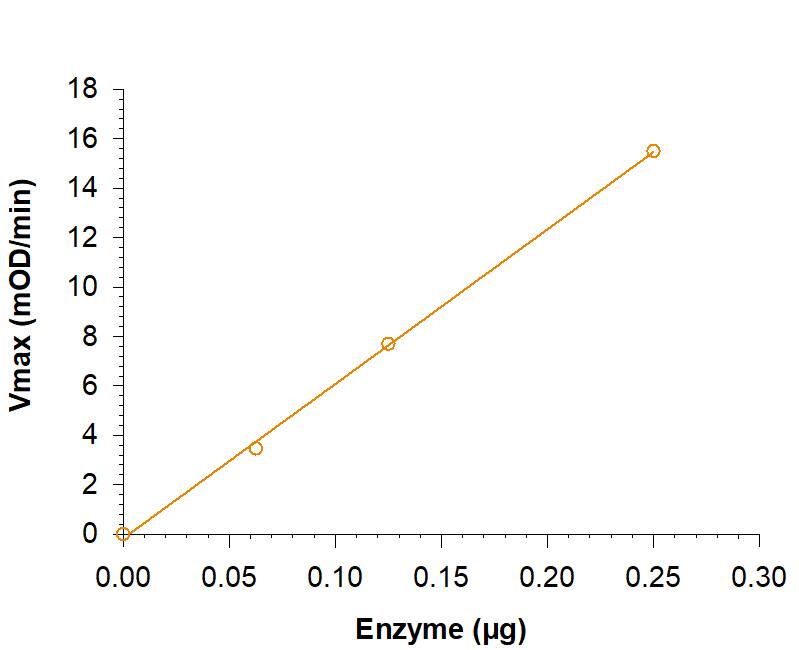
Recombinant Human GALT His-tag Enzyme Activity.
Recombinant Human GALT His-tag (Catalog # 11776-GT) is measured by its ability to hydrolyze UDP-Glucose.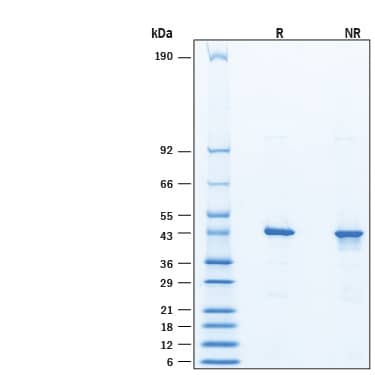
Recombinant Human GALT His-tag SDS-PAGE.
2 μg/lane of Recombinant Human GALT His-tag (Catalog # 11776-GT) was resolved with SDS-PAGE under reducing (R) and non-reducing (NR) conditions and visualized by Coomassie® Blue staining, showing bands at 40-45 kDa, under reducing conditions.Formulation, Preparation and Storage
11776-GT
| Formulation | Supplied as a 0.2 μm filtered solution in Tris, NaCl and TCEP. |
| Shipping | The product is shipped with dry ice or equivalent. Upon receipt, store it immediately at the temperature recommended below. |
| Stability & Storage | Use a manual defrost freezer and avoid repeated freeze-thaw cycles.
|
Background: GALT
References
- Elsas, L.J. and K. Lai. (1998) Genet. Med. 1:40.
- Brenner, C. (2002) Biochemistry 41:9003.
- McCorvie, T.J. et al (2016) Hu. Mol. Genet. 25:2234.
- Weckbecker, G. and D.O. Keppler. (1982) Eur. J. Biochem. 128:163.
- Donnell, G. et al (1963) Pediatrics 31:802.
- Lai, K. et al (2003) Glycobiology 13:285.
- Staubach, S. et al. (2012) J. Proteome Res. 11: 906.
- Coss, K.P. et al. (2014) J. Proteome Res. 13: 385.
- Maratha, A. et al. (2016) Eur. J. Hum. Genet. 24:976.
- Tang, M. et al. (2012) Hum. Mutat. 33: 1107.
- Coelho, A.I. et al. (2014) Mol. Genet. Genomic Med. 2:484.
- Banford, S. et al. (2021) J. Pers. Med. 11:106.
- Delnoy, B. et al. (2021) J. Pers. Med. 11:75.
- Pasquali, M. et al. (2018) Genet. Med. 20:3.
Long Name
galactose-1-phosphate uridylyltransferase
Alternate Names
EC 2.7.7.12, Gal-1-P uridylyltransferase, galactose-1-phosphate uridyl transferase, galactose-1-phosphate uridylyltransferase, UDP-glucose--hexose-1-phosphate uridylyltransferase
Gene Symbol
GALT
UniProt
Additional GALT Products
Product Documents for Recombinant Human GALT His-tag Protein, CF
Product Specific Notices for Recombinant Human GALT His-tag Protein, CF
For research use only
Loading...
Loading...
Loading...
Loading...