
Mouse DPPIV/CD26 PE-conjugated Antibody
R&D Systems, part of Bio-Techne | Catalog # FAB9541P

Discontinued Product
FAB9541P has been discontinued.
View all DPPIV/CD26 products.
Key Product Details
Species Reactivity
Mouse
Applications
Flow Cytometry
Label
Phycoerythrin (Excitation = 488 nm, Emission = 565-605 nm)
Antibody Source
Monoclonal Rat IgG2A Clone # 155202
Product Specifications
Immunogen
Mouse myeloma cell line NS0-derived recombinant mouse DPPIV/CD26
Extracellular domain
Extracellular domain
Specificity
Detects mouse DPPIV/CD26 in direct ELISAs.
Clonality
Monoclonal
Host
Rat
Isotype
IgG2A
Scientific Data Images for Mouse DPPIV/CD26 PE-conjugated Antibody
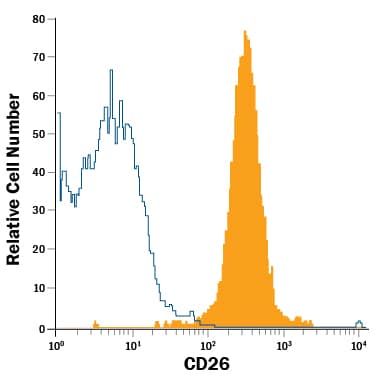
Detection of DPPIV/CD26 in Mouse Thymocytes by Flow Cytometry.
Mouse thymocytes were stained with Rat Anti-Mouse DPPIV/CD26 PE-conjugated Monoclonal Antibody (Catalog # FAB9541P, filled histogram) or isotype control antibody (Catalog # IC006P, open histogram). View our protocol for Staining Membrane-associated Proteins.Applications for Mouse DPPIV/CD26 PE-conjugated Antibody
Application
Recommended Usage
Flow Cytometry
10 µL/106 cells
Sample: Mouse thymocytes
Sample: Mouse thymocytes
Spectra Viewer
Plan Your Experiments
Use our spectra viewer to interactively plan your experiments, assessing multiplexing options. View the excitation and emission spectra for our fluorescent dye range and other commonly used dyes.
Spectra Viewer
Formulation, Preparation, and Storage
Purification
Protein A or G purified from hybridoma culture supernatant
Formulation
Supplied in a saline solution containing BSA and Sodium Azide.
Shipping
The product is shipped with polar packs. Upon receipt, store it immediately at the temperature recommended below.
Stability & Storage
Store the unopened product at 2 - 8° C. Do not use past expiration date. Protect from light.
Background: DPPIV/CD26
DPPIV/CD26 (EC 3.4.14.5) is a serine exopeptidase that releases Xaa-Pro dipeptides from the N-terminus of oligo- and polypeptides (1, 2). It is a type II membrane protein consisting of a short cytoplasmic tail, a transmembrane domain, and a long extracellular domain (3‑5). The extracellular domain contains glycosylation sites, a cysteine-rich region and the catalytic active site (Ser, Asp and His charge relay system). The amino acid sequence of the mouse DPPIV/CD26 extracellular domain is 84% and 91% identical to the human and rat counterparts, respectively. In the native state, DPPIV/CD26 is present as both a monomer and a noncovalently linked homodimer on the cell surface, the latter configuration being necessary for optimal activity. A soluble form is also detectable in human serum and other body fluids, the levels of which may have clinical significance in patients with cancer, liver and kidney disease, and depression. DPPIV/CD26 plays an important role in many biological and pathological processes. It functions as T cell-activating molecule (THAM). It serves as a co‑factor for entry of HIV in CD4+ cells (6). It binds adenosine deaminase, the deficiency of which causes severe combined immunodeficiency disease in humans (7). It cleaves chemokines such as stromal-cell-derived factor 1 alpha and macrophage-derived chemokine (8, 9). It degrades peptide hormones such as glucagon (10). It truncates procalcitonin, a marker for systemic bacterial infections with elevated levels detected in patients with thermal injury, sepsis and severe infection, and in children with bacterial meningitis (11).
References
- Misumi, Y. and Y. Ikehara (2004) in Handbook of Proteolytic Enzymes. Barrett, A.J. et al. (eds), p. 1905, Elsevier, London.
- Ikehara, Y. et al. (1994) Methods Enzymol. 244:215.
- Marguet, D. et al. (1992) J. Biol. Chem. 267:2200.
- Bernard, A.M. et al. (1994) Biochemistry 33:15204.
- Vivier, I. et al. (1991) J. Immunol. 147:447.
- Callebaut, C. et al. (1993) Science 262:2045.
- Kameoka, J. et al. (1993) Science 261:466.
- Ohtsuki, T. et al. (1998) FEBS Lett. 431:236.
- Proost, P. et al. (1999) J. Biol. Chem. 274:3988.
- Hinke, S.A. et al. (2000) J. Biol. Chem. 275:3827.
- Wrenger, S. et al. (2000) FEBS Lett. 466:155.
Long Name
Dipeptidyl-peptidase IV
Alternate Names
CD26, DPP4
Gene Symbol
DPP4
Additional DPPIV/CD26 Products
Product Documents for Mouse DPPIV/CD26 PE-conjugated Antibody
Product Specific Notices for Mouse DPPIV/CD26 PE-conjugated Antibody
For research use only
Loading...
Loading...
Loading...
Loading...
Loading...