
Human PAWR Antibody
R&D Systems, part of Bio-Techne | Catalog # AF6885

Conjugate
Catalog #
Key Product Details
Species Reactivity
Human
Applications
Immunocytochemistry
Label
Unconjugated
Antibody Source
Polyclonal Sheep IgG
Product Specifications
Immunogen
E. coli-derived recombinant human PAWR
Arg2-Ala121
Accession # CAD88640
Arg2-Ala121
Accession # CAD88640
Specificity
Detects human PAWR in direct ELISAs and Western blots.
Clonality
Polyclonal
Host
Sheep
Isotype
IgG
Scientific Data Images for Human PAWR Antibody
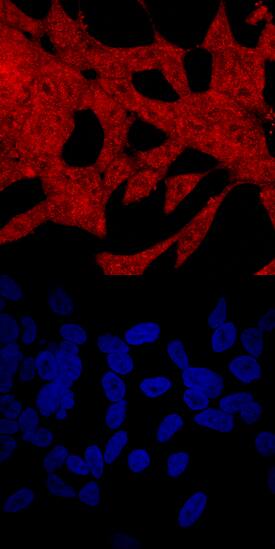
PAWR in LNCaP Human Cell Line.
PAWR was detected in immersion fixed LNCaP human prostate cancer cell line using Sheep Anti-Human PAWR Antigen Affinity-purified Polyclonal Antibody (Catalog # AF6885) at 10 µg/mL for 3 hours at room temperature. Cells were stained using the NorthernLights™ 557-conjugated Anti-Sheep IgG Secondary Antibody (red, upper panel; Catalog # NL010) and counterstained with DAPI (blue, lower panel). Specific staining was localized to cell surfaces and cytoplasm. View our protocol for Fluorescent ICC Staining of Cells on Coverslips.Applications for Human PAWR Antibody
Application
Recommended Usage
Immunocytochemistry
5-15 µg/mL
Sample: Immersion fixed LNCaP human prostate cancer cell line
Sample: Immersion fixed LNCaP human prostate cancer cell line
Formulation, Preparation, and Storage
Purification
Antigen Affinity-purified
Reconstitution
Sterile PBS to a final concentration of 0.2 mg/mL. For liquid material, refer to CoA for concentration.
Formulation
Lyophilized from a 0.2 μm filtered solution in PBS with Trehalose. *Small pack size (SP) is supplied either lyophilized or as a 0.2 µm filtered solution in PBS.
Shipping
Lyophilized product is shipped at ambient temperature. Liquid small pack size (-SP) is shipped with polar packs. Upon receipt, store immediately at the temperature recommended below.
Stability & Storage
Use a manual defrost freezer and avoid repeated freeze-thaw cycles.
- 12 months from date of receipt, -20 to -70 °C as supplied.
- 1 month, 2 to 8 °C under sterile conditions after reconstitution.
- 6 months, -20 to -70 °C under sterile conditions after reconstitution.
Background: PAWR
PAWR (PRKC Apoptosis WT1 Regulator protein; also PAR-4) is an intracellular, 38-42 kDa pro-apoptotic protein. It is widely expressed, and serves multiple functions. WT1 protein is both a transcriptional activator and repressor. When complexed to PAWR, WT1 activation function is repressed, while its repressor activity is enhanced. Thus, PAWR generates transcriptional repression. PAWR also binds to the atypical lambdaPKC and zetaPKC isotypes. Such binding inhibits PKC avtivity, blocks cell division and MAPK activation, and promotes Fas-mediated cell apoptosis. Finally, in neurons, PAWR binds to BACE1, promoting the cleavage of APP. Human PAWR is 340 amino acids (aa) in length. It contains an Ala-rich region (aa 49-120), an NLS (aa 145-161), one coiled-coil region (aa 186-206), and a Leu-zipper domain (aa 300-340). There are at least five utilized Ser/Thr phosphorylation sites. PAWR forms noncovalent homodimers and is reported to homooligomerize. There is one potential splice form that shows a three aa substitution for aa 173-340, and a P-P-A-R substitution for A102P103. Full-length PAWR shares 78% aa identity with mouse PAWR.
Long Name
PRKC, Apoptosis, WT1, Regulator
Alternate Names
PAR4, WT1 Interacting Protein
Gene Symbol
PAWR
UniProt
Additional PAWR Products
Product Documents for Human PAWR Antibody
Product Specific Notices for Human PAWR Antibody
For research use only
Loading...
Loading...
Loading...
Loading...