
Human Neuropeptide Y/NPY Antibody
R&D Systems, part of Bio-Techne | Catalog # MAB8517

Scientific images may be resized, cropped, or adjusted for brightness or contrast for presentation purposes. These updates are limited to presentation and do not affect the underlying scientific interpretation of the data. Where available, additional source data may be provided upon request.
Conjugate
Catalog #
Key Product Details
Species Reactivity
Human
Applications
Immunohistochemistry
Label
Unconjugated
Antibody Source
Monoclonal Mouse IgG2A Clone # 904032
Product Specifications
Immunogen
Neuropeptide Y/NPY conjugated to KLH
YPSKPDNPGEDAPAEDMARYYSALRHYINLITRQRY
Accession # P01303
YPSKPDNPGEDAPAEDMARYYSALRHYINLITRQRY
Accession # P01303
Specificity
Detects human Neuropeptide Y/NPY in direct ELISAs.
Clonality
Monoclonal
Host
Mouse
Isotype
IgG2A
Scientific Data Images for Human Neuropeptide Y/NPY Antibody
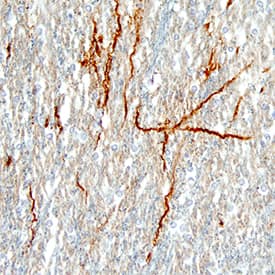
Neuropeptide Y/NPY in Human Brain.
Neuropeptide Y/NPY was detected in immersion fixed paraffin-embedded sections of human brain (hypothalamus) using Mouse Anti-Human Neuropeptide Y/NPY Monoclonal Antibody (Catalog # MAB8517) at 15 µg/mL overnight at 4 °C. Tissue was stained using the Anti-Mouse HRP-DAB Cell & Tissue Staining Kit (brown; Catalog # CTS002) and counterstained with hematoxylin (blue). Specific staining was localized to neuronal processes. View our protocol for Chromogenic IHC Staining of Paraffin-embedded Tissue Sections.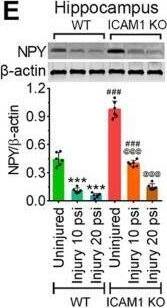
Detection of Mouse Neuropeptide Y/NPY by Western Blot
ICAM-1 reduces neurotransmitters expression that reflects in sensorimotor deficits and psychological stress after TBI. A, Immunofluorescent staining of NE (red) in the hippocampus area of WT and ICAM-1−/− mice after 10 and 20 psi FPI and merged with NeuN (green) and DAPI (blue). Scale bar: 20 μm (all panels). B, Quantification of NE staining in the hippocampus area of uninjured, 10 and 20 psi FPI WT and ICAM-1−/− mice using ImageJ software (n = 6/group). C–E, Western blot analysis of 5-HT1AR (C), DAD1R (D), NPY (E) and beta-actin in the tissue lysates of hippocampus of WT and ICAM-1−/− mice 48 h after 10 and 20 psi FPI. The bar graph with dot plots shows the quantification of 5-HT1AR (C), DAD1R (D), NPY (E) versus beta-actin (n = 6/group). F, Schematic presentation of the findings. All values are expressed as mean ± SD two-way ANOVA followed by Bonferroni post hoc tests. Statistically significant ***p < 0.001 versus WT uninjured group; @@@p < 0.001 versus uninjured ICAM-1−/− group; #p < 0.05, ##p < 0.01, ###p < 0.001 versus WT corresponding injury groups; ns = non-significant. NE, norepinephrine; 5-HT1AR, 5-HT 1A receptor; DAD1R, DA D1 receptor; NPY, neuropeptide Y. Image collected and cropped by CiteAb from the following open publication (https://pubmed.ncbi.nlm.nih.gov/34135004), licensed under a CC-BY license. Not internally tested by R&D Systems.Applications for Human Neuropeptide Y/NPY Antibody
Application
Recommended Usage
Immunohistochemistry
8-25 µg/mL
Sample: Immersion fixed paraffin-embedded sections of human brain (hypothalamus)
Sample: Immersion fixed paraffin-embedded sections of human brain (hypothalamus)
Formulation, Preparation, and Storage
Purification
Protein A or G purified from hybridoma culture supernatant
Reconstitution
Reconstitute at 0.5 mg/mL in sterile PBS. For liquid material, refer to CoA for concentration.
Formulation
Lyophilized from a 0.2 μm filtered solution in PBS with Trehalose. *Small pack size (SP) is supplied either lyophilized or as a 0.2 µm filtered solution in PBS.
Shipping
Lyophilized product is shipped at ambient temperature. Liquid small pack size (-SP) is shipped with polar packs. Upon receipt, store immediately at the temperature recommended below.
Stability & Storage
Use a manual defrost freezer and avoid repeated freeze-thaw cycles.
- 12 months from date of receipt, -20 to -70 °C as supplied.
- 1 month, 2 to 8 °C under sterile conditions after reconstitution.
- 6 months, -20 to -70 °C under sterile conditions after reconstitution.
Background: Neuropeptide Y/NPY
Neuropeptide Y (NPY) is a 36 amino acid peptide that was isolated from hypothalamus in porcine brain in 1982 and lately it belongs to a family of peptides which include Pancreatic Polypeptide (PP) and Peptide YY (PYY) which exert their pharmacological action via interaction with G-protein coupled receptors Y1, Y2, Y4, Y5 and y6. NPY is the most abundant peptide in brain and in nervous system NPY functions as a neurotransmitter regulating many processes including memory and learning, pain, fat storage and blood pressure. NPY also regulates stress by stimulating secretion of corticotropin-releasing hormone in brain. It appears there is a correlation between the increased levels of NPY gene expression in hippocampus and epileptic seizures. Cocaine reduces the levels of NPY and such a decrease is thought to be related to depression and anxiety. NPY receptors are rhodopsin-like G-protein coupled receptors (GPCR) coupled to Gi or G0 proteins, which inhibit adenylate cyclase and reduce cAMP accumulation and modulate Calcium and Potassium channels.
Alternate Names
NPY, PYY4
Gene Symbol
NPY
UniProt
Additional Neuropeptide Y/NPY Products
Product Documents for Human Neuropeptide Y/NPY Antibody
Product Specific Notices for Human Neuropeptide Y/NPY Antibody
For research use only
Loading...
Loading...
Loading...
Loading...
Loading...