
Human/Mouse DR3/TNFRSF25 APC-conjugated Antibody
R&D Systems, part of Bio-Techne | Catalog # FAB943A

Discontinued Product
FAB943A has been discontinued.
View all DR3/TNFRSF25 products.
Key Product Details
Species Reactivity
Human, Mouse
Applications
Flow Cytometry
Label
Allophycocyanin (Excitation = 620-650 nm, Emission = 660-670 nm)
Antibody Source
Monoclonal Mouse IgG1 Clone # 59204
Product Specifications
Immunogen
Mouse myeloma cell line NS0-derived recombinant human DR3 isoform 1
Gln25-Phe201
Accession # Q93038
Gln25-Phe201
Accession # Q93038
Specificity
Detects human DR3/TNFRSF25 in direct ELISAs and Western blots. Shows 100% cross-reactivity with recombinant mouse (rm) DR3/TNFRSF25 and no cross-reactivity with recombinant human (rh) 4-1BB, rhCD27, rhCD30, rhCD40, rhDR6, rhBAFF R, rhFas, rhGITR, rhLTR beta, rhNGF R, rhOPG, rmOX40, rhRANK, rhTAJ, rhTNF RI, rhTNF RII, or rhHVEM.
Clonality
Monoclonal
Host
Mouse
Isotype
IgG1
Scientific Data Images for Human/Mouse DR3/TNFRSF25 APC-conjugated Antibody
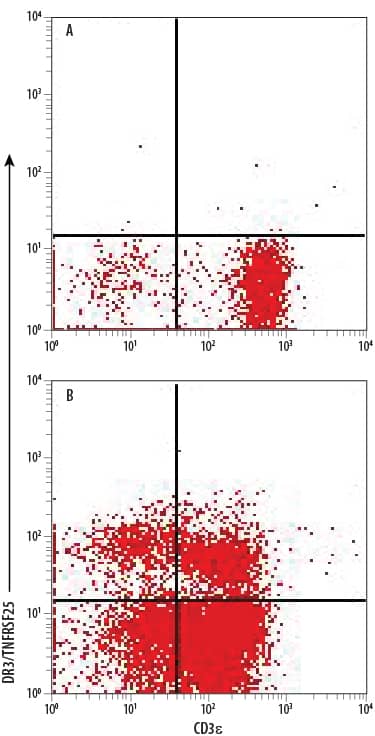
Detection of DR3/TNFRSF25 in Human PBMCs by Flow Cytometry.
Human peripheral blood mononuclear cells (PBMCs) either (A) untreated or (B) treated with PMA and Calcium Ionomycin for 24 hours were stained with Mouse Anti-Human/Mouse DR3/TNFRSF25 APC-conjugated Monoclonal Antibody (Catalog # FAB943A) and Mouse Anti-Human CD3e PE-conjugated Monoclonal Antibody (Catalog # FAB100P). Quadrant markers were set based on control antibody staining (Catalog # IC002A). View our protocol for Staining Membrane-associated Proteins.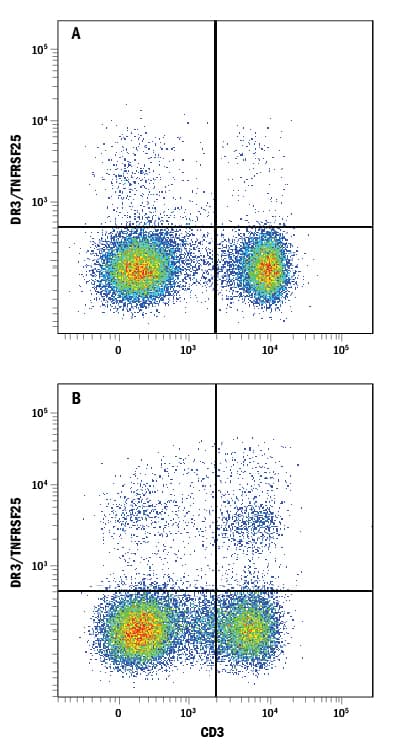
Detection of DR3/TNFRSF25 in Mouse Splenocytes by Flow Cytometry.
Mouse splenocytes either (A) untreated or (B) treated with PMA and Calcium Ionomycin for 24 hours were stained with Mouse Anti-Human/Mouse DR3/TNFRSF25 APC-conjugated Monoclonal Antibody (Catalog # FAB943A) and Rat Anti-Mouse CD3 PE-conjugated Monoclonal Antibody (Catalog # FAB4841P). Quadrant markers were set based on control antibody staining (Catalog # IC002A). View our protocol for Staining Membrane-associated Proteins.Applications for Human/Mouse DR3/TNFRSF25 APC-conjugated Antibody
Application
Recommended Usage
Flow Cytometry
10 µL/106 cells
Sample: Human peripheral blood mononuclear cells (PBMCs) treated with PMA and Calcium Ionomycin and mouse splenocytes treated with PMA and Calcium Ionomycin
Sample: Human peripheral blood mononuclear cells (PBMCs) treated with PMA and Calcium Ionomycin and mouse splenocytes treated with PMA and Calcium Ionomycin
Formulation, Preparation, and Storage
Purification
Protein A or G purified from ascites
Formulation
Supplied in a saline solution containing BSA and Sodium Azide.
Shipping
The product is shipped with polar packs. Upon receipt, store it immediately at the temperature recommended below.
Stability & Storage
Protect from light. Do not freeze.
- 12 months from date of receipt, 2 to 8 °C as supplied.
Background: DR3/TNFRSF25
Death receptor 3 (DR3), also known as lymphocyte-associated receptor of death (LARD), WSL-1, APO3, TRAMP and TR3, is a glycoprotein belonging to the TNF receptor superfamily (TNFRSF) (1 - 5). DR3 was formerly designated TNFRSF12 when it was thought to be a receptor for TWEAK/TNFSF12 (6). However, work disavowed the DR3:TWEAK interaction and DR3 is now designated TNFRSF 25 (7). By alternative splicing, at least 11 distinct human DR3 transcripts encoding secreted or type I membrane proteins exist (7). The human DR3 isoform 1 cDNA encodes a 417 amino acid residue (aa) transmembrane precursor with a 24 aa signal peptide, a 175 aa extracellular domain containing four cysteine-rich repeats and two potential N-glycosylation sites, a 21 aa transmembrane region and a 195 aa cytoplasmic region with one death domain. DR3 is one of six within the TNF R superfamily that contains a death domain in its cytoplasmic region. It is most closely related to TNF R1 and FAS/CD95, sharing 29% and 23% aa sequence identity, respectively. DR3 is expressed primarily in tissues enriched in lymphocytes. Whereas naïve B and T cells express multiple truncated DR3 isoforms but not the transmembrane isoform 1, upon T cell activation, expression of the transmembrane DR3 isoform 1 predominates. TL1A/VEGI, a TNF superfamily ligand, has been shown to bind and activate DR3 (8). Depending on the cell context, ligation of DR3 by TL1A can trigger one of two signaling pathways. On primary T cells, TL1A induces NF-kappa-B activation and a costimulatory signal to increase IL-2 responsiveness and the secretion of proinflammatory cytokines. However, in a tumor cell line, TF-1, TL1A has been shown to induce caspase activity and apoptosis. In DR3-null mice, an impairment of negative selection and anti-CD3-mediated thymocyte apoptosis is observed.
References
- Chinnaiyan, A.M. et al. (1996) Science 274:990.
- Kitson, J. et al. (1996) Nature 384:372.
- Bodmer, J-L. et al. (1997) Immunity 6:79.
- Screaton, G.R. et al. (1997) Proc. Nat. Acad. Sci. USA 94:4615.
- Marsters, S.A. et al. (1996) Curr. Biol. 6:1669.
- Marsters, S.A. et al. (1998) Curr. Biol. 8:525.
- Kaptein, A. et al. (2000) FEBS Lett. 485:135.
- Migone, T-S. et al. (2002) Immunity 16:479.
Long Name
Death Receptor 3
Alternate Names
Apo-3, LARD, TNFRSF25, TRAMP, WSL-1
Gene Symbol
TNFRSF25
UniProt
Additional DR3/TNFRSF25 Products
Product Documents for Human/Mouse DR3/TNFRSF25 APC-conjugated Antibody
Product Specific Notices for Human/Mouse DR3/TNFRSF25 APC-conjugated Antibody
For research use only
Loading...
Loading...
Loading...
Loading...
Loading...
Loading...