
Human LIMPII/SR-B2 Antibody
R&D Systems, part of Bio-Techne | Catalog # AF1966

Conjugate
Catalog #
Key Product Details
Species Reactivity
Validated:
Human
Cited:
Human, Mouse
Applications
Validated:
Western Blot, ELISA Capture (Matched Antibody Pair)
Cited:
Immunohistochemistry, Western Blot, Neutralization, Flow Cytometry, Immunoprecipitation, Functional Assay
Label
Unconjugated
Antibody Source
Polyclonal Goat IgG
Product Specifications
Immunogen
Mouse myeloma cell line NS0-derived recombinant human LIMPII lumenal loop
Arg27-Thr432
Accession # Q14108
Arg27-Thr432
Accession # Q14108
Specificity
Detects human LIMPII in ELISAs and Western blots. In sandwich immunoassays, approximately 6% cross-reactivity with recombinant mouse LIMPII is observed and less than 0.3% cross-reactivity with recombinant human (rh) SR-B1 and rhCD36 is observed.
Clonality
Polyclonal
Host
Goat
Isotype
IgG
Scientific Data Images for Human LIMPII/SR-B2 Antibody
Detection of LIMPII/SR-B2 by Western Blot
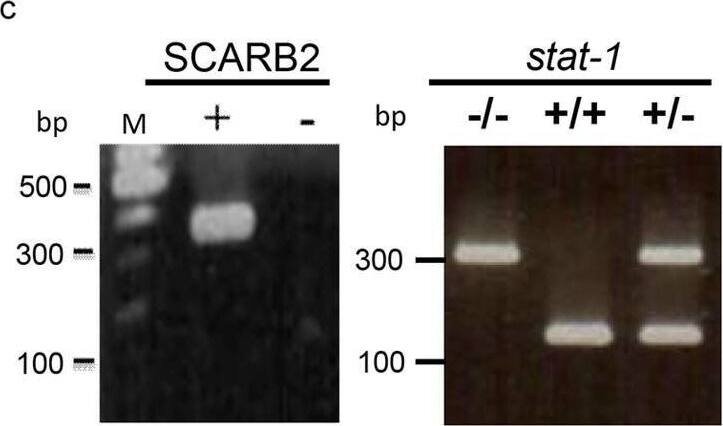
Generation of a hybrid mouse model SCARB2/stat-1 KO by crossbreeding hSCARB2 transgenic mice and stat-1 KO mice.(a) Human SCARB2 (hSCARB2) cDNA was cloned under its own native promoter in an SV40 expression vector. (b) The generation of homozygous hSCARB2+/+ transgenic mice was as detailed in M&M. The heterozygote strain of hSCARB2+/−/stat-1+/− mice were generated by crossing the stat-1−/− and the hSCARB2+/+ parental mice. The hybrid strain hSCARB2+/+/stat-1−/− was generated by crossing the heterozygote mice hSCARB2+/−/stat-1+/− to each other. (c) Genotyping of parental and hybrid mouse strains was performed by PCR assay using genomic DNAs extracted from mouse tail. The transgene of hSCARB2 was screened by detection of a 369 bp PCR product using primers specific for hSCARB2. For the stat-1+/− heterozygote mice, 320 bp and 150 bp PCR products were used as markers for screening. The former indicates a mutant stat-1 allele, while the latter indicates a wild type stat-1 allele. (d) The expressions of hSCARB2 protein were compared among parental and hybrid mouse strains in brain, spinal cord, spleen and muscle by immunoblot via an anti-SCARB2 antibody. The weaker signals of the SCARB2 protein detected in stat-1 KO mice reflect cross reactivity between human and mouse SCARB2 proteins to the anti-SCARB2 antibody. Image collected and cropped by CiteAb from the following open publication (https://pubmed.ncbi.nlm.nih.gov/27499235), licensed under a CC-BY license. Not internally tested by R&D Systems.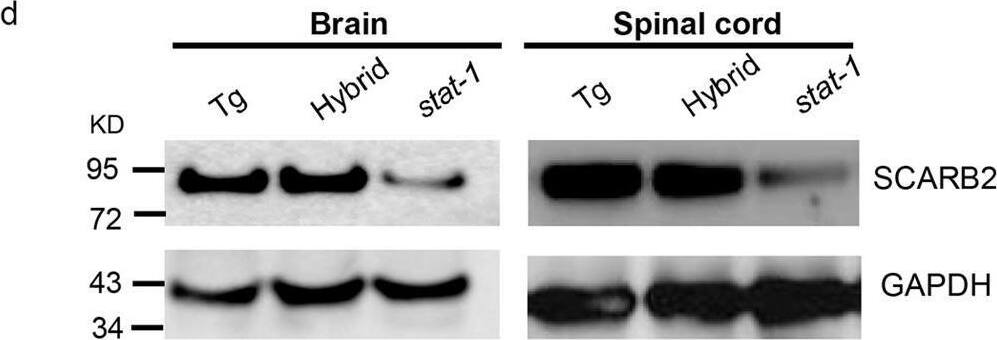
Detection of LIMPII/SR-B2 by Western Blot
Generation of a hybrid mouse model SCARB2/stat-1 KO by crossbreeding hSCARB2 transgenic mice and stat-1 KO mice.(a) Human SCARB2 (hSCARB2) cDNA was cloned under its own native promoter in an SV40 expression vector. (b) The generation of homozygous hSCARB2+/+ transgenic mice was as detailed in M&M. The heterozygote strain of hSCARB2+/−/stat-1+/− mice were generated by crossing the stat-1−/− and the hSCARB2+/+ parental mice. The hybrid strain hSCARB2+/+/stat-1−/− was generated by crossing the heterozygote mice hSCARB2+/−/stat-1+/− to each other. (c) Genotyping of parental and hybrid mouse strains was performed by PCR assay using genomic DNAs extracted from mouse tail. The transgene of hSCARB2 was screened by detection of a 369 bp PCR product using primers specific for hSCARB2. For the stat-1+/− heterozygote mice, 320 bp and 150 bp PCR products were used as markers for screening. The former indicates a mutant stat-1 allele, while the latter indicates a wild type stat-1 allele. (d) The expressions of hSCARB2 protein were compared among parental and hybrid mouse strains in brain, spinal cord, spleen and muscle by immunoblot via an anti-SCARB2 antibody. The weaker signals of the SCARB2 protein detected in stat-1 KO mice reflect cross reactivity between human and mouse SCARB2 proteins to the anti-SCARB2 antibody. Image collected and cropped by CiteAb from the following open publication (https://pubmed.ncbi.nlm.nih.gov/27499235), licensed under a CC-BY license. Not internally tested by R&D Systems.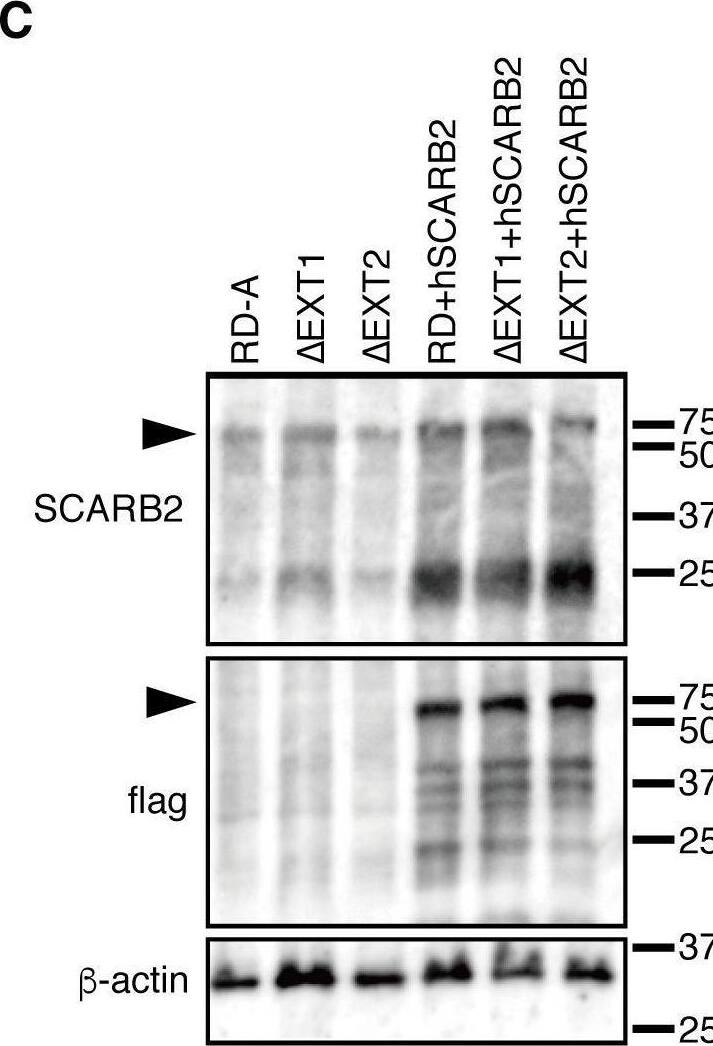
Detection of LIMPII/SR-B2 by Western Blot
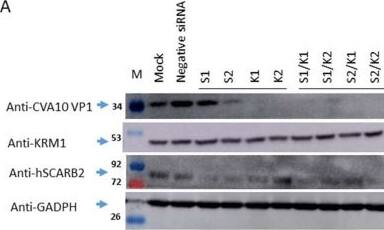
HS and SCARB2 expression in genetically modified RD-A cells.(A–B) FACS analysis of HS expression at the cell surface. (C) Western blotting analysis using anti-SCARB2 (top), anti-flag (middle), and anti-beta -actin (bottom) antibodies. The arrowheads indicate hSCARB2. Image collected and cropped by CiteAb from the following open publication (https://pubmed.ncbi.nlm.nih.gov/32187235), licensed under a CC-BY license. Not internally tested by R&D Systems.
Applications for Human LIMPII/SR-B2 Antibody
Application
Recommended Usage
Western Blot
0.1 µg/mL
Sample: Recombinant Human LIMPII/SR-B2 Fc Chimera (Catalog # 1966-LM)
Sample: Recombinant Human LIMPII/SR-B2 Fc Chimera (Catalog # 1966-LM)
Human LIMPII/SR-B2 Sandwich Immunoassay
Please Note: Optimal dilutions of this antibody should be experimentally determined.
Formulation, Preparation, and Storage
Purification
Antigen Affinity-purified
Reconstitution
Reconstitute at 0.2 mg/mL in sterile PBS. For liquid material, refer to CoA for concentration.
Formulation
Lyophilized from a 0.2 μm filtered solution in PBS with Trehalose. *Small pack size (SP) is supplied either lyophilized or as a 0.2 µm filtered solution in PBS.
Shipping
Lyophilized product is shipped at ambient temperature. Liquid small pack size (-SP) is shipped with polar packs. Upon receipt, store immediately at the temperature recommended below.
Stability & Storage
Use a manual defrost freezer and avoid repeated freeze-thaw cycles.
- 12 months from date of receipt, -20 to -70 °C as supplied.
- 1 month, 2 to 8 °C under sterile conditions after reconstitution.
- 6 months, -20 to -70 °C under sterile conditions after reconstitution.
Background: LIMPII/SR-B2
LIMPII (Lysosomal Integral Membrane Protein II), also known as LPG85 (85 kDa lysosomal membrane sialoglycoprotein) and as CD36 antigen-like 2 (CD36L2), is a major lysosomal membrane protein. It belongs to the scavenger receptor class B subfamily and is designated member 2 (SR-B2). Other mammalian members of this family include SR-B1 (alternatively known as Cla-1 and CD36L1), and SR-B3 (CD36) (1 - 3). SR-B/CD36 family members are type III integral membrane proteins with an N- as well as a C-terminal cytoplasmic tail, and a large extracellular (or lumenal in the case of LIMPII) loop containing similarly spaced cysteine residues and multiple glycosylation sites. The C-terminal cytoplasmic tail has a di-leucine-based motif that mediates effective lysosomal targeting. LIMPII is widely expressed on all tissues and cell types so far examined. It is also expressed on the surface of activated platelets. LIMPII binds thrombospondin-1, but the biological significance of this interaction is not known. LIMPII-thrombospondin interaction may contribute to the pro-adhesive changes of activated platelets during coagulation, and inflammation (1). Overexpression of LIMPII causes an enlargement of early endosomes and late endosomes, suggesting that LIMPII may play a role in lysosome/endosome biogenesis (4). Mice deficient in LIMPII are impaired in membrane transport processes, resulting in ureteric pelvic junction obstruction, deafness and peripheral neuropathy (5).
References
- Crombie, R. and R. Silverstein (1998) J. Biol. Chem. 273:4855.
- Febbraio, M. et al. (2001) J. Clin. Invest. 108:785.
- Eskelinen, E-L. et al. (2003) Trends in Cell Biology 13:137.
- Kuronita, T. et al. (2002) J. Cell Sci. 115:4117.
- Gamp, A-C. et al. (2003) Human Molecular Genetics 12:631.
Long Name
Lysosomal Integral Membrane Protein II
Alternate Names
CD36L2, LPG85, SCARB2, SR-B2, SR-BII, SRB2
Gene Symbol
SCARB2
UniProt
Additional LIMPII/SR-B2 Products
Product Documents for Human LIMPII/SR-B2 Antibody
Product Specific Notices for Human LIMPII/SR-B2 Antibody
For research use only
Loading...
Loading...
Loading...
Loading...
Loading...