
Arginase 1/ARG1/liver Arginase Antibody
Novus Biologicals, part of Bio-Techne | Catalog # NB100-59740

Key Product Details
Species Reactivity
Validated:
Human, Mouse, Rat
Cited:
Human, Mouse, Rat
Applications
Validated:
Immunohistochemistry, Immunohistochemistry-Frozen, Western Blot, Peptide ELISA, Flow Cytometry, Immunocytochemistry/ Immunofluorescence, Simple Western
Cited:
Immunohistochemistry-Frozen, Western Blot, Flow Cytometry, Immunocytochemistry/ Immunofluorescence, IF/IHC
Label
Unconjugated
Antibody Source
Polyclonal Goat IgG
Concentration
0.5 mg/ml
Product Specifications
Immunogen
Peptide with sequence C-NHKPETDYLKPPK corresponding to C-Terminus according to NP_058830.2.
Epitope
NHKPETDYLKPPK
Reactivity Notes
Human reactivity reported in scientific literature (PMID: 28246332).
Clonality
Polyclonal
Host
Goat
Isotype
IgG
Theoretical MW
37 kDa.
Disclaimer note: The observed molecular weight of the protein may vary from the listed predicted molecular weight due to post translational modifications, post translation cleavages, relative charges, and other experimental factors.
Disclaimer note: The observed molecular weight of the protein may vary from the listed predicted molecular weight due to post translational modifications, post translation cleavages, relative charges, and other experimental factors.
Scientific Data Images for Arginase 1/ARG1/liver Arginase Antibody
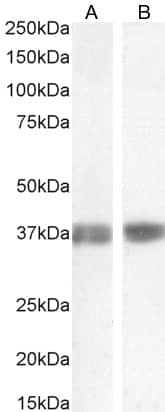
Western Blot: Arginase 1/ARG1/liver Arginase Antibody [NB100-59740] -
Western Blot: Arginase 1/ARG1/liver Arginase Antibody [NB100-59740] - (0.003ug/ml) staining of Mouse (A) and Rat (B) Liver lysate (35ug protein in RIPA buffer). Detected by chemiluminescence.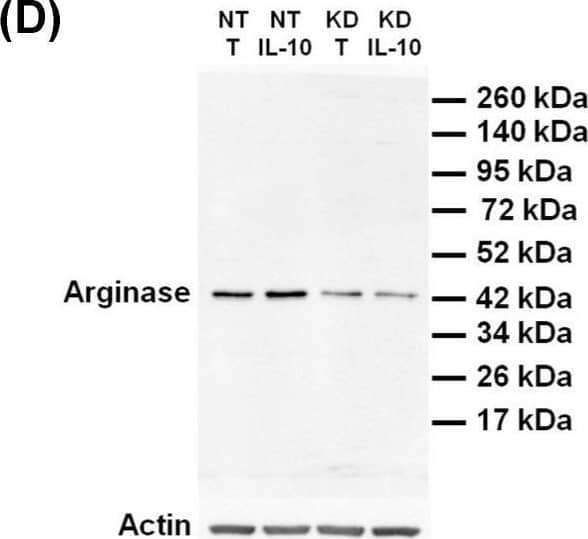
Western Blot: Arginase 1/ARG1/liver Arginase Antibody [NB100-59740] -
Under IL-10 treatment, PC1/3 KD cells exhibit lower levels of arginase than NT cells. NT and PC1/3 KD NR8383 macrophages were treated with 20 ng/mL of IL-10 for 24 h. (A) Western blot studies conducted with anti-iNOS. (B) Intensities of iNOS quantified and normalized to those of Actin. (C) Intensities of s-iNOS quantified and normalized to those of Actin. (D) Western blot studies conducted with anti-arginase. (E) Intensities of arginase quantified and normalized to those of Actin. The results are obtained from three independent experiments and depicted through graphic representations (means +/- SD). Data are analyzed by the Student t-test and values of p < 0.05 are considered statistically significant (*p-value of <0.05, **p-value of <0.01). Image collected and cropped by CiteAb from the following open publication (https://pubmed.ncbi.nlm.nih.gov/31766635), licensed under a CC-BY license. Not internally tested by Novus Biologicals.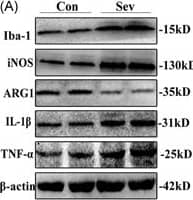
Western Blot: Arginase 1/ARG1/liver Arginase Antibody [NB100-59740] -
Western blot results. (A) Representative Western blot and quantitative analysis of protein levels of Iba‐1, iNOS, ARG1, IL‐1 beta, and TNF‐ alpha in PFC tissues, n = 6. (B) Relative level of Iba‐1 protein in PFC (fold change relative to beta‐actin protein level). (C) The relative level of iNOS protein in PFC (fold change relative to beta‐actin protein level). (D) The relative level of ARG1 protein in PFC (fold change relative to beta‐actin protein level). (E) The relative level of IL‐1 beta protein in PFC (fold change relative to beta‐actin protein level). (F) The relative level of TNF‐ alpha protein in PFC (fold change relative to beta‐actin protein level). *p < 0.05 versus Con group. ARG1, arginase‐1; IL‐1 beta, interleukin‐1 beta; iNOS, inducible nitric oxide synthase; PFC, prefrontal cortex; TNF‐ alpha, tumor necrosis factor‐ alpha [Color figure can be viewed at wileyonlinelibrary.com] Image collected and cropped by CiteAb from the following open publication (https://pubmed.ncbi.nlm.nih.gov/37786559), licensed under a CC-BY license. Not internally tested by Novus Biologicals.Applications for Arginase 1/ARG1/liver Arginase Antibody
Application
Recommended Usage
Peptide ELISA
1:64000
Simple Western
5 ug/mL
Western Blot
0.003-0.01 ug/ml
Application Notes
WB: Approx. 37 kDa band observed in mouse and rat liver lysates (calculated MW of 35 kDa band according to NP_058830.2 and 34.8kDa according to Mouse NP_031508.1). Primary incubation 1 hour at room temperature. IHC-F usage is reported in scientific literature (PMID: 24089194). Use in ICC/IF reported in scientific literature (PMID 28246332). Use in Flow Cytometry reported in (PMID: 24089194). Use in IHC reported in scientific literature (PMID: 23207546).
See Simple Western Antibody Database for Simple Western validation: Tested in Mouse liver lysate, separated by Size, antibody dilution of 5 ug/mL
See Simple Western Antibody Database for Simple Western validation: Tested in Mouse liver lysate, separated by Size, antibody dilution of 5 ug/mL
Formulation, Preparation, and Storage
Purification
Immunogen affinity purified
Formulation
Tris saline (20 mM Tris pH 7.3, 150 mM NaCl), 0.5% BSA
Preservative
0.02% Sodium Azide
Concentration
0.5 mg/ml
Shipping
The product is shipped with polar packs. Upon receipt, store it immediately at the temperature recommended below.
Stability & Storage
Store at -20C. Avoid freeze-thaw cycles.
Background: Arginase 1/ARG1
Arginase and nitric oxidase synthase (NOS) compete for the same L-arginine substrate, creating a delicate balance between pathways (1). Furthermore, bioavailability of L-arginine and ARG1 expression has been implicated in several pathologies including vascular disease, neuronal disease, cardiovascular disease, immune dysfunction, inflammation, and cancer (1,3-5). For instance, ARG1 functions as a macrophage marker, defining the M2 population, while inducible nitric oxide synthase (iNOS) characterizes the M1 population; impaired M1/M2 polarization and changes in ARG1 expression is observed in diseases such as arteriogenesis, asthma, pulmonary fibrosis, and inflammatory bowel disease (1,3). In humans, arginase deficiency, known as argininemia, is an autosomal recessive metabolic disorder characterized by elevated ammonia (hyperammonemia) levels and arginine accumulation (6). Given that many arginase-associated diseases are characterized by upregulation in expression of ARG1, ARG2, or both, arginase inhibitors are currently being studied as a potential therapeutic approach (1,4).
References
1. S Clemente, G., van Waarde, A., F Antunes, I., Domling, A., & H Elsinga, P. (2020). Arginase as a Potential Biomarker of Disease Progression: A Molecular Imaging Perspective. International Journal of Molecular Sciences. https://doi.org/10.3390/ijms21155291
2. Uniprot (P05089)
3. Kieler, M., Hofmann, M., & Schabbauer, G. (2021). More than just protein building blocks: How amino acids and related metabolic pathways fuel macrophage polarization. The FEBS Journal. Advance online publication. https://doi.org/10.1111/febs.15715
4. Shosha, E., Fouda, A. Y., Narayanan, S. P., Caldwell, R. W., & Caldwell, R. B. (2020). Is the Arginase Pathway a Novel Therapeutic Avenue for Diabetic Retinopathy?. Journal of Clinical Medicine. https://doi.org/10.3390/jcm9020425
5. Correale J. (2021). Immunosuppressive Amino-Acid Catabolizing Enzymes in Multiple Sclerosis. Frontiers in Immunology. https://doi.org/10.3389/fimmu.2020.600428
6. Morales, J. A., & Sticco, K. L. (2020). Arginase Deficiency. In StatPearls. StatPearls Publishing.
Long Name
Liver-Type Arginase
Alternate Names
AI, ARG1, Arginase-1, Liver Arginase, PGIF, Type I Arginase
Gene Symbol
ARG1
UniProt
Additional Arginase 1/ARG1 Products
Product Documents for Arginase 1/ARG1/liver Arginase Antibody
Product Specific Notices for Arginase 1/ARG1/liver Arginase Antibody
This product is for research use only and is not approved for use in humans or in clinical diagnosis. Primary Antibodies are guaranteed for 1 year from date of receipt.
Loading...
Loading...
Loading...
Loading...
Loading...