
Human CD30/TNFRSF8 PE-conjugated Antibody
R&D Systems, part of Bio-Techne | Catalog # FAB229P

Discontinued Product
FAB229P has been discontinued.
View all CD30/TNFRSF8 products.
Key Product Details
Species Reactivity
Human
Applications
Flow Cytometry
Label
Phycoerythrin (Excitation = 488 nm, Emission = 565-605 nm)
Antibody Source
Monoclonal Mouse IgG2B Clone # 81337
Product Specifications
Immunogen
S. frugiperda insect ovarian cell line Sf 21-derived recombinant human CD30/TNFRSF8
Phe19-Lys379
Accession # P28908
Phe19-Lys379
Accession # P28908
Specificity
Detects human CD30/TNFRSF8 in direct ELISAs and Western blots. In direct ELISAs, less than 1% cross-reactivity with recombinant mouse CD30, recombinant human (rh) CD27, and rhCD40 is observed.
Clonality
Monoclonal
Host
Mouse
Isotype
IgG2B
Scientific Data Images for Human CD30/TNFRSF8 PE-conjugated Antibody
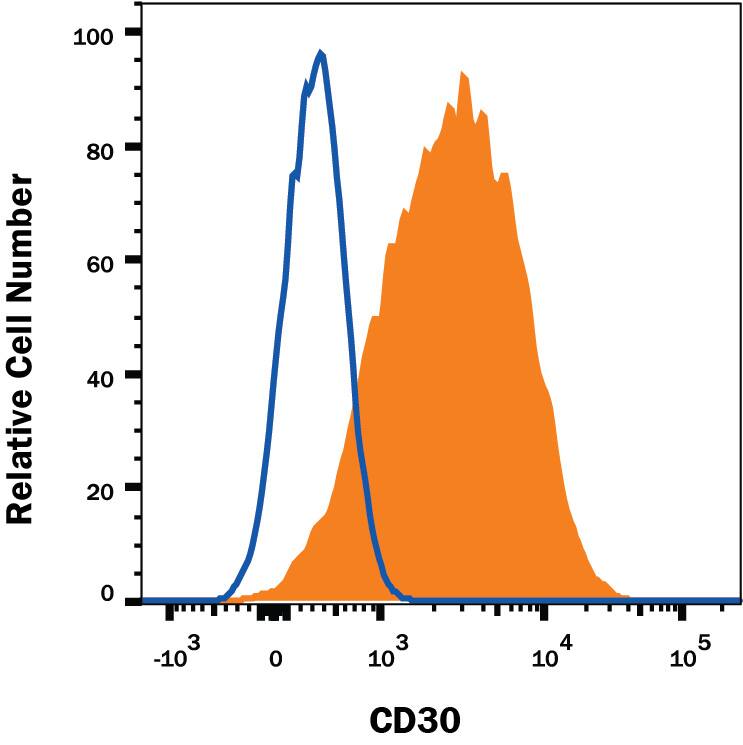
Detection of CD30/TNFRSF8 in Jurkat Human Cell Line by Flow Cytometry.
Jurkat human acute T cell leukemia cell line was stained with Mouse Anti-Human CD30/TNFRSF8 PE-conjugated Monoclonal Antibody (Catalog # FAB229P, filled histogram) or isotype control antibody (Catalog # IC0041P, open histogram). View our protocol for Staining Membrane-associated Proteins.Applications for Human CD30/TNFRSF8 PE-conjugated Antibody
Application
Recommended Usage
Flow Cytometry
10 µL/106 cells
Sample: Jurkat human acute T cell leukemia cell line
Sample: Jurkat human acute T cell leukemia cell line
Formulation, Preparation, and Storage
Purification
Protein A or G purified from ascites
Formulation
Supplied in a saline solution containing BSA and Sodium Azide.
Shipping
The product is shipped with polar packs. Upon receipt, store it immediately at the temperature recommended below.
Stability & Storage
Store the unopened product at 2 - 8° C. Do not use past expiration date. Protect from light.
Background: CD30/TNFRSF8
CD30, also known as Ki-1 antigen and TNFRSF8, is a 120 kDa type I transmembrane glycoprotein belonging to the TNF receptor superfamily (1, 2). Mature human CD30 consists of a 361 amino acid (aa) extracellular domain (ECD) with six cysteine-rich repeats, a 28 aa transmembrane segment, and a 188 aa cytoplasmic domain (3). In contrast, mouse and rat CD30 lack 90 aa of the ECD and contain only three cysteine-rich repeats. Within common regions of the ECD, human CD30 shares 53% and 49% aa sequence identity with mouse and rat CD30, respectively. Alternate splicing of human CD30 generates an isoform that includes only the C‑terminal 132 aa of the cytoplasmic domain. CD30 is normally expressed on antigen-stimulated Th cells and B cells (4 - 6). However, it is upregulated in Hodgkin’s disease (on Reed-Sternberg cells), other lymphomas, chronic inflammation, and autoimmunity (7). CD30 binds to CD30 Ligand/TNFSF8 which is expressed on activated Th cells, monocytes, granulocytes and medullary thymic epithelial cells (1, 5). CD30 signaling costimulates antigen-induced Th0 and Th2 proliferation and cytokine secretion but favors a Th2-biased immune response (8). In the absence of antigenic stimulation, it can still induce T cell expression of IL-13 (9). CD30 contributes to thymic negative selection by inducing the apoptotic cell death of CD4+CD8+ T cells (10, 11). In B cells, CD30 ligation promotes cellular proliferation and antibody production in addition to the expression of CXCR4, CCL3, and CCL5 (5, 12). An 85-90 kDa soluble form of CD30 is shed from the cell surface by TACE-mediated cleavage (13, 14). Soluble CD30 retains the ability to bind CD30 Ligand and functions as an inhibitor of normal CD30 signaling (15).
References
- Kennedy, M.K. et al. (2006) Immunology 118:143.
- Tarkowski, M. (2003) Curr. Opin. Hematol. 10:267.
- Durkop, H. et al. (1992) Cell 68:421.
- Hamann, D. et al. (1996) J. Immunol. 156:1387.
- Shanebeck, S.D. et al. (1995) Eur. J. Immunol. 25:2147.
- Gruss, H.-J. et al. (1994) Blood 83:2045.
- Oflzoglu E. et al. (2009) Adv. Exp. Med. Biol. 647:174.
- Del Prete, G. et al. (1995) J. Exp. Med. 182:1655.
- Harlin, H. et al. (2002) J. Immunol. 169:2451.
- Amakawa, R. et al. (1996) Cell 84:551.
- Chiarle, R. et al. (1999) J. Immunol. 163:194.
- Vinante, F. et al. (2002) Blood 99:52.
- Hansen, H.P. et al. (1995) Int. J. Cancer 63:750.
- Hansen, H.P. et al. (2000) J. Immunol. 165:6703.
- Hargreaves, P.G. and A. Al-Shamkhani (2002) Eur. J. Immunol. 32:163.
Alternate Names
CD30, TNFRSF8
Gene Symbol
TNFRSF8
UniProt
Additional CD30/TNFRSF8 Products
Product Documents for Human CD30/TNFRSF8 PE-conjugated Antibody
Product Specific Notices for Human CD30/TNFRSF8 PE-conjugated Antibody
For research use only
Loading...
Loading...
Loading...
Loading...
Loading...