
Human PD-1 Antibody
R&D Systems, part of Bio-Techne | Catalog # MAB10863
Recombinant Monoclonal Antibody.


Conjugate
Catalog #
Key Product Details
Validated by
Biological Validation
Species Reactivity
Human
Applications
Western Blot, ELISA, Flow Cytometry, CyTOF-ready
Label
Unconjugated
Antibody Source
Recombinant Monoclonal Rabbit IgG Clone # 2335A
Product Specifications
Immunogen
Mouse myeloma cell line, NS0-derived human PD-1
Met1-Gln167
Accession # Q15116
Met1-Gln167
Accession # Q15116
Specificity
Detects human PD-1 in direct ELISAs.
Clonality
Monoclonal
Host
Rabbit
Isotype
IgG
Scientific Data Images for Human PD-1 Antibody
Detection of Human PD‑1 by Western Blot.
Western blot shows lysates of HEK293T human embryonic kidney cell line either mock transfected or transfected with human PD-1. PVDF membrane was probed with 0.5 µg/mL of Rabbit Anti-Human PD-1 Monoclonal Antibody (Catalog # MAB10863) followed by HRP-conjugated Anti-Rabbit IgG Secondary Antibody (Catalog # HAF008). Specific bands were detected for PD-1 at approximately 40 kDa and 80 kDa (as indicated). This experiment was conducted under reducing conditions and using Immunoblot Buffer Group 1.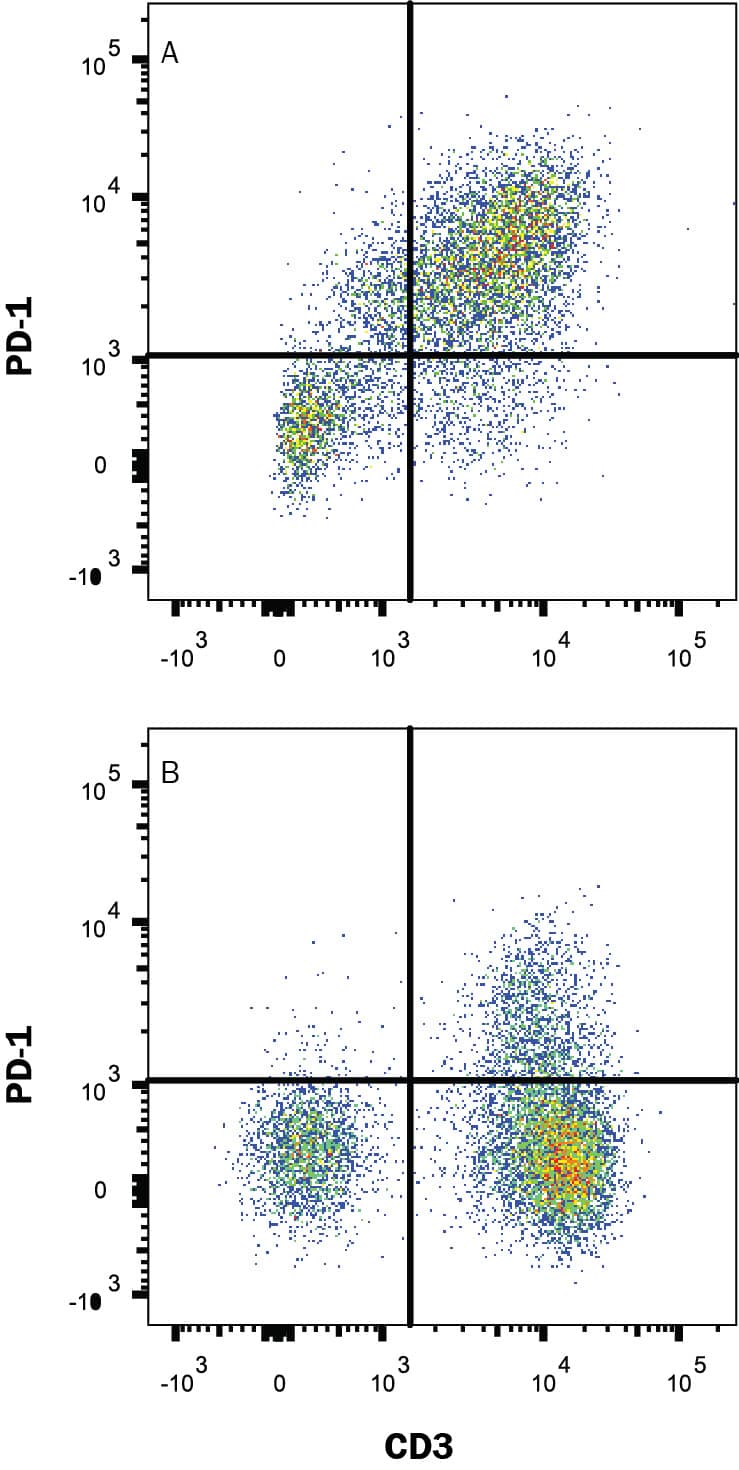
Detection of PD‑1 in Human PBMCs by Flow Cytometry.
Human peripheral blood mononuclear cells (PBMCs) either (A) treated with 5 ug/mL PHA for 5 days or (B) untreated, were stained with Rabbit Anti-Human PD-1 Monoclonal Antibody (Catalog # MAB10863) followed by Allophycocyanin-conjugated Anti-Rabbit IgG Secondary Antibody (Catalog # F0111) and Mouse Anti-Human CD3 epsilon PE-conjugated Monoclonal Antibody (Catalog # FAB100P). Quadrant markers were set based on control antibody staining (Catalog # MAB1050). View our protocol for Staining Membrane-associated Proteins.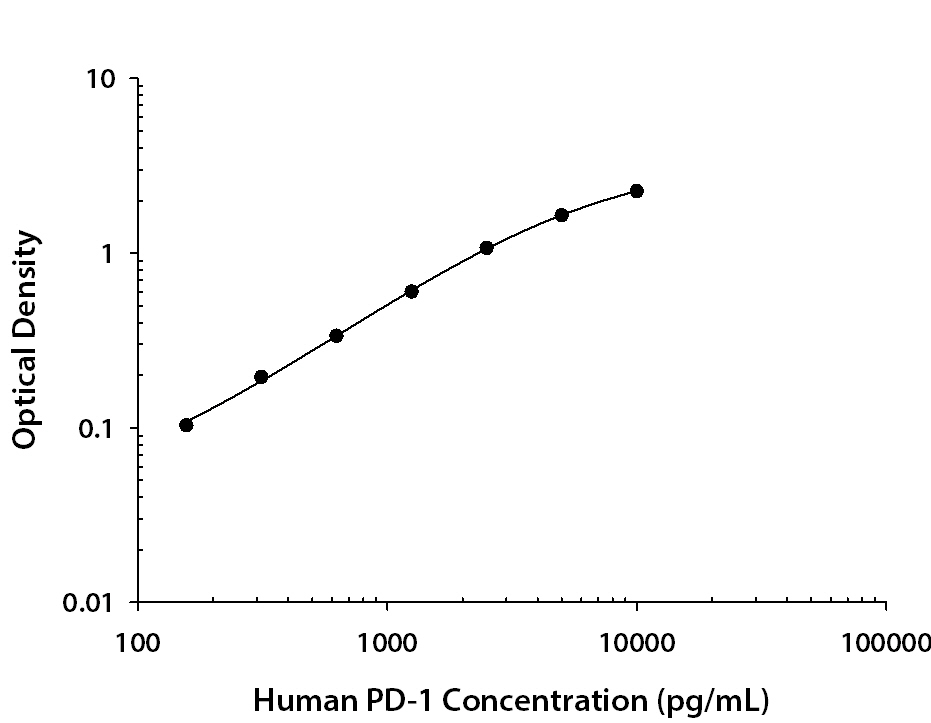
Human PD‑1 ELISA Standard Curve.
Recombinant Human PD-1 protein was serially diluted 2-fold and captured by Rabbit Anti-Human PD-1 Monoclonal Antibody (Catalog # MAB10863) coated on a Clear Polystyrene Microplate (Catalog # DY990). Mouse Anti-Human PD-1 Monoclonal Antibody(Catalog # MAB10864) was biotinylated and incubated with the protein captured on the plate. Detection of the standard curve was achieved by incubating Streptavidin-HRP (Catalog # DY998) followed by Substrate Solution (Catalog # DY999) and stopping the enzymatic reaction with Stop Solution (Catalog # DY994).Applications for Human PD-1 Antibody
Application
Recommended Usage
CyTOF-ready
Ready to be labeled using established conjugation methods. No BSA or other carrier proteins that could interfere with conjugation.
ELISA
This antibody functions as an ELISA capture antibody when paired with Mouse Anti-Human PD‑1 Monoclonal Antibody(Catalog # MAB10864).
This product is intended for assay development on various assay platforms requiring antibody pairs. We recommend the Human PD-1 DuoSet ELISA Kit (Catalog # DY1086) for convenient development of a sandwich ELISA.
Flow Cytometry
0.25 µg/106 cells
Sample: Human PBMC treated with PHA
Sample: Human PBMC treated with PHA
Western Blot
0.5 µg/mL
Sample: HEK293T human embryonic kidney cell line transfected with human PD-1
Sample: HEK293T human embryonic kidney cell line transfected with human PD-1
Reviewed Applications
Read 1 review rated 4 using MAB10863 in the following applications:
Formulation, Preparation, and Storage
Purification
Protein A or G purified from cell culture supernatant
Reconstitution
Reconstitute at 0.5 mg/mL in sterile PBS. For liquid material, refer to CoA for concentration.
Formulation
Lyophilized from a 0.2 μm filtered solution in PBS with Trehalose. *Small pack size (SP) is supplied either lyophilized or as a 0.2 µm filtered solution in PBS.
Shipping
Lyophilized product is shipped at ambient temperature. Liquid small pack size (-SP) is shipped with polar packs. Upon receipt, store immediately at the temperature recommended below.
Stability & Storage
Use a manual defrost freezer and avoid repeated freeze-thaw cycles.
- 12 months from date of receipt, -20 to -70 °C as supplied.
- 1 month, 2 to 8 °C under sterile conditions after reconstitution.
- 6 months, -20 to -70 °C under sterile conditions after reconstitution.
Background: PD-1
References
- Ishida, Y. et al. (1992) EMBO J. 11:3887.
- Sharpe, A.H. and G. J. Freeman (2002) Nat. Rev. Immunol. 2:116.
- Coyle, A. and J. Gutierrez-Ramos (2001) Nat. Immunol. 2:203.
- Nishimura, H. and T. Honjo (2001) Trends Immunol. 22:265.
- Watanabe, N et al. (2003) Nat. Immunol. 4:670.
- Zhang, X. et al. (2004) Immunity 20:337.
- Lázár-Molnár, E. et al. (2008) Proc. Natl. Acad. Sci. USA 105:10483.
- Nishimura, H et al. (1996) Int. Immunol. 8:773.
- Keir, M.E. et al. (2008) Annu. Rev. Immunol. 26:677.
- Butte, M.J. et al. (2007) Immunity 27:111.
- Okazaki, T. et al. (2013) Nat. Immunol. 14:1212.
- Iwai, Y. et al. (2002) Proc. Natl. Acad. Sci. USA 99: 12293.
- Nogrady, B. (2014) Nature 513:S10.
- Swaika, A. et al. (2015) Mol. Immunol. 67: 4
Long Name
Programmed Death-1
Alternate Names
CD279, PD1, PDCD1, SLEB2
Entrez Gene IDs
Gene Symbol
PDCD1
UniProt
Additional PD-1 Products
Product Documents for Human PD-1 Antibody
Product Specific Notices for Human PD-1 Antibody
For research use only
Loading...
Loading...
Loading...
Loading...
Loading...
Loading...