
Canine/Equine CD44 Antibody
R&D Systems, part of Bio-Techne | Catalog # MAB5449

Scientific images may be resized, cropped, or adjusted for brightness or contrast for presentation purposes. These updates are limited to presentation and do not affect the underlying scientific interpretation of the data. Where available, additional source data may be provided upon request.
Key Product Details
Species Reactivity
Validated:
Canine, Equine
Cited:
Canine, Equine
Applications
Validated:
Flow Cytometry, CyTOF-ready
Cited:
Flow Cytometry
Label
Unconjugated
Antibody Source
Monoclonal Mouse IgG1 Clone # 69-S5
Product Specifications
Immunogen
Canine marrow cells
Accession # Q28284
Accession # Q28284
Specificity
Detects canine and equine CD44 in Flow Cytometry.
Clonality
Monoclonal
Host
Mouse
Isotype
IgG1
Scientific Data Images for Canine/Equine CD44 Antibody
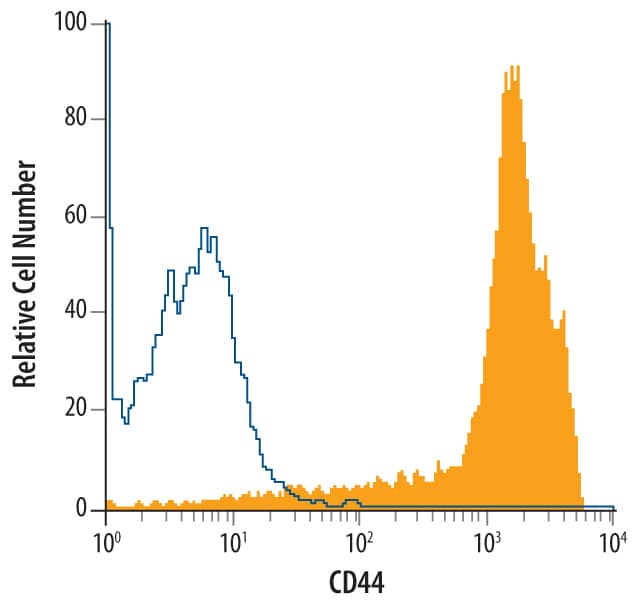
Detection of CD44 in Canine Monocytes by Flow Cytometry.
Canine blood-derived monocytes were stained with Mouse Anti-Canine/Equine CD44 Monoclonal Antibody (Catalog # MAB5449, filled histogram) or isotype control antibody (Catalog # MAB002, open histogram), followed by Allophycocyanin-conjugated Anti-Mouse IgG F(ab')2Secondary Antibody (Catalog # F0101B).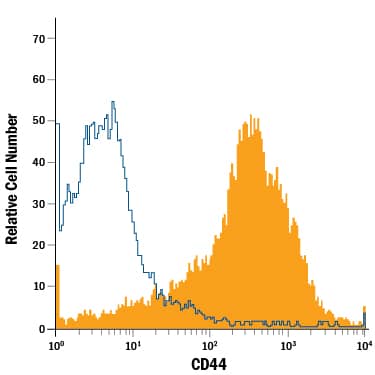
Detection of CD44 in Equine PBMCs by Flow Cytometry.
Equine peripheral blood mononuclear cells (PBMCs) were stained with Mouse Anti-Canine/Equine CD44 Monoclonal Antibody (Catalog # MAB5449, filled histogram) or isotype control antibody (Catalog # MAB002, open histogram), followed by Phycoerythrin-conjugated Anti-Mouse IgG Secondary Antibody (Catalog # F0102B).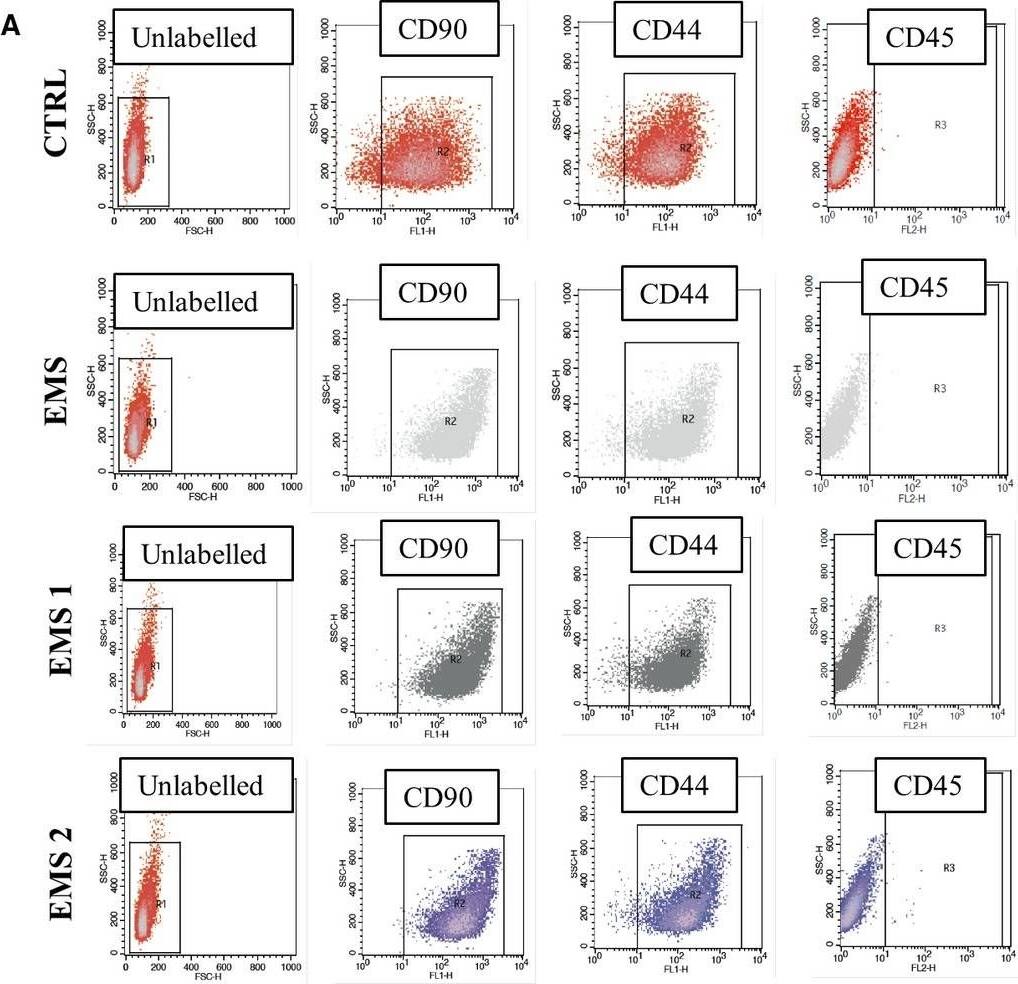
Detection of Equine CD44 by Flow Cytometry
Immunophenotyping and multipotency assay. Representative dot plots from flow cytometry analysis (A). Expression of surface antigens were investigated in cells cultured in control and AZA/RES supplemented medium. Isolated cells were characterized by the expression of CD90 and CD44 while lacked the expression of CD45 hematopoietic marker (B). Multipotency of isolated cells was confirmed by three lineage differentiation (C). In order to confirm formation of proteoglycans during chondrogenesis cells were stained with Safranin O. Intracellular lipid droplets were visualized by Oil Red O while mineralized matrix formed during osteogenesis with Alizarin Red. Magnification ×100, scale bars: 250 μm. Results expressed as mean ± SD. Statistical significance indicated as asterisk (*) when comparing the result to ASCCTRL, and as hashtag (#) when comparing to ASCEMS. ###P < 0.001 Image collected and cropped by CiteAb from the following open publication (https://pubmed.ncbi.nlm.nih.gov/30370650), licensed under a CC-BY license. Not internally tested by R&D Systems.Applications for Canine/Equine CD44 Antibody
Application
Recommended Usage
CyTOF-ready
Ready to be labeled using established conjugation methods. No BSA or other carrier proteins that could interfere with conjugation.
Flow Cytometry
2.5 µg/106 cells
Sample: Canine blood‑derived monocytes and equine peripheral blood mononuclear cells (PBMCs)
Sample: Canine blood‑derived monocytes and equine peripheral blood mononuclear cells (PBMCs)
Formulation, Preparation, and Storage
Purification
Protein A or G purified from hybridoma culture supernatant
Reconstitution
Reconstitute at 0.5 mg/mL in sterile PBS. For liquid material, refer to CoA for concentration.
Formulation
Lyophilized from a 0.2 μm filtered solution in PBS with Trehalose. *Small pack size (SP) is supplied either lyophilized or as a 0.2 µm filtered solution in PBS.
Shipping
Lyophilized product is shipped at ambient temperature. Liquid small pack size (-SP) is shipped with polar packs. Upon receipt, store immediately at the temperature recommended below.
Stability & Storage
Use a manual defrost freezer and avoid repeated freeze-thaw cycles.
- 12 months from date of receipt, -20 to -70 °C as supplied.
- 1 month, 2 to 8 °C under sterile conditions after reconstitution.
- 6 months, -20 to -70 °C under sterile conditions after reconstitution.
Background: CD44
Canine CD44 is a ubiquitously expressed 85‑90 kDa transmembrane glycoprotein that binds to hyaluronan and is involved in matrix adhesion, lymphocyte activation, and lymph node homing. The CD44 protein is expressed as a family of molecular isoforms generated by alternate splicing and variable posttranslational modification. Within the N‑terminal invariant portion of the ECD (aa 14‑191), canine CD44 shares 90%, 83%, and 82% identity with human, mouse, and rat CD44, respectively.
Alternate Names
CD44, ECMR-III, HCAM, HCELL, LHR, MDU2, MDU3, MIC4, MUTCH-I, Pgp1
Gene Symbol
CD44
UniProt
Additional CD44 Products
Product Documents for Canine/Equine CD44 Antibody
Product Specific Notices for Canine/Equine CD44 Antibody
For research use only
Loading...
Loading...
Loading...
Loading...
Loading...
Loading...