Smad3: Small Molecules and Peptides
Smads are a family of intracellular proteins that mediate signaling by members of the TGF-beta superfamily. Smads are divided into three distinct subgroups based on their different roles in TGF-beta family signal transduction: R-Smads (receptor-regulated), Co-Smads (common partner), and I-Smads (inhibitory). In general, activation of TGF-beta superfamily serine/threonine kinase receptors leads to the phosphorylation of R-Smads (Smads1, 2, 3, 5, and 8). This is followed by recruitment of the Co-Smad (Smad-4) into an R-Smad/Co-Smad complex that translocates to the nucleus to regulate gene expression. I-Smads (Smad6 and Smad7) antagonize this signaling pathway by preventing R-Smads from interacting with the receptor, or by competing with Co-Smads for the generation of R-Smad/Co-Smad complexes.
1 result for "Smad3 Small Molecules and Peptides" in Products
Smad3: Small Molecules and Peptides
Smads are a family of intracellular proteins that mediate signaling by members of the TGF-beta superfamily. Smads are divided into three distinct subgroups based on their different roles in TGF-beta family signal transduction: R-Smads (receptor-regulated), Co-Smads (common partner), and I-Smads (inhibitory). In general, activation of TGF-beta superfamily serine/threonine kinase receptors leads to the phosphorylation of R-Smads (Smads1, 2, 3, 5, and 8). This is followed by recruitment of the Co-Smad (Smad-4) into an R-Smad/Co-Smad complex that translocates to the nucleus to regulate gene expression. I-Smads (Smad6 and Smad7) antagonize this signaling pathway by preventing R-Smads from interacting with the receptor, or by competing with Co-Smads for the generation of R-Smad/Co-Smad complexes.
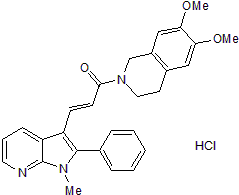
Selective Smad3 inhibitor; inhibits TGF-βR1 signaling
| Chemical Name: | 1,2,3,4-Tetrahydro-6,7-dimethoxy-2-[(2E)-3-(1-phenyl-1H-pyrrolo[2,3-b]pyridin-3-yl)-1-oxo-2-propenyl]-isoquinoline hydrochloride |
| Purity: | ≥97% (HPLC) |