
Recombinant Human IL-3 Heat Stable Protein, CF New
R&D Systems, part of Bio-Techne | Catalog # BT-003HS

Key Product Details
Source
E. coli
Conjugate
Unconjugated
Applications
Bioactivity
Product Specifications
Source
E. coli-derived human IL-3 protein
Proprietary, engineered based on P08700
Proprietary, engineered based on P08700
Purity
>95%, by SDS-PAGE visualized with Silver Staining and quantitative densitometry by Coomassie® Blue Staining.
Endotoxin Level
<0.10 EU per 1 μg of the protein by the LAL method.
SDS-PAGE
12-15 kDa, under reducing conditions.
Activity
Measured in a cell proliferation assay using TF-1 human erythroleukemic cells. Kitamura, T. et al. (1989) J. Cell Physiol. 140:323.
The ED50 for this effect is 0.015-0.150 ng/mL.
The ED50 for this effect is 0.015-0.150 ng/mL.
Scientific Data Images for Recombinant Human IL-3 Heat Stable Protein, CF
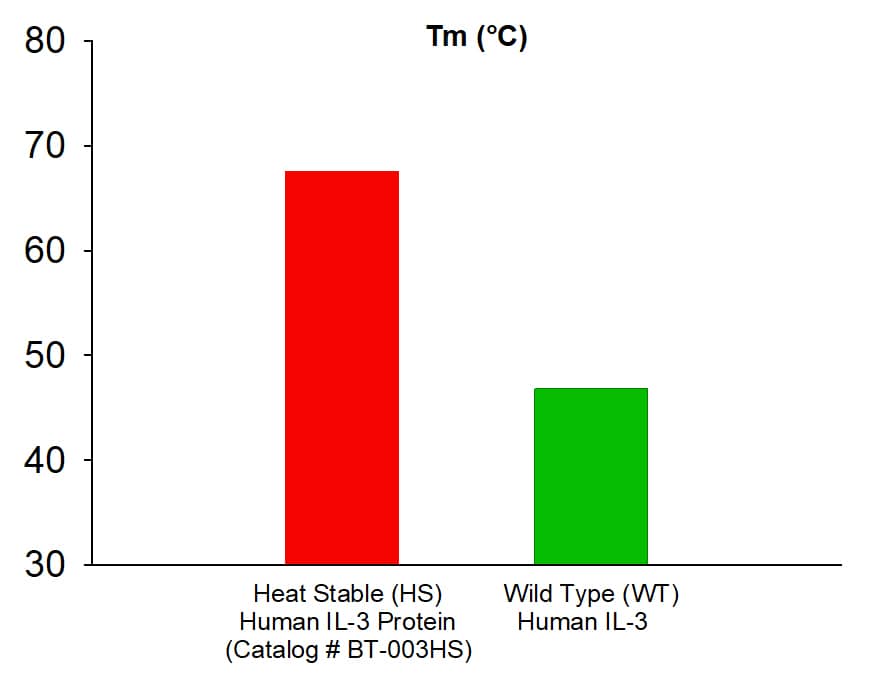
Melting Temperature Comparison of Heat Stable (HS) and Wild-Type (WT) Recombinant Human IL-3.
Recombinant Human IL-3 Heat Stable Protein (Catalog # BT-003HS) exhibits a higher melting temperature (Tm) than wild-type human IL-3. Thermal stability was assessed by Differential Scanning Fluorimetry (DSF).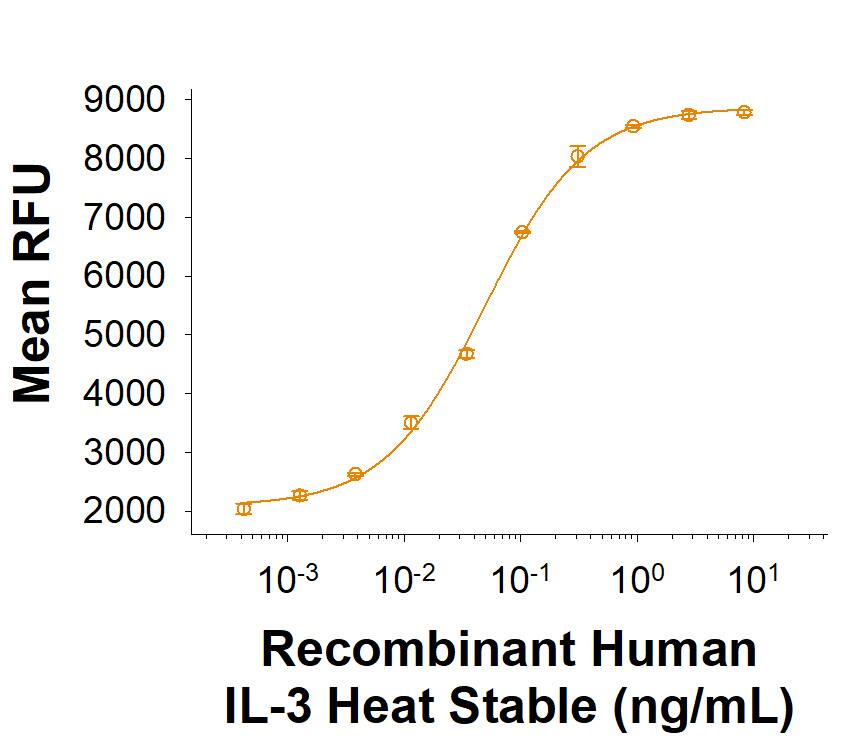
Recombinant Human IL-3 HeatStable Protein Bioactivity.
Recombinant Human IL-3 HeatStable Protein (Catalog # BT-003HS) stimulates theproliferation of TF-1 humanerythroleukemic cells.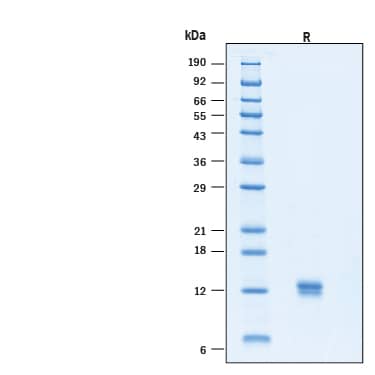
Recombinant Human IL‑3 Heat Stable Protein SDS-PAGE.
2 μg/lane of Recombinant Human IL‑3 Heat Stable Protein (Catalog # BT-003HS) was resolved with SDS-PAGE under reducing (R) condition and visualized by Coomassie® Blue staining, showing bands at 12-15 kDa.Formulation, Preparation and Storage
BT-003HS
| Formulation | Lyophilized from a 0.2 μm filtered solution in PBS with Trehalose. |
| Reconstitution | Reconstitute at 250 μg/mL in water. |
| Shipping | The product is shipped at ambient temperature. Upon receipt, store it immediately at the temperature recommended below. |
| Stability & Storage | Use a manual defrost freezer and avoid repeated freeze-thaw cycles.
|
Background: IL-3
Interleukin 3 is a pleiotropic factor produced primarily by activated T cells that can stimulate the proliferation and differentiation of pluripotent hematopoietic stem cells as well as various lineage committed progenitors. In addition, IL-3 also affects the functional activity of mature mast cells, basophils, eosinophils and macrophages. Because of its multiple functions and targets, it was originally studied under different names, including mast cell growth factor, P-cell stimulating factor, burst promoting activity, multi-colony stimulating factor, thy-1 inducing factor and WEHI-3 growth factor. In addition to activated T cells, other cell types such as human thymic epithelial cells, activated murine mast cells, murine keratinocytes and neurons/astrocytes can also produce IL-3. At the amino acid sequence level, mature human and murine IL-3 share only 29% sequence identity. Consistent with this lack of homology, IL-3 activity is highly species-specific and human IL-3 does not show activity on murine cells. IL-3 exerts its biological activities through binding to specific cell surface receptors. The high affinity receptor responsible for IL-3 signaling is composed of at least two subunits, an IL-3 specific alpha chain which binds IL-3 with low affinity and a common beta chain that is shared by the IL-5 and GM-CSF high-affinity receptors. Although the beta chain itself does not bind IL-3, it confers high-affinity IL-3 binding in the presence of the alpha chain. Receptors for IL-3 are present on bone marrow progenitors, macrophages, mast cells, eosinophils, megakaryocytes, basophils and various myeloid leukemic cells. Our Heat Stable IL-3 incorporates precise point mutations that increase structural stability without compromising biological activity.
Long Name
Interleukin 3
Alternate Names
IL3, MCGF, MULTI-CSF
Gene Symbol
IL3
Additional IL-3 Products
Product Documents for Recombinant Human IL-3 Heat Stable Protein, CF
Product Specific Notices for Recombinant Human IL-3 Heat Stable Protein, CF
For research use only
Loading...
Loading...
Loading...
Loading...