
Recombinant B. Thetaiotaomicron Arylsulfatase Protein, CF
R&D Systems, part of Bio-Techne | Catalog # 11383-SU
His-tag

Key Product Details
- R&D Systems E. coli-derived Recombinant B. Thetaiotaomicron Arylsulfatase Protein (11383-SU)
- Quality control testing to verify active proteins with lot specific assays by in-house scientists
- All R&D Systems proteins are covered with a 100% guarantee
Product Specifications
Source
E. coli-derived b. thetaiotaomicron Bacteroides Thetaiotaomicron Arylsulfatase protein
Met1-Lys509 (S77C) with a C-terminal 6-His tag
Met1-Lys509 (S77C) with a C-terminal 6-His tag
Purity
>95%, by SDS-PAGE visualized with Silver Staining and quantitative densitometry by Coomassie® Blue Staining.
Endotoxin Level
<0.10 EU per 1 μg of the protein by the LAL method.
N-terminal Sequence Analysis
Met1 & Leu8
Predicted Molecular Mass
58 kDa & 59 kDa
SDS-PAGE
54-60 kDa, under reducing conditions
Activity
Measured by its ability to cleave 3'-sulfate from Galactose.
Recombinant Bt.1636 arylsulfatase will cleave >50% Cy5-Fuc labeled sulfo-G2 (Catalog # GL305), as measured under the described conditions.
Scientific Data Images for Recombinant B. Thetaiotaomicron Arylsulfatase Protein, CF

Recombinant Bacteroides Thetaiotaomicron Arylsulfatase His-tag Protein Enzyme Activity Diagram.
Recombinant B. Thetaiotaomicron Arylsulfatase Protein, CF (Catalog # 11383-SU) has specificity for 3S-Galactose. It has been shown to remove 3’-sulfate (3S) from various glycan structures including LacNAc, LNB, Lewis-X and Lewis-A.
Recombinant Bacteroides Thetaiotaomicron Arylsulfatase His-tag Protein SDS-PAGE.
2 μg/lane of Recombinant Bacteroides Thetaiotaomicron Arylsulfatase His-tag Protein (Catalog # 11383-SU) was resolved with SDS-PAGE under reducing (R) and non-reducing (NR) conditions and visualized by Coomassie® Blue staining, showing bands at 54-60 kDa under reducing condition.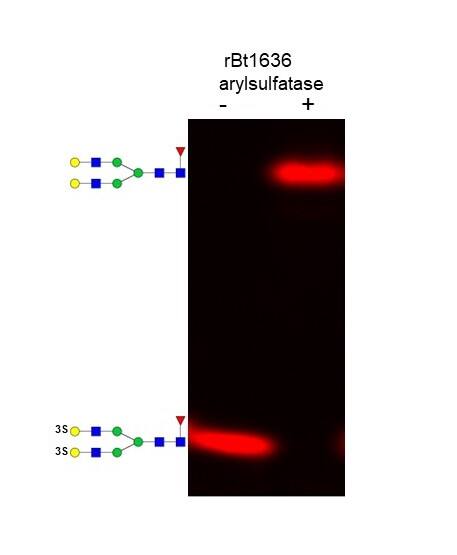
Recombinant Bacteroides Thetaiotaomicron Arylsulfatase His-tag Protein Enzyme Activity.
Lane 1 contained fluorescent substrate glycan Cy5-Fuc labeled sulfo-G2. Following treatment with Recombinant B. Thetaiotaomicron Arylsulfatase Protein, CF (Catalog # 11383-SU) 3’-sulfate (3S) from galactose was removed and a mobility shift was observed. SDS-PAGE gel was imaged using the red fluorescent channel.Formulation, Preparation and Storage
11383-SU
| Formulation | Supplied as a 0.2 μm filtered solution in Tris and NaCl. |
| Shipping | The product is shipped with polar packs. Upon receipt, store it immediately at the temperature recommended below. |
| Stability & Storage | Use a manual defrost freezer and avoid repeated freeze-thaw cycles.
|
Background: Bacteroides Thetaiotaomicron Arylsulfatase
References
- Luis, A.S. et al. (2021) Nature. 598:332.
- Cartmell, A. et al. (2017) Proc. Natl. Acad. Sci. U.S.A. 27:7037.
- Ulmer, J.E. et al. (2014) J. Biol. Chem. 289:24289.
- Martens, E.C. et al. (2008) Cell Host Microbe 4:447.
- Benjdia, A. et al. (2011) J. Biol. Chem. 286:25973.
- Wu, Z.L. et al. (2020) Glycobiology 30:970.
Long Name
Bacteroides Thetaiotaomicron Arylsulfatase
Alternate Names
BT1636
Entrez Gene IDs
60927621 (Bacterial)
Gene Symbol
BT_1636
UniProt
Additional Bacteroides Thetaiotaomicron Arylsulfatase Products
Product Documents for Recombinant B. Thetaiotaomicron Arylsulfatase Protein, CF
Product Specific Notices for Recombinant B. Thetaiotaomicron Arylsulfatase Protein, CF
For research use only
Loading...
Loading...
Loading...
Loading...