
CellXVivo Human Monocyte-derived DC Differentiation Kit Best Seller
R&D Systems, part of Bio-Techne | Catalog # CDK004
For the differentiation of CD14+ monocytes into dendritic cells.

Key Product Details
Species
Human
Product Summary for CellXVivo Human Monocyte-derived DC Differentiation Kit
Kit Summary
For the differentiation of CD14+ monocytes into dendritic cells.
Key Benefits
- Provides optimized reagents needed to induce immature and mature dendritic cell differentiation from CD14+ monocytes
- Utilizes validated and straightforward procedures
- Does not require specialized instrumentation
Why Generate Monocyte-derived Dendritic Cells Ex Vivo?
Dendritic cells are a heterogeneous population of functionally homologous immune cells that act as key mediators of the innate and adaptive immune responses. Under homeostatic conditions, dendritic cells are present in large numbers in areas of intense antigen exposure such as the skin, lung, and intestine and can be difficult to isolate and harvest. However, in response to an immune stimulus, CD14+ monocytes, which are present in high numbers in the periphery and circulation, can differentiate into inflammatory/monocyte-derived dendritic cells. Harvesting CD14+ monocytes from peripheral blood mononuclear cells and driving their differentiation into either immature or mature dendritic cells provides an abundant source of monocyte-derived dendritic cells for downstream studies.
Kit Contents
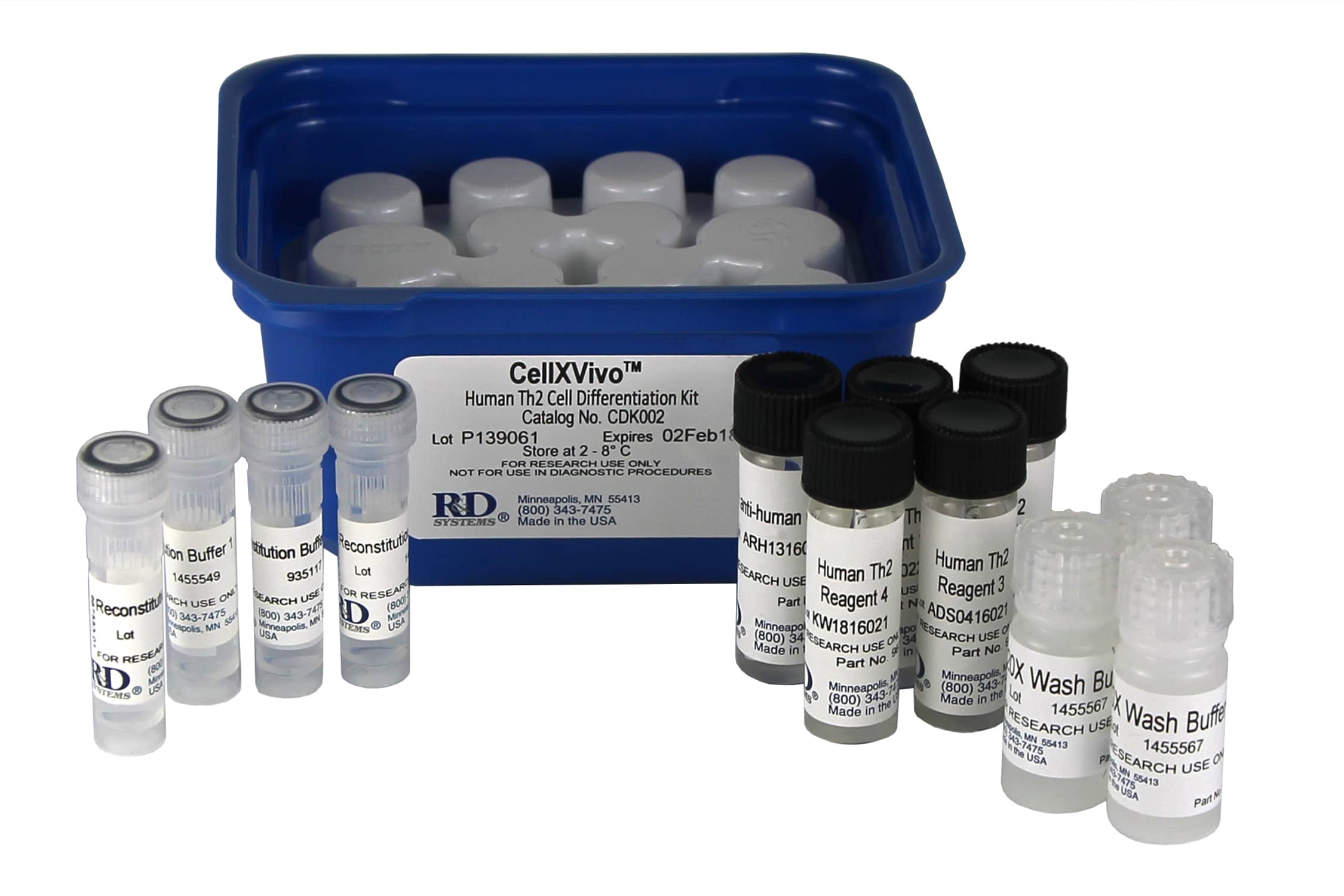
This kit contains the following optimized reagents for the differentiation of monocyte-derived dendritic cells.
- Serum-Free Dendritic Cell Base Media
- Recombinant Human IL-4
- Recombinant Human GM-CSF
- Recombinant Human TNF-alpha
- Reconstitution Buffer 2
Stability and Storage
Store the unopened kit at < -20 °C. Do not use past the kit expiration date. Opened or reconstituted Serum-Free Dendritic Cell Base Media, Recombinant Human IL-4, Recombinant Human GM-CSF, or Recombinant Human TNF-alpha should be stored at 2-8 °C under sterile conditions for up to 30 days or at -20 °C to -70 °C in a manual defrost freezer for up to 3 months.* Opened Reconstitution Buffer 2 should be stored at 2-8 °C under sterile conditions for up to 3 months.*
*Provided this is within the expiration date of the kit.
Scientific Data Images for CellXVivo Human Monocyte-derived DC Differentiation Kit
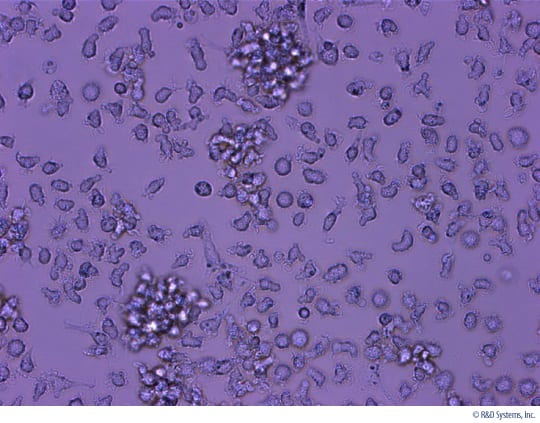
Morphology of Immature Human Dendritic Cells Cultured in Differentiation Media for 7 days.
Human CD14+monocytes were differentiated into immature human dendritic cells by culturing for 7 days using reagents included in this kit. Immature dendritic cells exhibit characteristic dendritic cell morphology.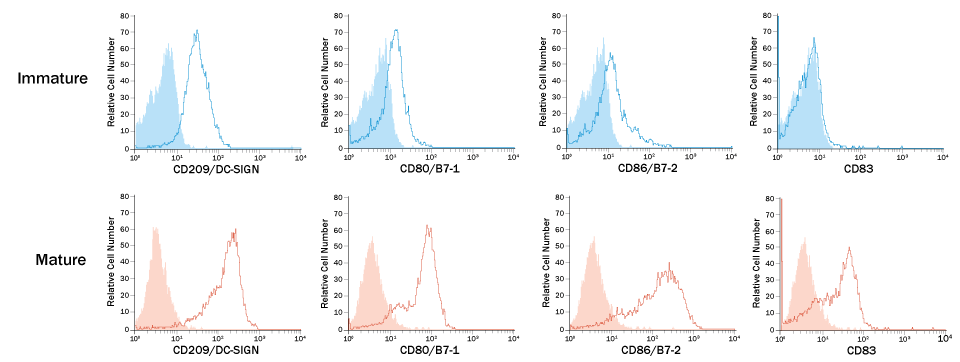
Phenotypic Analysis of Cultured Immature and Mature Monocyte-derived Dendritic Cells.
Following culture in complete monocyte-derived differentiation media provided in this kit, day 7 immature dendritic cells (top) and day 10 TNF-alpha treated mature dendritic cells (bottom) were stained with the indicated antibodies for DC-SIGN/CD209 (Catalog # MAB161), B7-1/CD80 (Catalog # MAB140), B7-2/CD86 (Catalog # MAB141), CD83 (Catalog # MAB1774; open histograms), or an appropriate isotype control antibody (filled histograms). Stained cells were analyzed using a Becton Dickinson FACSCalibur™.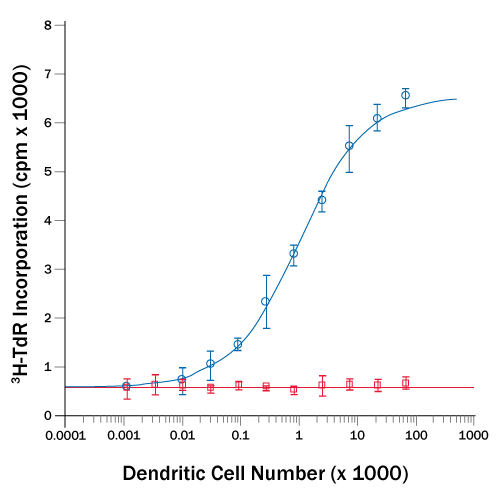
Mature Dendritic Cells Induce Proliferation of Allogeneic T-cells.
Serial dilutions of day 10 TNF-alpha treated mature dendritic cells were incubated with allogeneic (blue) or autologous (red) human T cells for 3 days.3H-Thymidine (3H-TdR) was added to the culture for the final 18 hours. Cells were harvested and the incorporation of3H-TdR was measured using a scintillation counter. Results are presented as the mean cpm of triplicates.Formulation, Preparation, and Storage
Shipping
The product is shipped with dry ice or equivalent. Upon receipt, store it immediately at the temperature recommended below.
Storage
Store the unopened product at -20 to -70 °C. Use a manual defrost freezer and avoid repeated freeze-thaw cycles. Do not use past expiration date.
Background: Dendritic Cell Differentiation Kits
Dendritic cells are a heterogeneous population of functionally homologous immune cells that act as key mediators of the innate and adaptive immune responses. Under homeostatic conditions, dendritic cells are present in large numbers in areas of intense antigen exposure such as the skin, lung, and intestine and can be difficult to isolate and harvest. However, in response to an immune stimulus, CD14+ monocytes, which are present in high numbers in the periphery and circulation, can differentiate into inflammatory/monocyte-derived dendritic cells. Harvesting CD14+ monocytes from peripheral blood mononuclear cells and driving their differentiation into either immature or mature dendritic cells provides an abundant source of monocyte-derived dendritic cells for downstream studies.
Additional Dendritic Cell Differentiation Kits Products
Product Documents for CellXVivo Human Monocyte-derived DC Differentiation Kit
Product Specific Notices for CellXVivo Human Monocyte-derived DC Differentiation Kit
For research use only
Loading...
Loading...
Loading...
Loading...
Loading...