
Mouse SR-AI/MSR Antibody
R&D Systems, part of Bio-Techne | Catalog # AF1797


Scientific images may be resized, cropped, or adjusted for brightness or contrast for presentation purposes. These updates are limited to presentation and do not affect the underlying scientific interpretation of the data. Where available, additional source data may be provided upon request.
Conjugate
Catalog #
Key Product Details
Species Reactivity
Validated:
Mouse
Cited:
Human, Mouse
Applications
Validated:
Western Blot, Blockade of Receptor-ligand Interaction
Cited:
Immunohistochemistry, Western Blot, Neutralization, Flow Cytometry, Immunocytochemistry, In vivo assay
Label
Unconjugated
Antibody Source
Polyclonal Goat IgG
Product Specifications
Immunogen
Mouse myeloma cell line NS0-derived recombinant mouse SR-AI/MSR
Trp79-Ser454
Accession # AAA39747
Trp79-Ser454
Accession # AAA39747
Specificity
Detects mouse SR-A1/MSR in direct ELISAs and Western blots.
Clonality
Polyclonal
Host
Goat
Isotype
IgG
Endotoxin Level
<0.10 EU per 1 μg of the antibody by the LAL method.
Scientific Data Images for Mouse SR-AI/MSR Antibody
Detection of Mouse SR-AI/MSR by Western Blot
CKIP-1 diminishes Oct-1-mediated LOX-1 expression. e Expression of LOX-1, CD36, and SR-A in Ckip-1−/− and Ckip-1−/−R BMDMs. Image collected and cropped by CiteAb from the following open publication (https://pubmed.ncbi.nlm.nih.gov/30683852), licensed under a CC-BY license. Not internally tested by R&D Systems.
Detection of Mouse SR-AI/MSR by Western Blot
CKIP-1 diminishes Oct-1-mediated LOX-1 expression. c Expression of LOX-1, CD36, and SR-A in WT and Ckip-1−/− BMDMs after 24 h incubation with or without 20 μg per ml oxLDL. Image collected and cropped by CiteAb from the following open publication (https://pubmed.ncbi.nlm.nih.gov/30683852), licensed under a CC-BY license. Not internally tested by R&D Systems.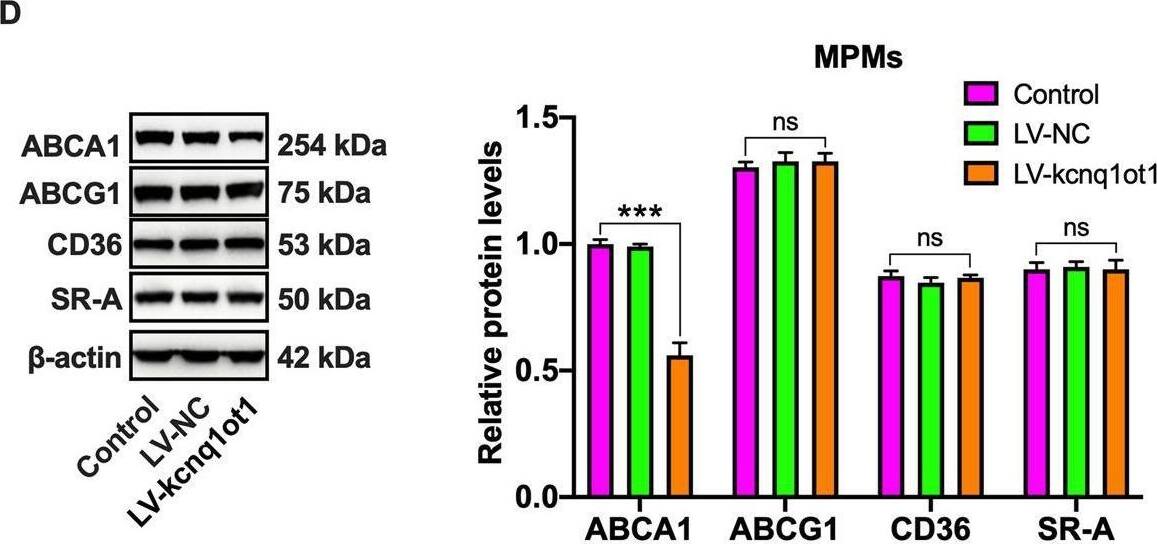
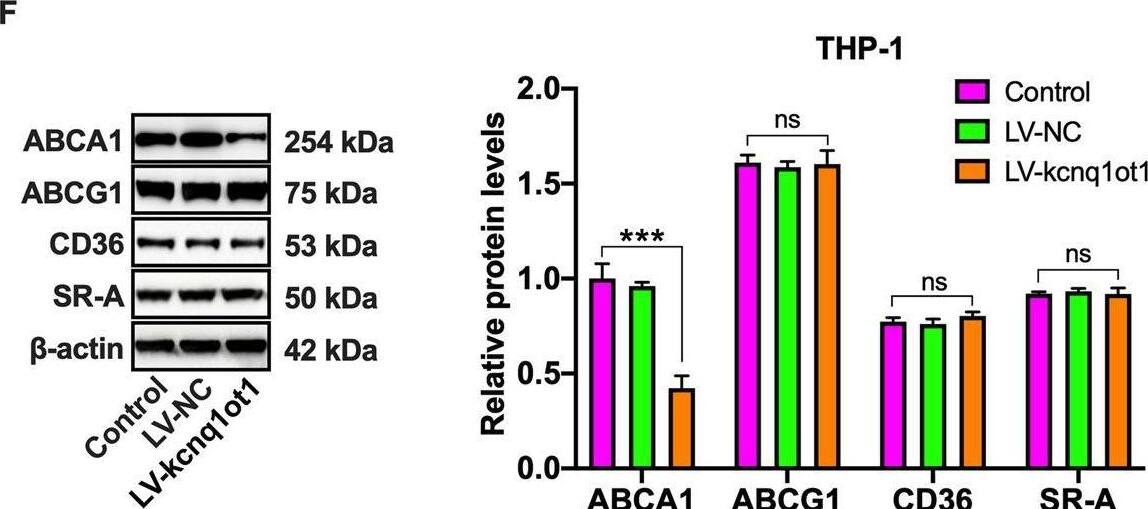
Detection of SR-AI/MSR by Western Blot
Effects of kcnq1ot1 on cholesterol transporter and receptor expression. A, B The mRNA and protein levels of ABCA1, ABCG1, CD36, and SR-A in the aorta from apoE−/− mice were assayed by qRT-PCR and western blot, respectively (n = 10). C, D qRT-PCR and western blot analyses of ABCA1, ABCG1, CD36 and SR-A expression in MPMs from apoE−/− mice (n = 5). E, F After treatment of THP-1 macrophages with PBS, LV-NC or LV-kcnq1ot1 for 72 h, both qRT-PCR and western blot were employed for detection of ABCA1, ABCG1, CD36, and SR-A expressions. Data are represented as mean ± SD. ***P < 0.001; ns not significant. Image collected and cropped by CiteAb from the following open publication (https://pubmed.ncbi.nlm.nih.gov/33293505), licensed under a CC-BY license. Not internally tested by R&D Systems.Applications for Mouse SR-AI/MSR Antibody
Application
Recommended Usage
Blockade of Receptor-ligand Interaction
In a functional ELISA, 0.5-2 µg/mL of this antibody will block 50% of the binding of 100 ng/mL of biotinylated AGE‑BSA to immobilized Recombinant Mouse SR-AI/MSR1 (Catalog # 1797-MS) coated at 5 µg/mL (100 µL/well). At 20 µg/mL, this antibody will block >90% of the binding.
Western Blot
0.1 µg/mL
Sample: Recombinant Mouse SR-AI/MSR (Catalog # 1797-MS)
Sample: Recombinant Mouse SR-AI/MSR (Catalog # 1797-MS)
Formulation, Preparation, and Storage
Purification
Antigen Affinity-purified
Reconstitution
Reconstitute at 0.2 mg/mL in sterile PBS. For liquid material, refer to CoA for concentration.
Formulation
Lyophilized from a 0.2 μm filtered solution in PBS with Trehalose. *Small pack size (SP) is supplied either lyophilized or as a 0.2 µm filtered solution in PBS.
Shipping
Lyophilized product is shipped at ambient temperature. Liquid small pack size (-SP) is shipped with polar packs. Upon receipt, store immediately at the temperature recommended below.
Stability & Storage
Use a manual defrost freezer and avoid repeated freeze-thaw cycles.
- 12 months from date of receipt, -20 to -70 °C as supplied.
- 1 month, 2 to 8 °C under sterile conditions after reconstitution.
- 6 months, -20 to -70 °C under sterile conditions after reconstitution.
Background: SR-AI/MSR
The scavenger receptor (SR) family comprises a group of functionally defined membrane receptors that share the common ability to bind and internalize modified forms of Low Density Lipoproteins (mLDL) (1 - 3). Family members are classified alphabetically. The A class include four proteins: the three subtypes of SR-A (AI, AII, and AIII) that are generated by alternative splicing of the same gene, and a structurally similar protein named MARCO (4). All A class SRs are multidomain trimeric type II membrane proteins. SR-AI has an N-terminal cytoplasmic domain, a transmembrane domain, a spacer domain, an alpha-helical coiled coil, a collagen-like domain and a C-terminal cysteine-rich domain. SR-A is expressed by most tissue macrophages, dendritic cells and Kupffer cells. It is also highly expressed by microglia in neonatal as well as Alzheimer’ Disease brains. SR-AI binds a broad range of polyanionic ligands including modified proteins (e.g. Oxidized, acetylated or maleylated LDL, Advanced glycation end-product proteins), polyribonucleotides (polyguanosine and polyinosine), polysaccharides (dextran sulfate, fucoidan), phospholipids (phosphatidylserine), bacterial products (lipopolysaccharide and lipoteichoic acid) and selected chemical compounds (silica, crocidolite asbestos). The ligand-binding region has been localized to a positively charged region in the carboxyl end of the collagen-like domain. Based on its ligand binding characteristics, SR-AI is implicated in many physiological and pathophysiological functions. Studies using SR-A knockout mouse have also suggested roles of SR-A in atherogenesis, host defense and innate immunity, acquired immune responses, macrophage adhesion, and phagocytosis of apoptotic cells (1 - 3).
References
- Daugherty, A. et al. (2000) Curr. Opin. Cardiovasc. Pulm. Ren. Invest. Drugs 2:223.
- Platt, N. and S. Gordon (2001) J. Clin. Invest. 108:649.
- Platt, N. and S. Gordon (1998) Chem. Biol. 5:R193.
- Elomaa, O. et al. (1995) Cell 80:603.
Long Name
Macrophage Scavenger Receptor Types I and II
Alternate Names
CD204, MSR1, SCARA1, SRAI
Gene Symbol
MSR1
UniProt
Additional SR-AI/MSR Products
Product Documents for Mouse SR-AI/MSR Antibody
Product Specific Notices for Mouse SR-AI/MSR Antibody
For research use only
Loading...
Loading...
Loading...
Loading...
Loading...