
Mouse Legumain/Asparaginyl Endopeptidase Antibody
R&D Systems, part of Bio-Techne | Catalog # AF2058

Conjugate
Catalog #
Key Product Details
Species Reactivity
Validated:
Mouse
Cited:
Mouse, Transgenic Mouse
Applications
Validated:
Western Blot
Cited:
Immunohistochemistry, Immunohistochemistry-Paraffin, Western Blot, Immunocytochemistry
Label
Unconjugated
Antibody Source
Polyclonal Sheep IgG
Product Specifications
Immunogen
Mouse myeloma cell line NS0-derived recombinant mouse Legumain
Val18-Tyr435
Accession # O89017
Val18-Tyr435
Accession # O89017
Specificity
Detects mouse Legumain in direct ELISAs and Western blots.
Clonality
Polyclonal
Host
Sheep
Isotype
IgG
Scientific Data Images for Mouse Legumain/Asparaginyl Endopeptidase Antibody
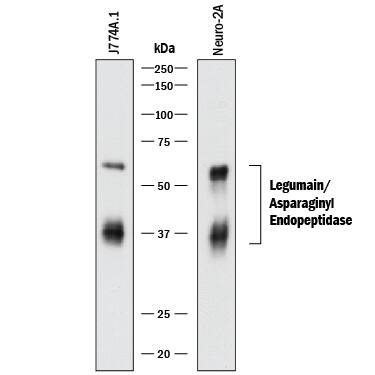
Detection of Mouse Legumain/Asparaginyl Endopeptidase by Western Blot.
Western blot shows lysates of J774A.1 mouse reticulum cell sarcoma macrophage cell line and Neuro-2A mouse neuroblastoma cell line. PVDF membrane was probed with 0.2 µg/mL of Sheep Anti-Mouse Legumain/Asparaginyl Endopeptidase Antigen Affinity-purified Polyclonal Antibody (Catalog # AF2058) followed by HRP-conjugated Anti-Sheep IgG Secondary Antibody (Catalog # HAF016). Specific bands were detected for Legumain/Asparaginyl Endopeptidase at approximately 37 and 56 kDa (as indicated). This experiment was conducted under reducing conditions and using Immunoblot Buffer Group 1.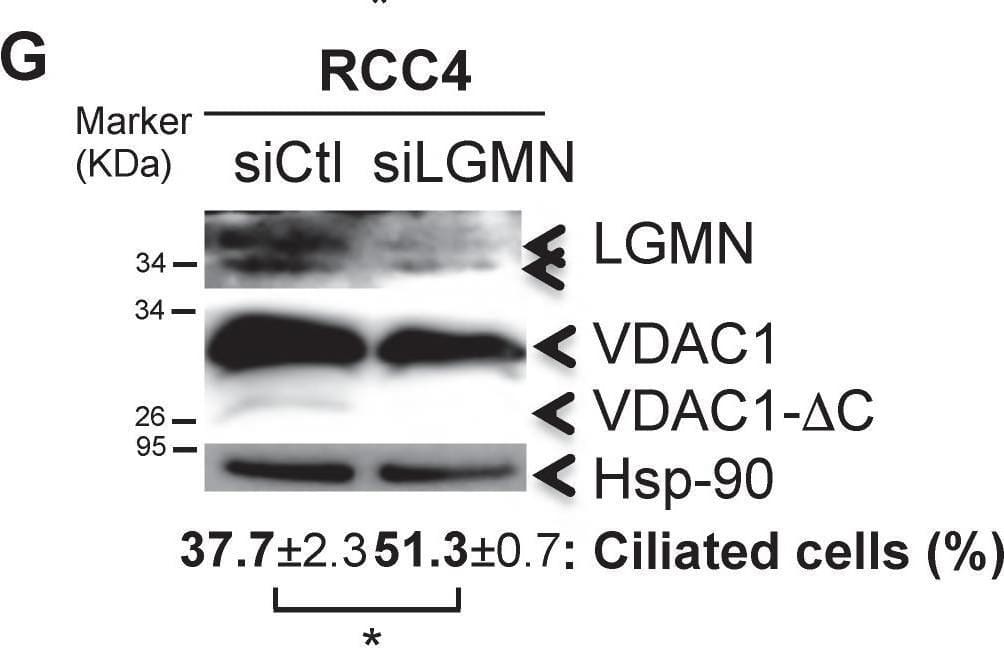
Detection of Legumain/Asparaginyl Endopeptidase by Western Blot
The presence of VDAC1-DC in ccRCC cells decreases or abolishes ciliation. A, Triple immunofluorescence labeling and merged images with acetylated alpha-tubulin (Acet. alpha-tubulin in red), Arl13b (in green) and DAPI (in blue). B, Electron microscopy of RCC4+pVHL cells. C, Quantitative analysis of the ciliation percentage was assessed by confocal fluorescence microscopy (n=100-300 cells). D, Both cell lines were seeded at the same density and incubated in Nx for 48h with or without serum. Percentage of ciliated cells, proliferation and FACS analysis were measured. The mean ± SEM is representative of three independent experiments carried out in duplicate. E, F and G, RCC4 cells were transfected with control siRNA (siCtl), (E) siHIF-1 alpha, siHIF-2 alpha and siHIF-1/2 alpha, (F) siVDAC1 and (G) siLGMN. Cell lysates were analyzed by immunoblotting for HIF-1 alpha, HIF-2 alpha, VDAC1, LGMN and beta- tubulin/Actin or HSP90 were used as a loading control. Quantitative analysis of the ciliation percentage was assessed by confocal fluorescence microscopy (n=100-300 cells). A * p<0.05 shows significant differences. Quantification of VDAC1 and VDAC1-delta C protein levels (E). Experiments have been proceeded without serum. Image collected and cropped by CiteAb from the following open publication (https://pubmed.ncbi.nlm.nih.gov/32194829), licensed under a CC-BY license. Not internally tested by R&D Systems.Applications for Mouse Legumain/Asparaginyl Endopeptidase Antibody
Application
Recommended Usage
Western Blot
0.2 µg/mL
Sample: J774A.1 mouse reticulum cell sarcoma macrophage cell line and Neuro‑2A mouse neuroblastoma cell line
Sample: J774A.1 mouse reticulum cell sarcoma macrophage cell line and Neuro‑2A mouse neuroblastoma cell line
Formulation, Preparation, and Storage
Purification
Antigen Affinity-purified
Reconstitution
Reconstitute at 0.2 mg/mL in sterile PBS. For liquid material, refer to CoA for concentration.
Formulation
Lyophilized from a 0.2 μm filtered solution in PBS with Trehalose. *Small pack size (SP) is supplied either lyophilized or as a 0.2 µm filtered solution in PBS.
Shipping
Lyophilized product is shipped at ambient temperature. Liquid small pack size (-SP) is shipped with polar packs. Upon receipt, store immediately at the temperature recommended below.
Stability & Storage
Use a manual defrost freezer and avoid repeated freeze-thaw cycles.
- 12 months from date of receipt, -20 to -70 °C as supplied.
- 1 month, 2 to 8 °C under sterile conditions after reconstitution.
- 6 months, -20 to -70 °C under sterile conditions after reconstitution.
Background: Legumain/Asparaginyl Endopeptidase
Legumain is a lysosomal cysteine protease found in all mouse tissues examined, but was particularly abundant in kidney and placenta (1). Legumain plays a pivotal role in the endosomal/lysosomal degradation system because the Legumain deficiency causes the accumulation of pro cathepsins B, H and L, another group of lysosomal cysteine proteases (2). Over-expression of Legumain in tumors is significant for invasion/metastasis (3). Also known as asparaginyl endopeptidase, it specifically cleaves peptide bonds with Asn at the P1 position. Nevertheless, it also cleaves peptide bonds with Asp at the P1 position. Auto-activation of pro Legumain involves both types of cleavage, which results in the removal of the pro peptides in both C- and N-termini (4). In addition, Legumain activates pro MMP-2 and processes bacterial antigens for MHC class II presentation and pro thymosin alpha to thymosin alpha1 and thymosin alpha11, two acidic peptides with immunoregulatory properties (5-7).
References
- Chen, J.M. et al. (1998) Biochem. J. 335:111.
- Shirahama-Noda, K. et al. (2003) J. Biol. Chem. 278:33194.
- Liu, C. et al. (2003) Cancer Res. 63: 2957.
- Li D.N. et al. (2003) J. Biol. Chem. 278:38980.
- Chen, J.M. et al. (2001) Biol. Chem. 382:777.
- Schwarz, G. et al. (2002) Biol. Chem. 383:1813.
- Sarndeses, C.S. et al. (2003) J. Biol. Chem. 278:13286.
Alternate Names
AEP, Asparaginyl Endopeptidase, LGMN
Gene Symbol
LGMN
UniProt
Additional Legumain/Asparaginyl Endopeptidase Products
Product Documents for Mouse Legumain/Asparaginyl Endopeptidase Antibody
Product Specific Notices for Mouse Legumain/Asparaginyl Endopeptidase Antibody
For research use only
Loading...
Loading...
Loading...
Loading...
Loading...