
Human Phospho-PGC1 alpha (S571) Antibody
R&D Systems, part of Bio-Techne | Catalog # AF6650

Conjugate
Catalog #
Key Product Details
Validated by
Biological Validation
Species Reactivity
Validated:
Human
Cited:
Human, Mouse
Applications
Validated:
Western Blot
Cited:
Western Blot
Label
Unconjugated
Antibody Source
Polyclonal Rabbit IgG
Product Specifications
Immunogen
Phosphopeptide containing the human PGC1 alpha S571 site.
Specificity
Detects human PGC1 alpha when phosphorylated at S571 in Western blots.
Clonality
Polyclonal
Host
Rabbit
Isotype
IgG
Scientific Data Images for Human Phospho-PGC1 alpha (S571) Antibody
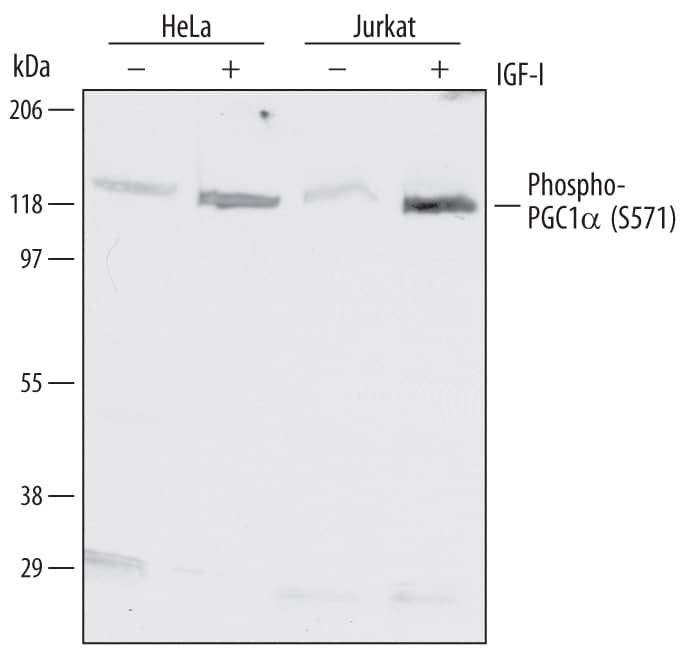
Detection of Human Phospho-PGC1 alpha (S571) by Western Blot.
Western blot shows lysates of HeLa human cervical epithelial carcinoma cell line and Jurkat human acute T cell leukemia cell line untreated (-) or treated (+) with 10 nm Recombinant Human IGF-I (Catalog # 291-G1) for 1 hour. PVDF Membrane was probed with 1 µg/mL of Rabbit Anti-Human Phospho-PGC1a (S571) Antigen Affinity-purified Polyclonal Antibody (Catalog # AF6650) followed by HRP-conjugated Anti-Rabbit IgG Secondary Antibody (Catalog # HAF008). A specific band was detected for Phospho-PGC1a (S571) at approximately 120 kDa (as indicated). This experiment was conducted under reducing conditions and using Immunoblot Buffer Group 1.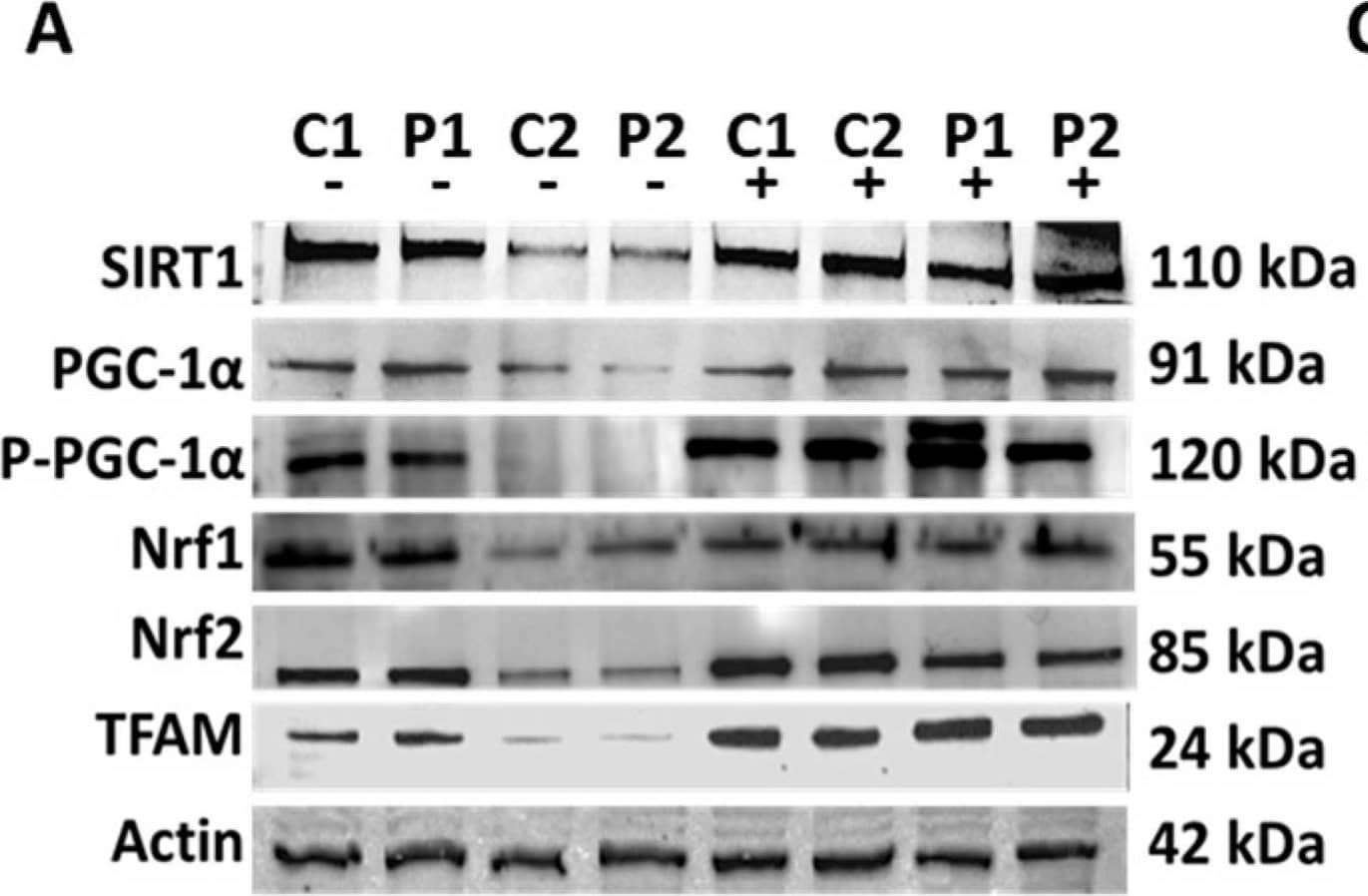
Detection of Phospho-PGC1 alpha (S571) by Western Blot
Expression levels of mitochondrial biogenesis proteins in control and mutant cells with and without treatment. Polydatin and nicotinamide at 10 µM were used for seven days. (A) Immunoblotting analysis of mitochondrial biogenesis proteins in control (C1, C2) and mutant (P1, P2) cells. Actin was used as the loading control. (B) Band densitometry of Western blot data referred to actin and normalized to the mean of controls. (C) Immunoblotting analysis of mitochondrial biogenesis proteins in control (C1, C3) and mutant (P3) fibroblasts. Actin was used as the loading control. Original images can be found in Supplementary Materials. (D) Band densitometry of Western blot data referred to actin and normalized to the mean of controls. Data represent the mean ± SEM of three independent experiments. **** p < 0.0001 between control and GFM1 fibroblasts. ####p < 0.0001 between untreated and treated GFM1 cells. a.u.: arbitrary units. Image collected and cropped by CiteAb from the following open publication (https://pubmed.ncbi.nlm.nih.gov/38786005), licensed under a CC-BY license. Not internally tested by R&D Systems.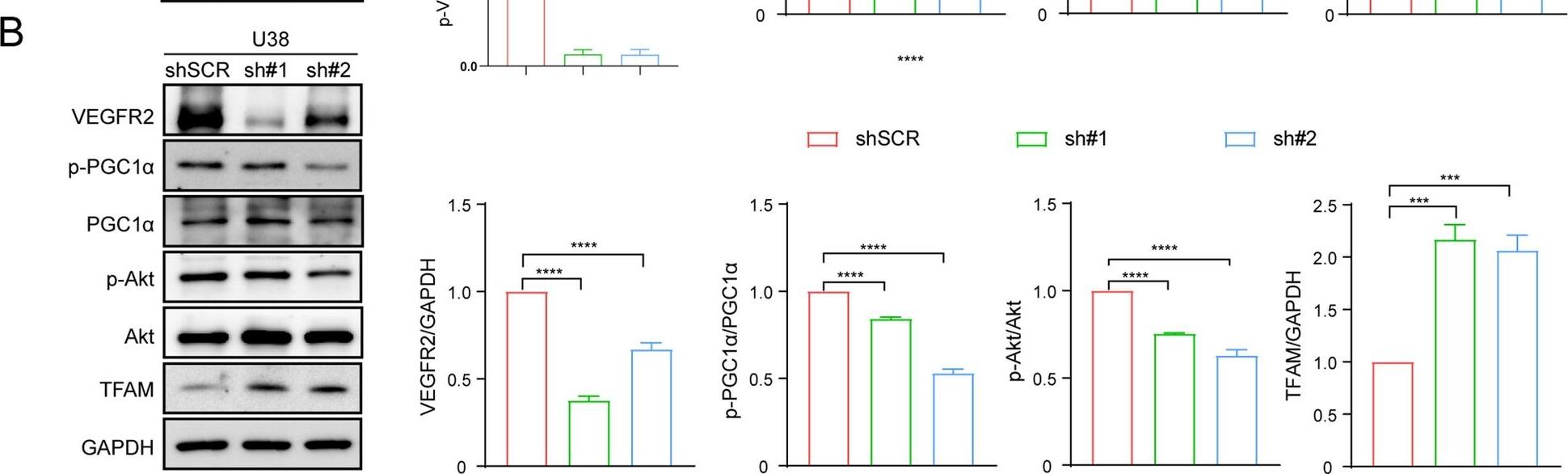
Detection of Phospho-PGC1 alpha (S571) by Western Blot
VEGFR2 inhibition by Ki8751 interferes VEGF intracellular signaling in glioblastoma cells. A Western blot images showing the protein levels of p-VEGFR2, VEGFR2, p-PGC1 alpha, PGC1 alpha, p-AKT, AKT, TFAM of U38 cell in the absence or presence of Ki8751treatment for 48 h. The bar graphs plot the relative intensities of p-Akt and p-PGC1 alpha. Mean ± SEM, ***p < 0.001, ****p < 0.0001 as compared to vehicle treatment. B Western blot images of p-PGC1 alpha, PGC1 alpha, p-AKT, AKT, and TFAM immunoreactive bands of U38 cells with VEGFR2 knockdown by shRNAs. Mean ± SEM, ****p < 0.0001 as compared to the control shSCR. C Immunofluorescence images demonstrate the cellular location of PGC1 alpha staining in U38 and U87 cells without or with Ki8751 treatment for 48 h. DAPI was used as a nuclear location marker. Bar charts depict PGC1 alpha fluorescence intensities without or with Ki8751 treatment. Mean ± SEM, *p < 0.05 as compared to vehicle, n = 3. D Western blot images showing the protein level of PGC1 alpha in the cytosol and nucleus of U87 cells after treatment with Ki8751 or shRNA knockdown. LaminB1 and GAPDH were used as input control for nuclear protein or cytoplasmic protein, respectively. Bar graphs show the relative expression of nuclear PGC1 alpha in U87 cells. Mean ± SEM, ****p < 0.0001 as compared to the control. E Schematic illustration of VEGFR2 inhibition-induced mitochondrial biogenesis signaling and apoptosis in glioblastoma cells Image collected and cropped by CiteAb from the following open publication (https://pubmed.ncbi.nlm.nih.gov/38702818), licensed under a CC-BY license. Not internally tested by R&D Systems.Applications for Human Phospho-PGC1 alpha (S571) Antibody
Application
Recommended Usage
Western Blot
1 µg/mL
Sample: HeLa human cervical epithelial carcinoma cell line and Jurkat human acute T cell leukemia cell line treated with Recombinant Human IGF‑I (Catalog # 291-G1)
Sample: HeLa human cervical epithelial carcinoma cell line and Jurkat human acute T cell leukemia cell line treated with Recombinant Human IGF‑I (Catalog # 291-G1)
Reviewed Applications
Read 2 reviews rated 4.5 using AF6650 in the following applications:
Formulation, Preparation, and Storage
Purification
Antigen Affinity-purified
Reconstitution
Sterile PBS to a final concentration of 0.2 mg/mL. For liquid material, refer to CoA for concentration.
Formulation
Lyophilized from a 0.2 μm filtered solution in PBS with Trehalose. *Small pack size (SP) is supplied either lyophilized or as a 0.2 µm filtered solution in PBS.
Shipping
Lyophilized product is shipped at ambient temperature. Liquid small pack size (-SP) is shipped with polar packs. Upon receipt, store immediately at the temperature recommended below.
Stability & Storage
Use a manual defrost freezer and avoid repeated freeze-thaw cycles.
- 12 months from date of receipt, -20 to -70 °C as supplied.
- 1 month, 2 to 8 °C under sterile conditions after reconstitution.
- 6 months, -20 to -70 °C under sterile conditions after reconstitution.
Background: PGC1 alpha
PGC-1 alpha (PPAR-gamma coactivator 1; also LEM6) is a 97-120 kDa member of the PGC-1 family of proteins. It is expressed in select cell types, including brown adipocytes, skeletal muscle and hepatocytes. PGC-1 alpha participates in both RNA processing and transcriptional coactivation in conjunction with multiple nuclear hormone receptors such as PPAR gamma, RAR and TR. Human PCG-1 alpha is 798 amino acids (aa) in length. It contains an LxxLL nuclear receptor binding motif (aa 144-148), one PPAR-gamma interaction domain (aa 293-339), two NLSs and an RNA binding/processing region (aa 566-710). PGC-1 alpha activity is regulated by phosphorylation. AMPK is known to phosphorylate Thr178 and Ser539, promoting cotranscriptional activity. Conversely, Akt-mediated phosphorylation at Ser571 is reported to downregulate PGC-1 alpha activity. This latter effect is achieved by an initial Ser571 phosphorylation, followed by GCN5 binding and subsequent PCG-1 alpha acetylation that promotes PGC-1 alpha dissociation from target gene promoters.
Long Name
Peroxisome Proliferator-activated Receptor gamma, Coactivator 1 alpha
Alternate Names
LEM6, PPARGC1A
Gene Symbol
PPARGC1A
Additional PGC1 alpha Products
Product Documents for Human Phospho-PGC1 alpha (S571) Antibody
Product Specific Notices for Human Phospho-PGC1 alpha (S571) Antibody
For research use only
Loading...
Loading...
Loading...
Loading...
Loading...