
Human Latexin Antibody
R&D Systems, part of Bio-Techne | Catalog # AF3246

Conjugate
Catalog #
Key Product Details
Species Reactivity
Human
Applications
Western Blot, Immunoprecipitation
Label
Unconjugated
Antibody Source
Polyclonal Goat IgG
Product Specifications
Immunogen
E. coli-derived recombinant human Latexin
Glu2-Glu222
Accession # AAH05346
Glu2-Glu222
Accession # AAH05346
Specificity
Detects human Latexin in direct ELISAs and Western blots.
Clonality
Polyclonal
Host
Goat
Isotype
IgG
Scientific Data Images for Human Latexin Antibody
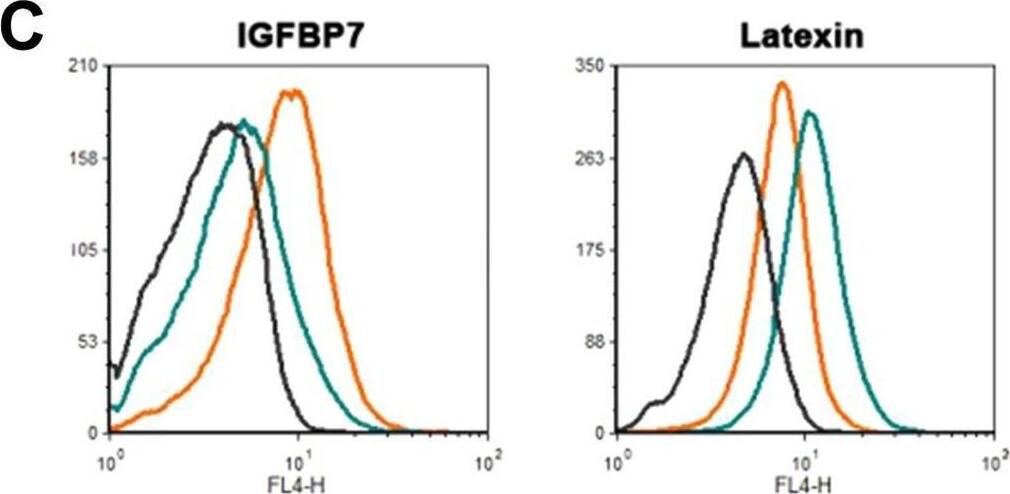
Detection of Latexin by Flow Cytometry
IGFBP7 expression is up- and Latexin expression is downregulated in the xenograft melanoma induced by CEACAM1 kd cells. (A) IGFBP7 and Latexin expression are significantly regulated on the transcriptional level as determined by qRT-PCR with template cDNA derived from RNA from MeWo tumors (human melanoma cell line) subcutaneously grown in scid mice. Please note that lower Cp values mean higher levels of expression: IGFBP7 expression is significantly higher in MeWo CEACAM1 kd than in MeWo Luc control tumors whereas latexin expression is significantly lower in the MeWo CEACAM1 kd tumors. Each experiment was performed twice with 5 replicates each time. (B) Immunohistochemical staining of paraffin embedded tumor tissue (xenograft MeWo tumors in scid mice) for IGFBP7 and latexin demonstrated respective up- and downregulation of these two proteins. Little to no IGFBP7 (in red) could be shown in the MeWo Luc tumors (upper left panel) whereas high IGFBP7 was detected in the MeWo CEACAM1 kd tumors (lower left panel). Vice versa, high latexin expression could be detected in the MeWo Luc tumors (upper right panel) and little to no latexin expression in the CEACAM1 kd tumors (lower right panel). (C) IGFBP7 and latexin expression are up- and downregulated, respectively, on the cell culture level in MeWo CEACAM1 kd cells compared with MeWo Luc cells: Flow cytometric determination of intracellular IGFBP7 and latexin in MeWo Luc (teal curves) and MeWo CEACAM1 kd cells (orange curves) with corresponding isotype controls (black curves). Image collected and cropped by CiteAb from the following open publication (https://pubmed.ncbi.nlm.nih.gov/30089785), licensed under a CC-BY license. Not internally tested by R&D Systems.Applications for Human Latexin Antibody
Application
Recommended Usage
Immunoprecipitation
25 µg/mL
Sample: Conditioned cell culture medium spiked with Recombinant Human Latexin (Catalog # 3246‑PI), see our available Western blot detection antibodies
Sample: Conditioned cell culture medium spiked with Recombinant Human Latexin (Catalog # 3246‑PI), see our available Western blot detection antibodies
Western Blot
0.1 µg/mL
Sample: Recombinant Human Latexin (Catalog # 3246‑PI)
Sample: Recombinant Human Latexin (Catalog # 3246‑PI)
Formulation, Preparation, and Storage
Purification
Antigen Affinity-purified
Reconstitution
Reconstitute at 0.2 mg/mL in sterile PBS. For liquid material, refer to CoA for concentration.
Formulation
Lyophilized from a 0.2 μm filtered solution in PBS with Trehalose. *Small pack size (SP) is supplied either lyophilized or as a 0.2 µm filtered solution in PBS.
Shipping
Lyophilized product is shipped at ambient temperature. Liquid small pack size (-SP) is shipped with polar packs. Upon receipt, store immediately at the temperature recommended below.
Stability & Storage
Use a manual defrost freezer and avoid repeated freeze-thaw cycles.
- 12 months from date of receipt, -20 to -70 °C as supplied.
- 1 month, 2 to 8 °C under sterile conditions after reconstitution.
- 6 months, -20 to -70 °C under sterile conditions after reconstitution.
Background: Latexin
Human Latexin, also known as tissue carboxypeptidase inhibitor, is the only mammalian carboxypeptidase inhibitor identified so far. Latexin was initially identified as a marker of neurons in the lateral neocortex of the developing brain (hence latexin) (1). Further studies have shown that latexin is highly expressed in mast cells and macrophages (2, 3). It is induced in acute pancreatitis and lung inflammatory disease. In addition, it is able to inhibit carboxypeptidases from the pancreas (CPA1 and CPA2) and mast cells (CPA3) (4). Therefore, it is thought that latexin primarily functions in inflammation and innate immunity pathways. Compared to other carboxypeptidase inhibitors from plants and parasites, the 222 amino acid latexin is much larger and more importantly, it lacks some conserved C-terminal residues, which interact with the target carboxypeptidase in a substrate-like manner (5). This distinct feature of latexin suggests that it has a different carboxypeptidase inhibition mechanism.
References
- Arimatsu, Y. et al. (1994) Neurosci. Res. 20:131.
- Uratani, Y. et al. (2000) Biochem. J. 346:817.
- Aagaard, A. et al. (2005) Structure 13:309.
- Normant, E. et al. (1995) Proc. Natl. Acad. Sci. USA 92:12225.
- Reverter, D. et al. (2000) Nat. Struct. Biol. 7:322.
Alternate Names
ECI, LXN, TCI
Gene Symbol
LXN
UniProt
Additional Latexin Products
Product Documents for Human Latexin Antibody
Product Specific Notices for Human Latexin Antibody
For research use only
Loading...
Loading...
Loading...
Loading...
Loading...