
Human Carbonic Anhydrase IX/CA9 Fluorescein-conjugated Antibody
R&D Systems, part of Bio-Techne | Catalog # FAB2188F


Scientific images may be resized, cropped, or adjusted for brightness or contrast for presentation purposes. These updates are limited to presentation and do not affect the underlying scientific interpretation of the data. Where available, additional source data may be provided upon request.
Conjugate
Catalog #
Key Product Details
Species Reactivity
Validated:
Human
Cited:
Human, Mouse
Applications
Validated:
Flow Cytometry
Cited:
Immunohistochemistry, Flow Cytometry
Label
FITC (Excitation = 488 nm, Emission = 515-545 nm)
Antibody Source
Monoclonal Mouse IgG2A Clone # 303123
Product Specifications
Immunogen
Mouse myeloma cell line NS0-derived recombinant human Carbonic Anhydrase IX
Pro59-Asp414
Accession # Q16790
Pro59-Asp414
Accession # Q16790
Specificity
Detects human Carbonic Anhydrase IX (CA9) in direct ELISAs. In direct ELISAs, this antibody does not cross-react with recombinant mouse (rm) CA9 or with rhCA1, 2, 3, 4, 5A, 6, 7, 8, 10, 12, 13, or 14.
Clonality
Monoclonal
Host
Mouse
Isotype
IgG2A
Scientific Data Images for Human Carbonic Anhydrase IX/CA9 Fluorescein-conjugated Antibody
Detection of Carbonic Anhydrase IX/CA9 in U‑87 MG Human Cell Line by Flow Cytometry.
U-87 MG human glioblastoma/ astrocytoma cell line was stained with Mouse Anti-Human Carbonic Anhydrase IX/CA9 Fluorescein-conjugated Monoclonal Antibody (Catalog # FAB2188F, filled histogram) or isotype control antibody (Catalog # IC003F, open histogram). View our protocol for Staining Membrane-associated Proteins.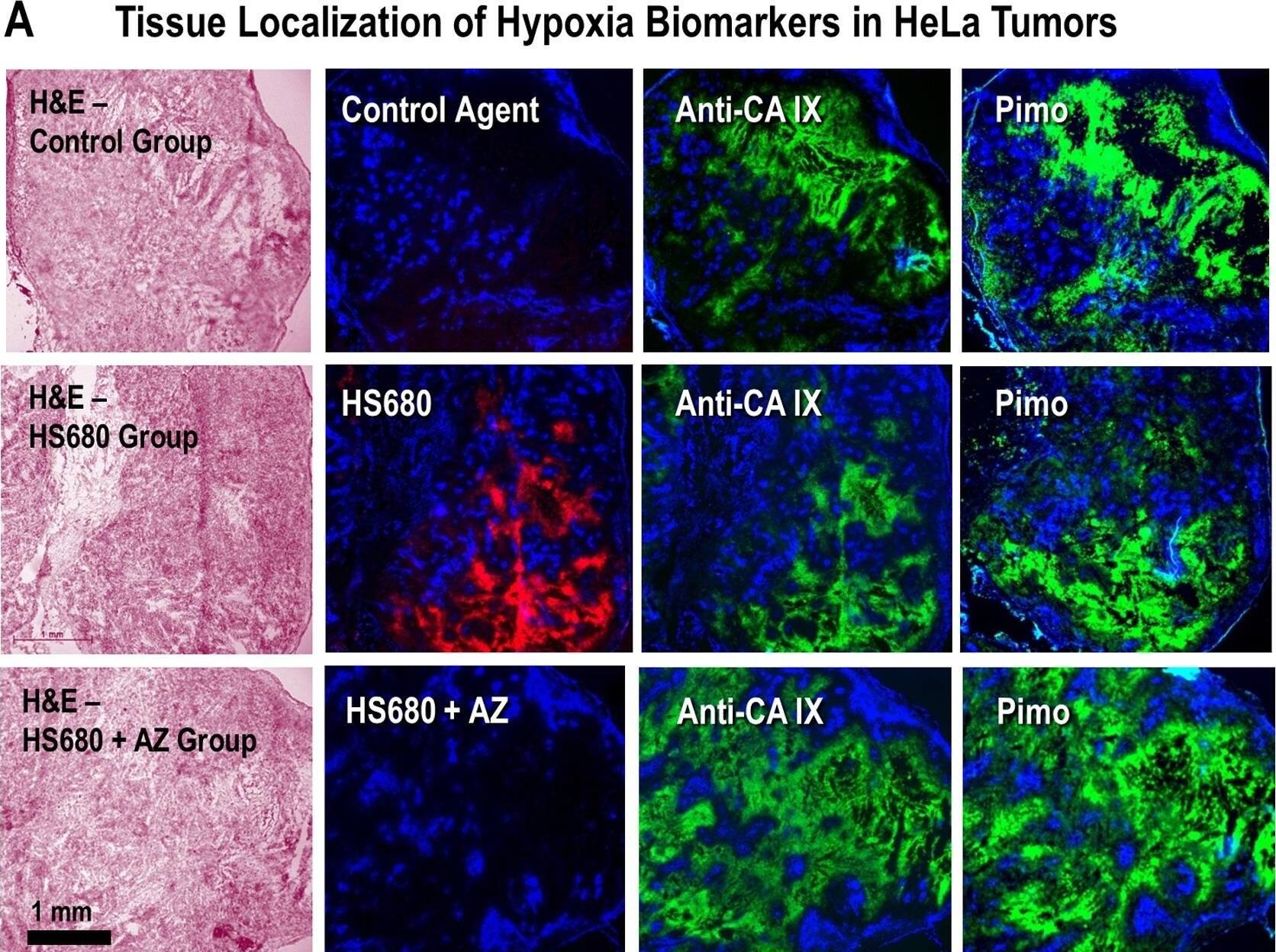
Detection of Carbonic Anhydrase IX/CA9 by Immunohistochemistry
Localization of HS680 and tumor hypoxia markers in HeLa xenografts. A, The tissue staining patterns of the control agent, HS680, and HS680+AZ (red) from the same or adjacent tumor sections as staining with fluorescent CA IX antibody or pimonidazole (green) and the Hoechst perfusion stain (blue). H&E staining of tissue sections that were used for localization are shown on the left side of images. HS680 was specifically localized in regions with low Hoechst staining indicative of low oxygen (less perfused) but positive staining with both the CA IX antibody and Pimonidazole. Preinjection of the mice with unlabeled AZ blocked the binding of HS680 to control levels. B, Co-localization (overlay) of HS680 with CA IX antibody or pimonidazole (hypoxyprobe) is shown on the right side images indicating HS680 was clearly co-localized with both anti-CA IX antibody and hypoxyprobe (pimonidazole). Similar results were obtained using HT-29 tumors (Figure S4A and Figure S4B). Image collected and cropped by CiteAb from the following open publication (https://pubmed.ncbi.nlm.nih.gov/23226406), licensed under a CC-BY license. Not internally tested by R&D Systems.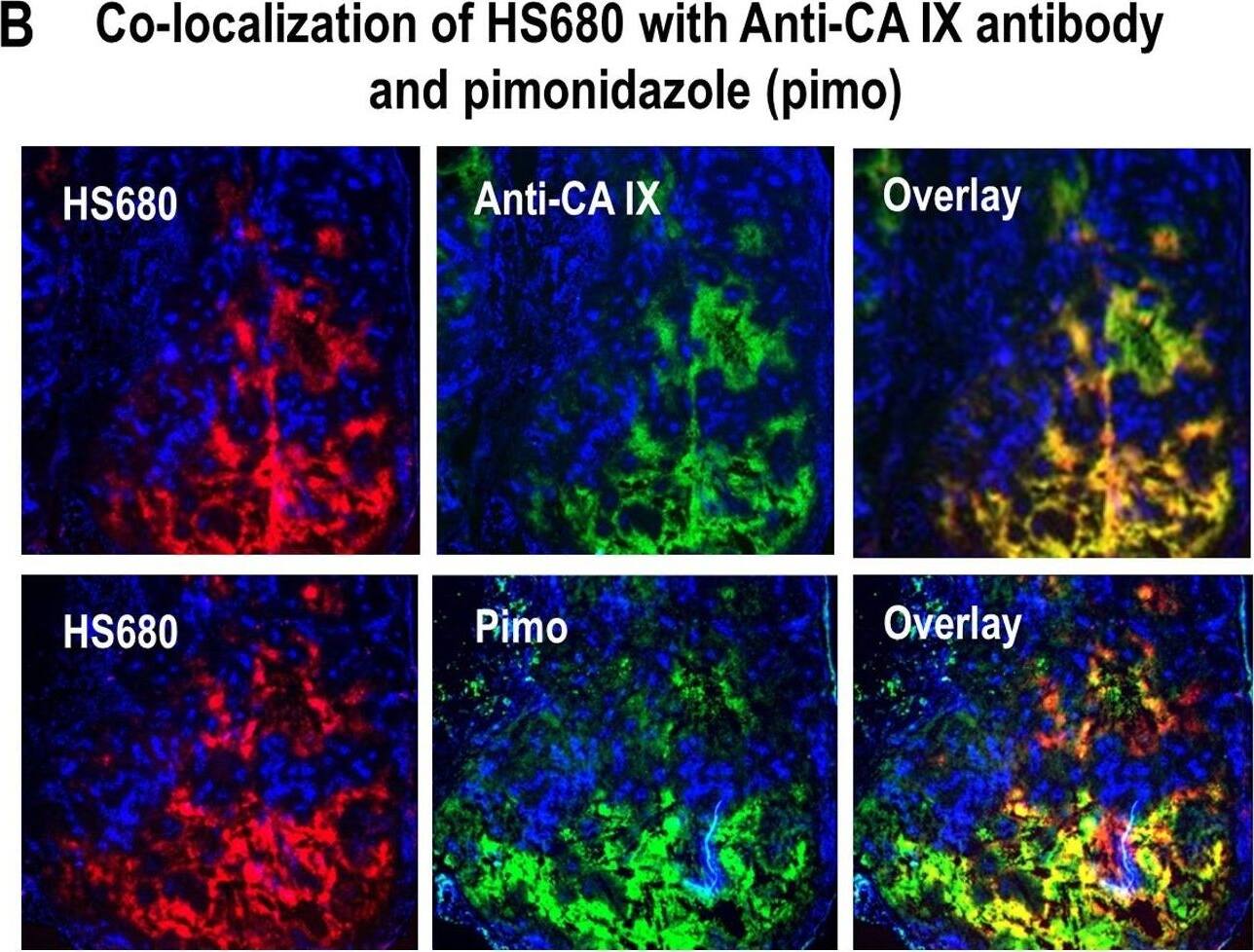
Detection of Carbonic Anhydrase IX/CA9 by Immunohistochemistry
Localization of HS680 and tumor hypoxia markers in HeLa xenografts. A, The tissue staining patterns of the control agent, HS680, and HS680+AZ (red) from the same or adjacent tumor sections as staining with fluorescent CA IX antibody or pimonidazole (green) and the Hoechst perfusion stain (blue). H&E staining of tissue sections that were used for localization are shown on the left side of images. HS680 was specifically localized in regions with low Hoechst staining indicative of low oxygen (less perfused) but positive staining with both the CA IX antibody and Pimonidazole. Preinjection of the mice with unlabeled AZ blocked the binding of HS680 to control levels. B, Co-localization (overlay) of HS680 with CA IX antibody or pimonidazole (hypoxyprobe) is shown on the right side images indicating HS680 was clearly co-localized with both anti-CA IX antibody and hypoxyprobe (pimonidazole). Similar results were obtained using HT-29 tumors (Figure S4A and Figure S4B). Image collected and cropped by CiteAb from the following open publication (https://pubmed.ncbi.nlm.nih.gov/23226406), licensed under a CC-BY license. Not internally tested by R&D Systems.Applications for Human Carbonic Anhydrase IX/CA9 Fluorescein-conjugated Antibody
Application
Recommended Usage
Flow Cytometry
10 µL/106 cells
Sample: U‑87 MG human glioblastoma/astrocytoma cell line
Sample: U‑87 MG human glioblastoma/astrocytoma cell line
Reviewed Applications
Read 2 reviews rated 5 using FAB2188F in the following applications:
Spectra Viewer
Plan Your Experiments
Use our spectra viewer to interactively plan your experiments, assessing multiplexing options. View the excitation and emission spectra for our fluorescent dye range and other commonly used dyes.
Spectra Viewer
Formulation, Preparation, and Storage
Purification
Protein A or G purified from hybridoma culture supernatant
Formulation
Supplied in a saline solution containing BSA and Sodium Azide.
Shipping
The product is shipped with polar packs. Upon receipt, store it immediately at the temperature recommended below.
Stability & Storage
Protect from light. Do not freeze.
- 12 months from date of receipt, 2 to 8 °C as supplied.
Background: Carbonic Anhydrase IX/CA9
Carbonic Anhydrase (CA) catalyzes the reversible reaction of CO2 + H2O = HCO3- + H+, which is fundamental to many processes such as respiration, renal tubular acidification and bone resorption (1-3). Topics in the CA meeting (6th International Conference on the CAs, June 20-25, 2003; Slovakia) ranged from use of CAs as markers for tumor and hypoxia in clinic, as nutritional supplement in milk, and as a tool for CO2 removal and mosquito control in industry. CA9, also known as membrane antigen MN and renal cell carcinoma (RCC)-associated antigen G250, is a transmembrane enzyme expressed primarily in carcinoma cells. It is one of the best markers for hypoxia and for RCC (4, 5). rhCA9 corresponds to the extracellular portion of human CA9.
References
- Pastorek, J. et al. (1994) Oncogene 9:2877.
- Opavsky, R. et al. (1996) Genomics 33:480.
- Hewett-Emmett, D. and R.E. Tashian (1996) Mol. Phylogenet. Evol. 5:50.
- Kaluzova, M. et al. (2004) Mol. Cell Biol. 24:5757.
- Mukouyama, H. et al. (2004) Clin. Cancer Res. 10:1421.
Alternate Names
CA9, G250, MN, RCC
Gene Symbol
CA9
UniProt
Additional Carbonic Anhydrase IX/CA9 Products
Product Specific Notices for Human Carbonic Anhydrase IX/CA9 Fluorescein-conjugated Antibody
For research use only
Loading...
Loading...
Loading...
Loading...
Loading...