
Nicotinamide
Tocris Bioscience, part of Bio-Techne | Catalog # 4106
PARP-1 inhibitor



Product Description
Nicotinamide is an anti-inflammatory agent. Inhibitor of poly(ADP-ribose) polymerase (PARP-1) enzymes. NAD+ precursor. Promotes differentiation of mesenchymal stem cells to insulin producing cells when used in combination with growth factors and high glucose concentration. Nicotinamide also acts as a SIRT1 inhibitor and promotes the expansion of hematopoietic progenitor cells. Nicotinamide can be used in a small molecule cocktail to generate 3D culture of lung alveolar cells.Nicotinamide synthesized to Ancillary Material Grade also available.
For more information about how Nicotinamide may be used, see our protocol: 3D Culture of Lung Alveolar Cells
Scientific Data Images for Nicotinamide

Application of Nicotinamide in Culture and Characterization of iPSC-derived Human Intestinal Organoids.
iPSC-derived human intestinal organoids were cultured using Nicotinamide, Y-27632 dihydrochloride (Catalog # 1254), SB 202190 (Catalog # 1264), N-Acetylcysteine (Catalog # 7874), A 83-01 (Catalog # 2939), along with other reagents used in the human intestinal organoid culture protocol. (A) Human intestinal organoids were stained using a Human/Mouse/Rat Vimentin Antibody (Catalog # MAB2105; green) and a Human/Mouse Desmin Antibody (Catalog # AF3844; red) to visualize myofibroblast cells and counterstained with DAPI (Catalog # 5748; blue). (B) Human intestinal organoids were stained using a Human/Mouse E-Cadherin Antibody (Catalog # AF748; green), a Human MUC2 Antibody (Novus Biologicals, Catalog # NBP2-44431; red) and counterstained with DAPI (Catalog # 5748; blue).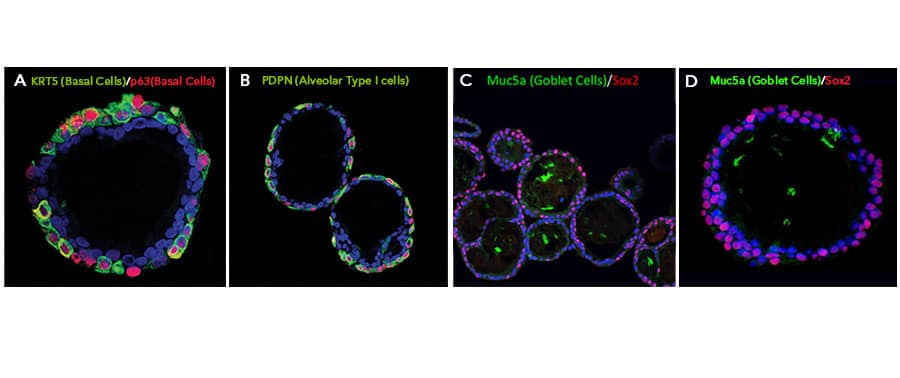
Application of Nicotinamide in Culture and Characterization of Adult Stem Cell-derived Lung Organoids.
Adult stem cells isolated from human lung biopsy tissue were embedded and then cultured for 20-60 days in lung organoid expansion medium, which includes Nicotinamide, Y-27632 dihydrochloride (Catalog # 1254), HEPES (Catalog # 3173), N-Acetylcysteine (Catalog # 7874), A 83-01 (Catalog # 2939), SB 202190 (Catalog # 1264), along with other reagents used in the human lung organoid culture protocol. Lung organoids were able to differentiate and exhibit markers for various lung cell types. Lung organoids were stained with (A) a Human Cytokeratin 5 (KRT5) Antibody (green) and a Human p63/TP73L Antibody (Catalog # AF1916; red) to visualize basal cells, (B) a Mouse Podoplanin (PDPN) Antibody (Novus Biologicals, Catalog # NB600-1015; green) to visualize alveolar type I cells and a Human p63/TP73L Antibody (Catalog # AF1916; red) to visualize basal cells, and (C, D) a Mouse MUC5AC Antibody (Novus Biologicals, Catalog # NBP2-15196; green) to visualize Goblet cells and a Human/Mouse/Rat SOX2 Antibody (Catalog # MAB2018; red). All samples were counterstained with DAPI (Catalog # 5748; blue).
Application of Nicotinamide in Culture and Characterization of Adult Stem Cell-derived Liver Organoids.
Adult stem cell-derived liver organoids were cultured using Y-27632 dihydrochloride (Catalog # 1254), HEPES (Catalog # 3173), A 83-0 (Catalog # 2939), Forskolin (Catalog # 1099), N-Acetylcysteine (Catalog # 7874), along with other reagents used in the human liver organoid culture protocol. After 3 days, liver organoid expansion medium was added for 7-10 days, followed by liver organoid differentiation medium, which includes Nicotinamide, HEPES (Catalog # 3173), N-Acetylcysteine (Catalog # 7874), A 83-0 (Catalog # 2939). Differentiated human liver organoids were stained using a (A) Human Serum Albumin Antibody (Catalog # MAB1455; red) and a (B) Human HNF-3 beta /FoxA2 Antibody (Catalog # AF2400; red) and counterstained with DAPI (Catalog # 5748; blue).Product Specifications
Molecular Weight
122.12
Formula
C6H6N2O
Storage
Store at RT
Purity
≥99% (HPLC)
Chemical Name
Pyridine-3-carboxamide
CAS Number
98-92-0
PubChem ID
936
InChI Key
DFPAKSUCGFBDDF-UHFFFAOYSA-N
SMILES
NC(C1=CC=CN=C1)=O
The technical data provided above is for guidance only. For batch specific data refer to the Certificate of Analysis.
Solubility
| Solvent | Max Conc. mg/mL | Max Conc. mM | |
|---|---|---|---|
| Solubility | |||
| water | 12.21 | 100 |
Preparing Stock Solutions
for Nicotinamide
The following data is based on the product molecular weight 122.12
Batch specific molecular weights may vary from batch to batch due to the degree of hydration, which all affect the solvent volumes required to prepare stock solutions.
| Concentration / Solvent Volume / Mass | 1 mg | 5 mg | 10 mg |
|---|---|---|---|
| 1 mM | 8.19 mL | 40.94 mL | 81.89 mL |
| 5 mM | 1.64 mL | 8.19 mL | 16.38 mL |
| 10 mM | 0.82 mL | 4.09 mL | 8.19 mL |
| 50 mM | 0.16 mL | 0.82 mL | 1.64 mL |
Calculators
Molarity Calculator
Dilution Calculator
Reconstitution Calculator
Background References
References are publications that support the biological activity of the product.
- Peled Nicotinamide, a SIRT1 inhibitor, inhibits differentiation and facilitates expansion of hematopoietic progenitor cells with enhanced bone marrow homing and engraftment. Exp.Hematol. 2012 PMID: 22198152
- Jung Isolation and in vitro expansion of human colonic stem cells. Nat.Med. 2011 PMID: 21892181
- Boj Organoid models of human and mouse ductal pancreatic cancer. Cell 2015 PMID: 25557080
- Bartfeld In vitro expansion of human gastric epithelial stem cells and their responses to bacterial infection. Gastroenterology 2015 PMID: 25307862
- Sato SnapShot: Growing organoids from stem cells. Cell 2015 PMID: 26091044
- Czubak A modified method of Ins producing cells' generation from bone marrow-derived mesenchymal stem cells. J.Diabetes Res. 2014 PMID: 25405207
- Cimadamore Nicotinamide rescues human embryonic stem cell-derived neuroectoderm from parthanatic cell death. Stem Cells. 2009 PMID: 19544437
- Suzuki Protective effect of nicotinamide against poly(ADP-ribose) polymerase-1-mediated astrocyte death depends on its transporter-mediated uptake. Life.Sci. 2010 PMID: 20188745
Product Specific Notices for Nicotinamide
For research use only
Loading...
Loading...
Loading...