
A 83-01
Tocris Bioscience, part of Bio-Techne | Catalog # 2939
Selective inhibitor of TGF-βRI, ALK4 and ALK7


Key Product Details
Description
Selective inhibitor of TGF-βRI, ALK4 and ALK7
Product Description
A 83-01 is a potent inhibitor of TGF-β type I receptor ALK5 kinase, type I activin/nodal receptor ALK4 and type I nodal receptor ALK7 (IC50 values are 12, 45 and 7.5 nM respectively). A 83-01 blocks phosphorylation of Smad2 and inhibits TGF-β-induced epithelial-to-mesenchymal transition. Only weakly inhibits ALK-1, -2, -3, -6 and MAPK activity. More potent than SB 431542 (Cat. No. 1614). A 83-01 inhibits differentiation of rat induced pluripotent stem cells (riPSCs) and increases clonal expansion efficiency. Helps maintain homogeneity and long-term in vitro self-renewal of human iPSCs. Combined with other reagents, A 83-01 promotes neural differentiation of hPSCs and also converts fibroblasts into cardiomyocytes (see protocol below).A 83-01 synthesized to Ancillary Material Grade also available.
For more information about how A 83-01 may be used, see our protocol: Converting Fibroblasts into Cardiomyocytes (9C Cocktail)
Scientific Data Images for A 83-01
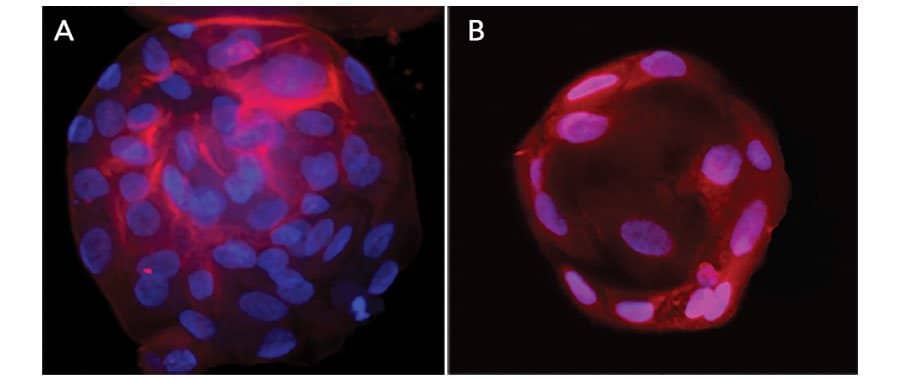
Application of A 83-01 in Culture and Characterization of Adult Stem Cell-derived Liver Organoids.
Adult stem cell-derived liver organoids were cultured using A 83-01, Y-27632 dihydrochloride (Catalog # 1254), HEPES (Catalog # 3173), Forskolin (Catalog # 1099), N-Acetylcysteine (Catalog # 7874), along with other reagents used in the human liver organoid culture protocol. After 3 days, liver organoid expansion medium was added for 7-10 days, followed by liver organoid differentiation medium, which includes A 83-01, HEPES (Catalog # 3173), Nicotinamide (Catalog # 4106), N-Acetylcysteine (Catalog # 7874), along with other reagents. Differentiated human liver organoids were stained using a (A) Human Serum Albumin Antibody (Catalog # MAB1455; red) and a (B) Human HNF-3beta /FoxA2 Antibody (Catalog # AF2400; red) and counterstained with DAPI (Catalog # 5748; blue).
Application of A 83-01 in Culture and Characterization of iPSC-derived Human Intestinal Organoids.
iPSC-derived human intestinal organoids were cultured using A 83-01, Y-27632 dihydrochloride (Catalog # 1254), SB 202190 (Catalog # 1264), N-Acetylcysteine (Catalog # 7874), Nicotinamide (Catalog # 4106), along with other reagents used in the human intestinal organoid culture protocol. (A) Human intestinal organoids were stained using a Human/Mouse/Rat Vimentin Antibody (Catalog # MAB2105; green) and a Human/Mouse Desmin Antibody (Catalog # AF3844; red) to visualize myofibroblast cells and counterstained with DAPI (Catalog # 5748; blue). (B) Human intestinal organoids were stained using a Human/Mouse E-Cadherin Antibody (Catalog # AF748; green), a Human MUC2 Antibody (Novus Biologicals, Catalog # NBP2-44431; red) and counterstained with DAPI (Catalog # 5748; blue).
Application of A 83-01 in Culture and Characterization of Adult Stem Cell-derived Human Descending Colon Organoids.
Adult stem cells isolated from human descending colon were embedded and then cultured for 30 days in intestinal organoid culture medium, which includes A 83-01, Y-27632 dihydrochloride (Catalog # 1254), SB 202190 (Catalog # 1264), N-Acetylcysteine (Catalog # 7874), Nicotinamide (Catalog # 4106), along with other reagents used in the human intestinal organoid culture protocol. (A) Organoids were fixed and stained with a Human MUC2 Antibody (Novus Biologicals; Catalog # NBP2-44431; green) to visualize intestinal goblet cells and counterstained with a Human/Mouse E-Cadherin Antibody (Catalog # AF748; red) and DAPI (Catalog # 5748; blue).(B) Organoids were fixed and stained with a Human Chromogranin A Antibody (Catalog # MAB90981; green) to visualize enteroendocrine cells and counterstained with a Human/Mouse E-Cadherin Antibody (Catalog # AF748; red) and DAPI (Catalog # 5748; blue).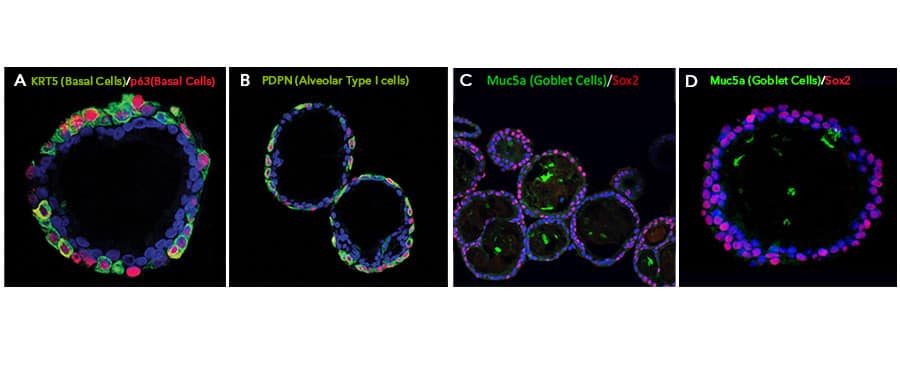
Product Specifications
Molecular Weight
421.52
Formula
C25H19N5S
Storage
Store at -20°C
Purity
≥98% (HPLC)
Chemical Name
3-(6-Methyl-2-pyridinyl)-N-phenyl-4-(4-quinolinyl)-1H-pyrazole-1-carbothioamide
CAS Number
909910-43-6
PubChem ID
16218924
InChI Key
HIJMSZGHKQPPJS-UHFFFAOYSA-N
SMILES
S=C(NC5=CC=CC=C5)N(N=C3C4=NC(C)=CC=C4)C=C3C2=CC=NC1=CC=CC=C12
The technical data provided above is for guidance only. For batch specific data refer to the Certificate of Analysis.
Solubility
| Solvent | Max Conc. mg/mL | Max Conc. mM | |
|---|---|---|---|
| Solubility | |||
| DMSO | 21.08 | 50 |
Preparing Stock Solutions
for A 83-01
The following data is based on the product molecular weight 421.52
Batch specific molecular weights may vary from batch to batch due to the degree of hydration, which all affect the solvent volumes required to prepare stock solutions.
| Concentration / Solvent Volume / Mass | 1 mg | 5 mg | 10 mg |
|---|---|---|---|
| 0.5 mM | 4.74 mL | 23.72 mL | 47.45 mL |
| 2.5 mM | 0.95 mL | 4.74 mL | 9.49 mL |
| 5 mM | 0.47 mL | 2.37 mL | 4.74 mL |
| 25 mM | 0.09 mL | 0.47 mL | 0.95 mL |
Calculators
Molarity Calculator
Dilution Calculator
Reconstitution Calculator
Background References
References are publications that support the biological activity of the product.
- Chen Chemically defined neural conversion of human pluripotent stem cells. Methods Mol.Biol. 2019 PMID: 30656621
- Karthaus Identification of multipotent luminal progenitor cells in human prostate organoid cultures. Cells 2014 PMID: 25201529
- Koehler 3D mouse embryonic stem cell culture for generating inner ear organoids. Nat.Protoc. 2014 PMID: 24784820
- Jung Isolation and in vitro expansion of human colonic stem cells. Nat.Med. 2011 PMID: 21892181
- Boj Organoid models of human and mouse ductal pancreatic cancer. Cell 2015 PMID: 25557080
- Bartfeld In vitro expansion of human gastric epithelial stem cells and their responses to bacterial infection. Gastroenterology 2015 PMID: 25307862
- Lancaster Generation of Cerebral Organoids from Human Pluripotent Stem Cells Nat.Protoc. 2015 PMID: 25188634
- Mahe Establishment of gastrointestinal epithelial organoids Curr.Protoc.Mouse Biol. 2014 PMID: 25105065
- Sato SnapShot: Growing Organoids from Stem Cells. Cell 2015 PMID: 26091044
- Li Generation of rat and human induced pluripotent stem cells by combining genetic reprogramming and chemical inhibitors. Cell Stem Cell 2009 PMID: 19097958
- Hoberg Attachment to laminin-111 facilitates transforming growth factor β-induced expression of matrix metalloproteinase-2 in synovial fibroblasts. Ann.Rheum.Dis. 2008 PMID: 17124250
- Tojo The ALK5 inhibitor A-83-01 inhibits smad signaling and epithelial-to-mesenchymal transition by transforming growth factor-β. Cancer.Sci. 2005 PMID: 16271073
Product Specific Notices for A 83-01
For research use only
Loading...
Loading...
Loading...