
Human FGF basic/FGF2/bFGF Antibody
R&D Systems, part of Bio-Techne | Catalog # AF-233-NA

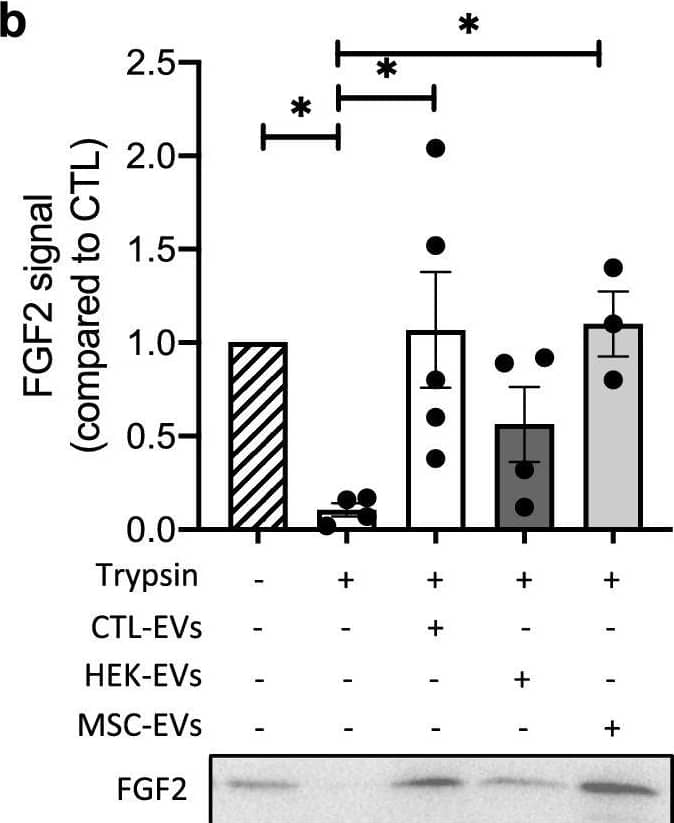

Scientific images may be resized, cropped, or adjusted for brightness or contrast for presentation purposes. These updates are limited to presentation and do not affect the underlying scientific interpretation of the data. Where available, additional source data may be provided upon request.
Conjugate
Catalog #
Key Product Details
Species Reactivity
Validated:
Human
Cited:
Human, Mouse, Rat, Avian, Bovine, Hamster
Applications
Validated:
Immunohistochemistry, Western Blot, Neutralization
Cited:
Immunohistochemistry, Immunohistochemistry-Paraffin, Immunohistochemistry-Frozen, Western Blot, Neutralization, Flow Cytometry, Immunocytochemistry, Bioassay, Cell Culture, Dot Blot, ELISA Capture, In vivo assay
Label
Unconjugated
Antibody Source
Polyclonal Goat IgG
Product Specifications
Immunogen
Bovine brain-derived FGF basic/FGF2/bFGF
Specificity
Detects human and bovine FGF basic/FGF2/bFGF in direct ELISAs and Western blots. In direct ELISAs, approximately 75% cross-reactivity with recombinant mouse FGF basic/FGF2/bFGF is observed.
Clonality
Polyclonal
Host
Goat
Isotype
IgG
Endotoxin Level
<0.10 EU per 1 μg of the antibody by the LAL method.
Scientific Data Images for Human FGF basic/FGF2/bFGF Antibody
FGF basic/FGF2/bFGF in Human Placenta.
FGF basic/FGF2/bFGF was detected in immersion fixed paraffin-embedded sections of human placenta using Goat Anti-Human FGF basic/FGF2/bFGF Antigen Affinity-purified Polyclonal Antibody (Catalog # AF-233-NA) at 10 µg/mL overnight at 4 °C. Before incubation with the primary antibody, tissue was subjected to heat-induced epitope retrieval using Antigen Retrieval Reagent-Basic (Catalog # CTS013). Tissue was stained using the Anti-Goat HRP-DAB Cell & Tissue Staining Kit (brown; Catalog # CTS008) and counterstained with hematoxylin (blue). Specific staining was localized to trophoblast cells in chorionic villi. View our protocol for Chromogenic IHC Staining of Paraffin-embedded Tissue Sections.
Cell Proliferation Induced by FGF basic/FGF2/bFGF and Neutralization by Human FGF basic/FGF2/bFGF Antibody.
Bovine FGF basic/FGF2/bFGF (Catalog # 133-FB) stimulates proliferation in the NR6R-3T3 mouse fibroblast cell line in a dose-dependent manner (orange line). Proliferation elicited by Bovine FGF basic/FGF2/bFGF (0.5 ng/mL) is neutralized (green line) by increasing concentrations of Goat Anti-Human FGF basic/FGF2/bFGF Antigen Affinity-purified Polyclonal Antibody (Catalog # AF-233-NA). The ND50 is typically 0.08-0.4 µg/mL.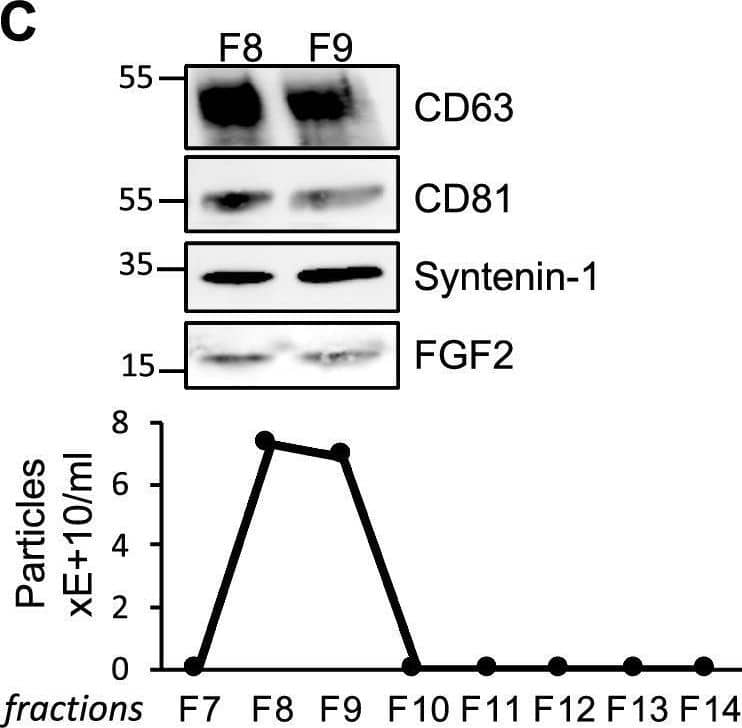
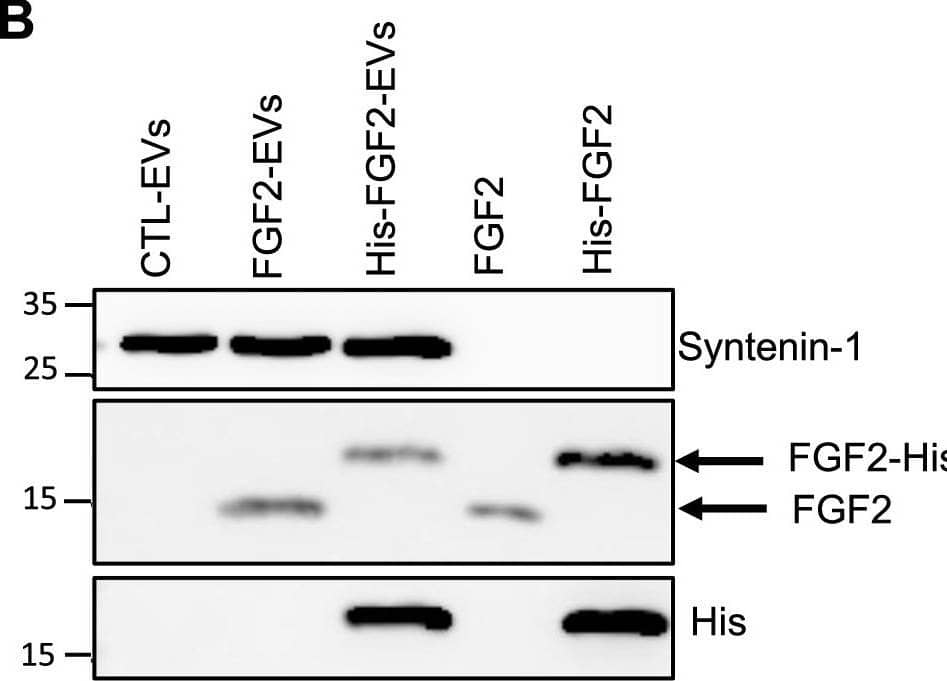
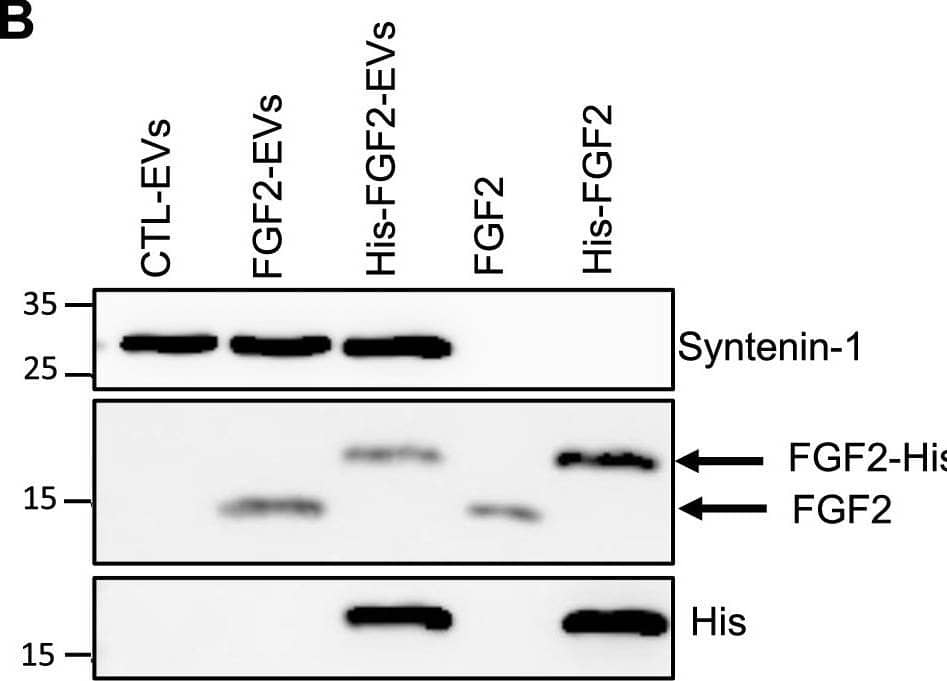
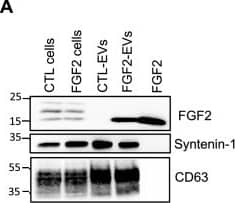
Detection of FGF basic/FGF2/bFGF by Western Blot
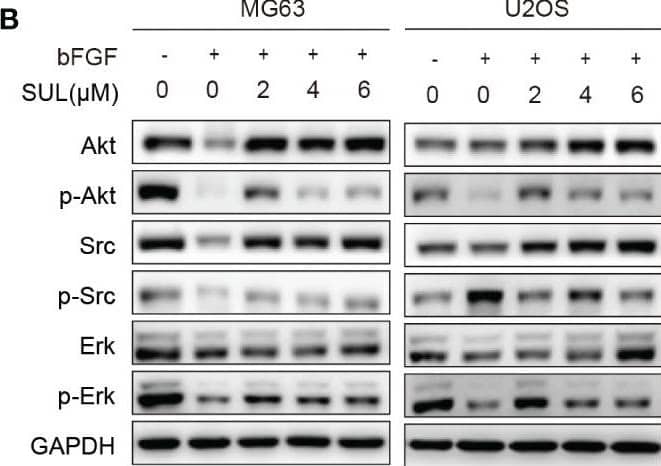
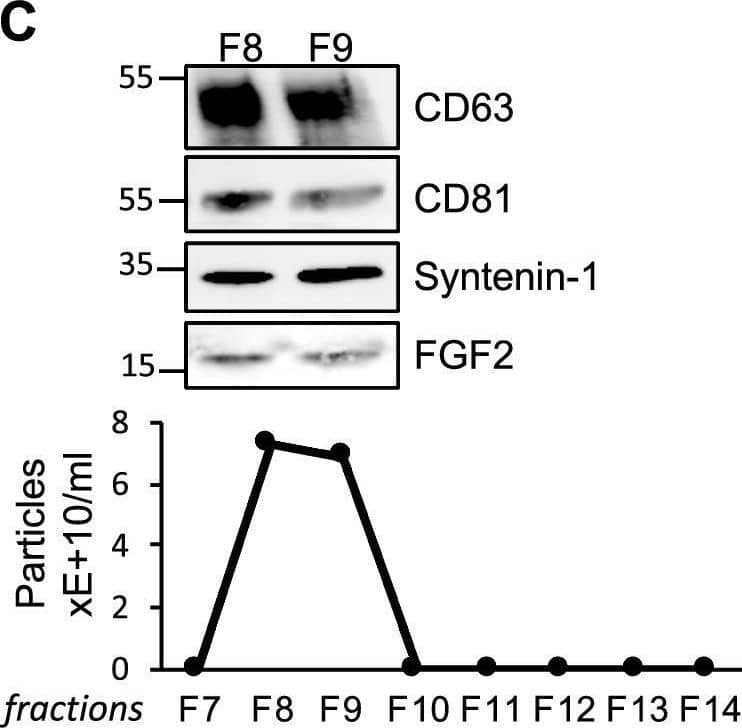
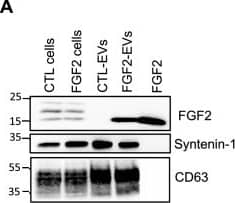
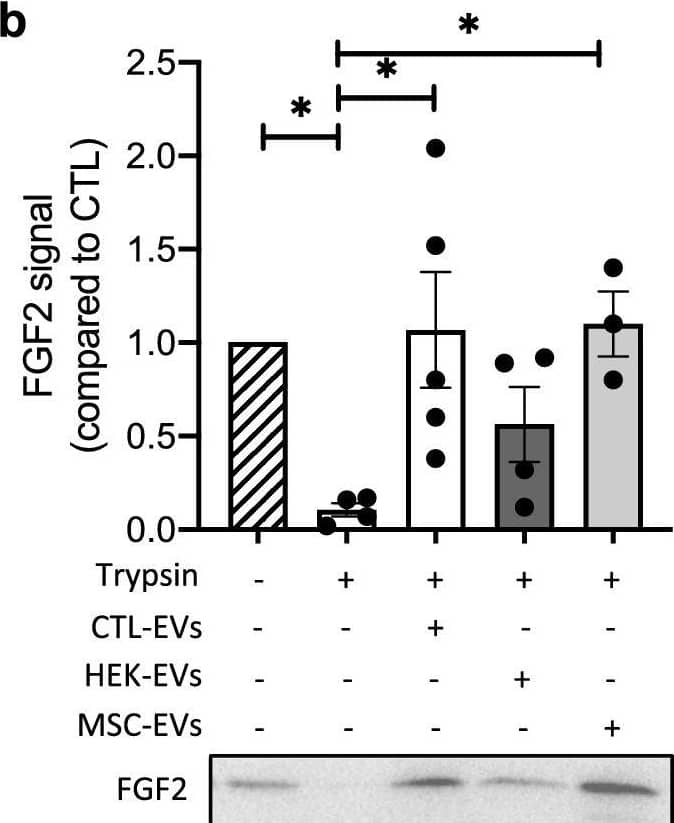
FGF2 is found at the outer surface of EVs secreted by dermal fibroblasts cultured in FGF2-containing medium. (A) FGF2, syntenin-1 and CD63 expression in DF cells and EV lysate (20 μg) was examined by western blot. Three isoforms of endogenous FGF2 were present in DF cells while FGF2-EVs contained the low molecular weight FGF2 isoform corresponding to recombinant FGF2. Original blots are shown in Suppl. Information. (B) Cells were cultured in the presence of His-tagged FGF2; western blot with 15 μg lysate and using anti-His antibody revealed the presence of His-FGF2 in secreted EVs. A shift in FGF2 size was also observed. Syntenin-1 was used as EV marker. Original blots are shown in Suppl. Information. (C) FGF2-EVs were loaded on a SEC column and collected fractions 8 and 9 (3E + 9p) were analyzed by western blot using antibodies for FGF2 and the EV markers CD63, CD81 and syntenin-1. Original blots are shown in Suppl. Information. For quantification, fractions were also analyzed by NTA. (D) FGF2 detection in FGF2-EVs by ELISA assay. Intact CTL- and FGF2-EVs (8E + 8p) were directly placed on FGF2 ELISA wells for external surface detection. FGF2-EVs were also treated with 0.1% triton and analyzed to detect internal FGF2. No FGF2 signal was detected in CTL-EVs. (E) FGF2 expression on FGF2-EVs was detected by flow cytometry. EVs were coupled to latex beads and labeled with FGF2 antibody before analysis by cytometry. Beads without EVs (beads) and beads labelled with goat IgG antibody (IgG) serve as negative controls. A representative plot is shown. Image collected and cropped by CiteAb from the following open publication (https://pubmed.ncbi.nlm.nih.gov/36550142), licensed under a CC-BY license. Not internally tested by R&D Systems.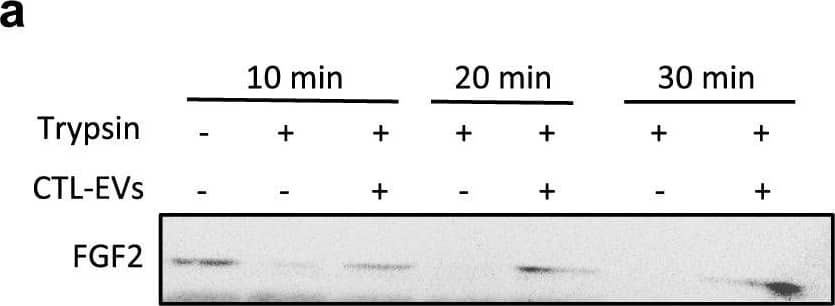
Applications for Human FGF basic/FGF2/bFGF Antibody
Application
Recommended Usage
Immunohistochemistry
5-15 µg/mL
Sample: Immersion fixed paraffin-embedded sections of human ovarian cancer tissue and Immersion fixed paraffin-embedded sections of human placenta subjected to Antigen Retrieval Reagent-Basic (Catalog # CTS013)
Sample: Immersion fixed paraffin-embedded sections of human ovarian cancer tissue and Immersion fixed paraffin-embedded sections of human placenta subjected to Antigen Retrieval Reagent-Basic (Catalog # CTS013)
Western Blot
0.1 µg/mL
Sample: Recombinant Human FGF basic/FGF2/bFGF (146 aa) (Catalog # 233-FB)
Sample: Recombinant Human FGF basic/FGF2/bFGF (146 aa) (Catalog # 233-FB)
Neutralization
Measured by its ability to neutralize FGF basic/FGF2/bFGF-induced proliferation in the NR6R‑3T3 mouse fibroblast cell line. Rizzino, A. et al. (1988) Cancer Res. 48:4266. The Neutralization Dose (ND50) is typically 0.08-0.4 µg/mL in the presence of 0.5 ng/mL Bovine FGF basic/FGF2/bFGF.
Formulation, Preparation, and Storage
Purification
Antigen Affinity-purified
Reconstitution
Reconstitute at 0.2 mg/mL in sterile PBS. For liquid material, refer to CoA for concentration.
Formulation
Lyophilized from a 0.2 μm filtered solution in PBS with Trehalose. *Small pack size (SP) is supplied either lyophilized or as a 0.2 µm filtered solution in PBS.
Shipping
Lyophilized product is shipped at ambient temperature. Liquid small pack size (-SP) is shipped with polar packs. Upon receipt, store immediately at the temperature recommended below.
Stability & Storage
Use a manual defrost freezer and avoid repeated freeze-thaw cycles.
- 12 months from date of receipt, -20 to -70 °C as supplied.
- 1 month, 2 to 8 °C under sterile conditions after reconstitution.
- 6 months, -20 to -70 °C under sterile conditions after reconstitution.
Background: FGF basic/FGF2/bFGF
FGF basic is a member of the FGF family of at least 23 related mitogenic proteins which show 35‑60% amino acid conservation. FGF acidic and basic, unlike the other members of the family, lack signal peptides and are apparently secreted by mechanisms other than the classical protein secretion pathway. FGF basic has been isolated from a number of sources, including neural tissue, pituitary, adrenal cortex, corpus luteum, and placenta. This factor contains four cysteine residues, but reduced FGF basic retains full biological activity, indicating that disulfide bonds are not required for this activity. A variety of forms of FGF basic are produced as a result of N-terminal extensions. These extensions affect localization of FGF basic in cellular compartments but do not affect biological activity. Binding of FGF to heparin or cell surface heparan sulfate proteoglycans is necessary for binding of FGF to high affinity FGF receptors. FGF acidic and basic appear to bind to the same high affinity receptors and show a similar range of biological activities. FGF basic stimulates the proliferation of all cells of mesodermal origin and many cells of neuroectodermal, ectodermal, and endodermal origin. FGF basic induces neuron differentiation, survival, and regeneration. FGF basic also modulates embryonic development and differentiation. These observed in vitro functions of FGF basic suggest FGF basic may play a role in vivo in the modulation of such normal processes as angiogenesis, wound healing and tissue repair, embryonic development and differentiation, and neuronal function and neural degeneration. Additionally, FGF basic may participate in the production of a variety of pathological conditions resulting from excessive cell proliferation and excessive angiogenesis.
References
- Coulier, F. et al. (1997) J. Mol. Evol. 44:43.
- Chen, C.H. et al. (2004) Curr. Vasc. Pharmacol. 2:33.
- Mohammadi, M. et al. (2005) Curr. Opin. Struct. Biol. 15:506.
- Fernig, D. et al. (1994) Prog. Growth Factor Res. 5:353.
Long Name
Fibroblast Growth Factor basic
Alternate Names
bFGF, FGF-2, FGF2, HBGF-2, Prostatropin
Gene Symbol
FGF2
Additional FGF basic/FGF2/bFGF Products
Product Documents for Human FGF basic/FGF2/bFGF Antibody
Product Specific Notices for Human FGF basic/FGF2/bFGF Antibody
For research use only
Loading...
Loading...
Loading...
Loading...
Loading...