TNF-alpha: Small Molecules and Peptides

TNF-alpha (Tumor necrosis factor alpha) plays a central role in inflammation, immune system development, apoptosis, and lipid metabolism. TNF-alpha was first identified as a cytotoxic factor produced by macrophages capable of killing mouse tumor cells. It is the prototypic ligand and along with Lymphotoxin-alpha, were identified as the first members of the TNF superfamily. Active TNF-alpha and other members of the TNF superfamily exist as a homotrimer with high structural homology. Receptor binding occurs at the interface of two TNF-alpha monomers. And receptor activation occurs when all three monomer interfaces are engaged with a receptor. For TNF-alpha, receptor binding and activation occurs through TNF R1 or TNF RII, and subsequently leads to activation of NF-kB or MAPK signaling pathways. Another pathway that TNF-alpha can activate utilizes the death domain of TNF RI to induce apoptosis. TNF-alpha promotes the inflammatory response largely through NF-kB signaling, and inhibition of TNF-alpha has proven successful in treating many autoimmune disorders. TNF-alpha is also present on the cell surface as membrane-bound TNF-alpha can induce the lysis of neighboring tumor cells and virus infected cells. TNF-alpha protein is translated as a type II transmembrane protein containing an N-terminal transmembrane domain. The soluble cytokine is released from its cell-anchoring TM domain by proteolytic processing by metalloproteases.

Show More

10 results for "TNF-alpha Small Molecules and Peptides" in Products

10 results for "TNF-alpha Small Molecules and Peptides" in Products

TNF-alpha: Small Molecules and Peptides

TNF-alpha (Tumor necrosis factor alpha) plays a central role in inflammation, immune system development, apoptosis, and lipid metabolism. TNF-alpha was first identified as a cytotoxic factor produced by macrophages capable of killing mouse tumor cells. It is the prototypic ligand and along with Lymphotoxin-alpha, were identified as the first members of the TNF superfamily. Active TNF-alpha and other members of the TNF superfamily exist as a homotrimer with high structural homology. Receptor binding occurs at the interface of two TNF-alpha monomers. And receptor activation occurs when all three monomer interfaces are engaged with a receptor. For TNF-alpha, receptor binding and activation occurs through TNF R1 or TNF RII, and subsequently leads to activation of NF-kB or MAPK signaling pathways. Another pathway that TNF-alpha can activate utilizes the death domain of TNF RI to induce apoptosis. TNF-alpha promotes the inflammatory response largely through NF-kB signaling, and inhibition of TNF-alpha has proven successful in treating many autoimmune disorders. TNF-alpha is also present on the cell surface as membrane-bound TNF-alpha can induce the lysis of neighboring tumor cells and virus infected cells. TNF-alpha protein is translated as a type II transmembrane protein containing an N-terminal transmembrane domain. The soluble cytokine is released from its cell-anchoring TM domain by proteolytic processing by metalloproteases.

Show More

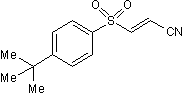
Irreversible inhibitor of TNF-α-induced IκBα phosphorylation

Alternate Names: Bay 11-7083
Chemical Name: (2E)-3-[[4-(1,1-Dimethylethyl)phenyl]sulfonyl]-2-propenenitrile
Purity: ≥98% (HPLC)
Irreversible inhibitor of TNF-α-induced IκBα phosphorylation

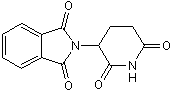
Binds cereblon; also TNF-α synthesis inhibitor

Chemical Name: N-(2,6-dioxo-3-piperidinyl)phthalimide
Purity: ≥98% (HPLC)
Binds cereblon; also TNF-α synthesis inhibitor

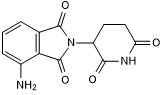
Cereblon binder; also TNF-α inhibitor and antiangiogenic

Chemical Name: 4-Amino-2-(2,6-dioxo-3-piperidinyl)-1H-isoindole-1,3(2H)-dione
Purity: ≥98% (HPLC)
Cereblon binder; also TNF-α inhibitor and antiangiogenic

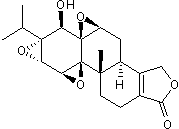
Inhibits RNAPII-mediated transcription; antitumor, anti-inflammatory and immunosuppressive

Chemical Name: (3bS,4aS,5aS,6R,6aR,7aS,7bS,8aS,8bS)-3b,4,4a,6,6a,7a,7b,8b,9,10-Decahydro-6-hydroxy-8b-methyl-6a-(1-methylethyl)trisoxireno[4b,5:6,7:8a,9]phenanthro[1,2-c]furan-1(3H)-one
Purity: ≥98% (HPLC)
Inhibits RNAPII-mediated transcription; antitumor, anti-inflammatory and immunosuppressive

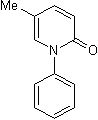
Antifibrotic agent; regulates cytokine levels in vivo

Chemical Name: 5-methyl-1-phenyl-2(1H)-pyridinone
Purity: ≥98% (HPLC)
Antifibrotic agent; regulates cytokine levels in vivo

Inhibits TNF-α-induced NF-κB activation

Chemical Name: (9β,13α,14β,20α)-3-Hydroxy-9,13-dimethyl-2-oxo-24,25,26-trinoroleana-1(10),3,5,7-tetraen-29-oic acid
Purity: ≥98% (HPLC)
Inhibits TNF-α-induced NF-κB activation

Active metabolite binds CPSF3; Pro-drug

Alternate Names: TO-207
Chemical Name: N-[3,5-Dichloro-2-hydroxy-4-[2-(4-methyl-1-piperazinyl)ethoxy]benzoyl]-L-phenylalanine ethyl ester dihydrochloride
Purity: ≥98% (HPLC)
Active metabolite binds CPSF3; Pro-drug

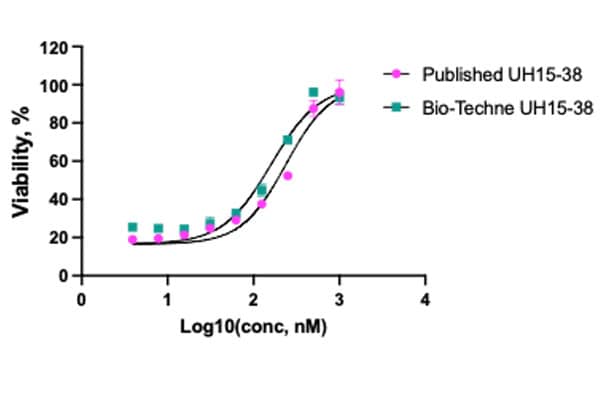
Potent and selective RIPK3 inhibitor; also blocks activation of necroptosis

Chemical Name: 3-(3-Hydroxyphenyl)-1-methyl-7-[[3-(4-methyl-1-piperazinyl)phenyl]amino]-1,6-naphthyridin-2(1H)-one dihydrochloride
Purity: ≥98% (HPLC)
Published vs Bio-Techne batch comparison for UH15-38
(2)

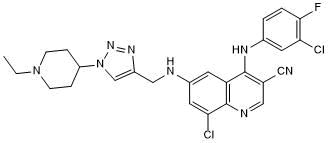
Potent and selective Tpl2 (MAP3K8) inhibitor

Chemical Name: 8-Chloro-4-[(3-chloro-4-fluorophenyl)amino]-6-[[[1-(1-ethyl-4-piperidinyl)-1H-1,2,3-triazol-4-yl]methyl]amino]-3-quinolinecarbonitrile
Purity: ≥98% (HPLC)
Potent and selective Tpl2 (MAP3K8) inhibitor

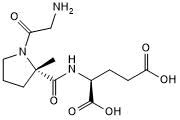
IGF-1 synthetic analogue

Chemical Name: Glycyl-2-methyl-L-prolyl-L-glutamic acid
Purity: ≥98% (HPLC)
IGF-1 synthetic analogue
Results Per Page
5 10 25 50
/ 1