p53: Small Molecules and Peptides

p53 is well known for its key role as a tumor suppressor protein. It is 393 amino acids (aa) in length with a predicted molecular weight of 44 kDa. It belongs to the p53 family that also includes p63 and p73. Structurally, p53 is characterized by an N-terminal transactivation domain, central DNA-binding and oligomerization domains, and a C-terminal regulatory domain. It is thought to exist as a homotetramer, and it exhibits approximately 72% and 76% aa identity with its mouse and rat orthologs, respectively. Mutations in the p53 gene are one of the most frequent genomic events accompanying oncogenic transformation. p53 responds to signals such as DNA damage or cell stress primarily through its actions as a transcription factor. Among its gene targets are a range factors that promote DNA repair mechanisms or apoptosis including cell cycle regulatory proteins and members the Bcl-2 family. Because of its critical role in genomic homeostasis, p53 activities are tightly regulated by a network of protein-protein interactions, microRNAs, and a range of post-translational modifications, including phosphorylation, acetylation, methylation, and ubiquitination. A widely studied regulator is Murine Double Minute 2 (MDM2). MDM2 is known to suppress p53 activity through direct binding or through its actions as a Ubiquitin ligase (E3) that catalyzes p53 ubiquitination and proteasome-mediated degradation.

Show More

11 results for "p53 Small Molecules and Peptides" in Products

11 results for "p53 Small Molecules and Peptides" in Products

p53: Small Molecules and Peptides

p53 is well known for its key role as a tumor suppressor protein. It is 393 amino acids (aa) in length with a predicted molecular weight of 44 kDa. It belongs to the p53 family that also includes p63 and p73. Structurally, p53 is characterized by an N-terminal transactivation domain, central DNA-binding and oligomerization domains, and a C-terminal regulatory domain. It is thought to exist as a homotetramer, and it exhibits approximately 72% and 76% aa identity with its mouse and rat orthologs, respectively. Mutations in the p53 gene are one of the most frequent genomic events accompanying oncogenic transformation. p53 responds to signals such as DNA damage or cell stress primarily through its actions as a transcription factor. Among its gene targets are a range factors that promote DNA repair mechanisms or apoptosis including cell cycle regulatory proteins and members the Bcl-2 family. Because of its critical role in genomic homeostasis, p53 activities are tightly regulated by a network of protein-protein interactions, microRNAs, and a range of post-translational modifications, including phosphorylation, acetylation, methylation, and ubiquitination. A widely studied regulator is Murine Double Minute 2 (MDM2). MDM2 is known to suppress p53 activity through direct binding or through its actions as a Ubiquitin ligase (E3) that catalyzes p53 ubiquitination and proteasome-mediated degradation.

Show More

MDM2-p53 interaction inhibitor

Alternate Names: NSC 652287
Chemical Name: 5,5'-(2,5-Furandiyl)bis-2-thiophenemethanol
Purity: ≥97% (HPLC)
MDM2-p53 interaction inhibitor

MDM2 antagonist; inhibits MDM2-p53 interaction

Chemical Name: (±)-4-[4,5-Bis(4-chlorophenyl)-2-(2-isopropoxy-4-methoxy-phenyl)-4,5-dihydro-imidazole-1-carbonyl]-piperazin-2-one
Purity: ≥98% (HPLC)
MDM2 antagonist; inhibits MDM2-p53 interaction

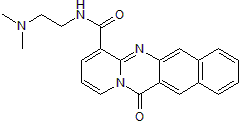
RNA polymerase I inhibitor; also p53 pathway activator

Chemical Name: N-[2-(Dimethylamino)ethyl]-12-oxo-12H-benzo[g]pyrido[2,1-b]quinazoline-4-carboxamide
Purity: ≥98% (HPLC)
RNA polymerase I inhibitor; also p53 pathway activator

p53 inhibitor. Also aryl hydrocarbon receptor agonist

Chemical Name: 1-(4-Methylphenyl)-2-(4,5,6,7-tetrahydro-2-imino-3(2H)-benzothiazolyl)ethanone hydrobromide
p53 inhibitor. Also aryl hydrocarbon receptor agonist

Restores mutant p53 activity

Alternate Names: APR-246
Chemical Name: 2-(Hydroxymethyl)-2-(methoxymethyl)-1-azabicyclo[2.2.2]octan-3-one
Purity: ≥98% (HPLC)
Restores mutant p53 activity

Potent MDM2 inhibitor; inhibits MDM2-p53 interaction

Chemical Name: 4-[[[(2R,3S,4R,5S)-3-(3-Chloro-2-fluorophenyl)-4-(4-chloro-2-fluorophenyl)-4-cyano-5-(2,2-dimethylpropyl)-2-pyrrolidinyl]carbonyl]amino]-3-methoxybenzoic acid
Purity: ≥98% (HPLC)
Potent MDM2 inhibitor; inhibits MDM2-p53 interaction

Hdm2 inhibitor; activates p53-dependent transcription

Chemical Name: 5-[[3-Dimethylamino)propyl]amino]-3,10-dimethylpyrimido[4,5-b]quinoline-2,4(3H,10H)-dione dihydrochloride
Purity: ≥98% (HPLC)
Hdm2 inhibitor; activates p53-dependent transcription

Restores mutant p53 activity; proapoptotic

Chemical Name: 1-[(1-Oxopropoxy)methyl]-1H-pyrrole-2,5-dione
Restores mutant p53 activity; proapoptotic

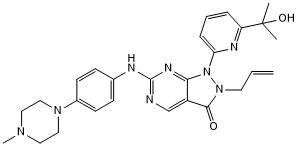
Potent and selective Wee1 inhibitor

Alternate Names: AZD 1775,MK 1775
Chemical Name: 1,2-Dihydro-1-[6-(1-hydroxy-1-methylethyl)-2-pyridinyl]-6-[[4-(4-methyl-1-piperazinyl)phenyl]amino]-2-(2-propen-1-yl)-3H-pyrazolo[3,4-d]pyrimidin-3-one
Purity: ≥98% (HPLC)
Potent and selective Wee1 inhibitor

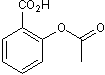
Cyclooxygenase inhibitor; NSAID

Chemical Name: 2-Acetoxybenzoic acid
Purity: ≥98% (HPLC)
Cyclooxygenase inhibitor; NSAID

High affinity MDM2 inhibitor

Chemical Name: 6-Methoxy-1-(1-naphthalenyl)-9H-pyrido[3,4-b]indole
Purity: ≥98% (HPLC)
High affinity MDM2 inhibitor
Results Per Page
5 10 25 50
/ 1