
Mouse Semaphorin 7A Antibody
R&D Systems, part of Bio-Techne | Catalog # AF1835

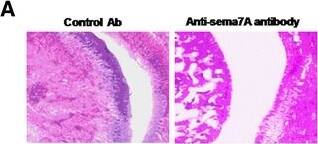
Conjugate
Catalog #
Key Product Details
Species Reactivity
Validated:
Mouse
Cited:
Mouse, Opossum, Transgenic Mouse, Zebrafish
Applications
Validated:
Western Blot, Simple Western
Cited:
Immunohistochemistry, Western Blot
Label
Unconjugated
Antibody Source
Polyclonal Goat IgG
Product Specifications
Immunogen
Mouse myeloma cell line NS0-derived recombinant mouse Semaphorin 7A
Gln45-Ala646
Accession # Q9QUR8
Gln45-Ala646
Accession # Q9QUR8
Specificity
Detects mouse Semaphorin 7A in direct ELISAs and Western blots. In these formats, less than 1% cross‑reactivity with recombinant mouse (rm) Semaphorin 3C, rmSemaphorin 3E, rmSemaphorin 3F, rmSemaphorin 6A, rmSemaphorin 6B, rmSemaphorin 6C, recombinant human (rh) Semaphorin 3A, rhSemaphorin 3B, and rhSemaphorin 6D is observed.
Clonality
Polyclonal
Host
Goat
Isotype
IgG
Scientific Data Images for Mouse Semaphorin 7A Antibody
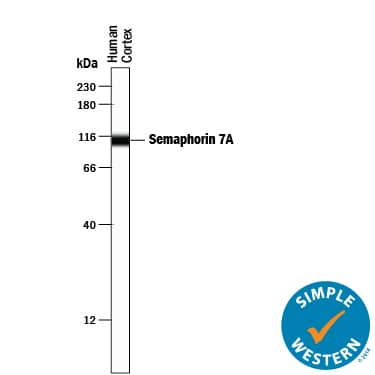
Detection of Human Semaphorin 7A by Simple WesternTM.
Simple Western lane view shows lysates of human brain (cortex) tissue, loaded at 0.2 mg/mL. A specific band was detected for Semaphorin 7A at approximately 109 kDa (as indicated) using 2.5 µg/mL of Goat Anti-Mouse Semaphorin 7A Antigen Affinity-purified Polyclonal Antibody (Catalog # AF1835) followed by 1:50 dilution of HRP-conjugated Anti-Goat IgG Secondary Antibody (Catalog # HAF109). This experiment was conducted under reducing conditions and using the 12-230 kDa separation system.
Detection of Mouse Semaphorin 7A by Western Blot.
Western blot shows lysates of mouse brain tissue, mouse testis tissue, and mouse ovary tissue. PVDF membrane was probed with 0.25 µg/mL of Goat Anti-Mouse Semaphorin 7A Antigen Affinity-purified Polyclonal Antibody (Catalog # AF1835) followed by HRP-conjugated Anti-Goat IgG Secondary Antibody (Catalog # HAF019). A specific band was detected for Semaphorin 7A at approximately 75 kDa (as indicated). This experiment was conducted under reducing conditions and using Immunoblot Buffer Group 1.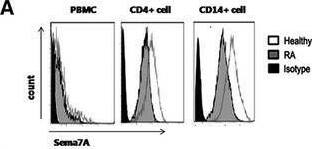
Detection of Mouse Semaphorin 7A by Flow Cytometry
Semaphorin 7A (Sema7A) expression, and inflammatory cytokine synthesis induced by Sema7A in primary human cells. a Cell surface expression of Sema7A in peripheral blood CD4+ and CD14+ cells and peripheral blood mononuclear cells (PBMCs) from patients with rheumatoid arthritis (RA) and healthy volunteer donors. Results shown are representative of findings from nine patients with RA and eight healthy volunteer donors. b Expression of messenger RNA (mRNA) for Sema7A in peripheral blood CD4+ and CD14+ cells. Results shown are from nine patients with RA and eight healthy individuals. N.S. Not significant. c Cytokine production by PBMCs from healthy donors (n = 6 percytokine) after treatment with or without Sema7A (10 ng/ml) for 24 h. Supernatants were analyzed for expression of IL-17, TNF-alpha, and IL-6 by enzyme-linked immunosorbent assay. Results are shown as the mean of triplicate values ± SD from one of three representative experiments. *P<0.05 versus unstimulated controls. d Interferon-gamma (IFN-gamma), IL-17, and IL-22 synthesis by primary human CD4+ T cells from patients with RA after treatment with either Sema7A or heat-denatured Sema7A (DSema7A) (both at 10 ng/ml) for 24 h. Data are shown as the mean of triplicate values ± SD as compared with DSema7A (10 ng/ml) or unstimulated CD4+ T cells. **P < 0.01. e Tumor necrosis factor-alpha (TNF-alpha) and interleukin-6 (IL-6) production by primary human CD14+ monocytes from patients with RA after stimulation with naturally cleaved soluble Sema7A (sSema7A) for 48 h with or without anti-Sema7A antibody. Results shown are representative of three independent experiments Image collected and cropped by CiteAb from the following open publication (https://pubmed.ncbi.nlm.nih.gov/28109308), licensed under a CC-BY license. Not internally tested by R&D Systems.Applications for Mouse Semaphorin 7A Antibody
Application
Recommended Usage
Simple Western
2.5 µg/mL
Sample: Human brain (cortex) tissue
Sample: Human brain (cortex) tissue
Western Blot
0.25 µg/mL
Sample: Mouse brain tissue, mouse testis tissue, and mouse ovary tissue
Sample: Mouse brain tissue, mouse testis tissue, and mouse ovary tissue
Formulation, Preparation, and Storage
Purification
Antigen Affinity-purified
Reconstitution
Reconstitute at 0.2 mg/mL in sterile PBS. For liquid material, refer to CoA for concentration.
Formulation
Lyophilized from a 0.2 μm filtered solution in PBS with Trehalose. *Small pack size (SP) is supplied either lyophilized or as a 0.2 µm filtered solution in PBS.
Shipping
Lyophilized product is shipped at ambient temperature. Liquid small pack size (-SP) is shipped with polar packs. Upon receipt, store immediately at the temperature recommended below.
Stability & Storage
Use a manual defrost freezer and avoid repeated freeze-thaw cycles.
- 12 months from date of receipt, -20 to -70 °C as supplied.
- 1 month, 2 to 8 °C under sterile conditions after reconstitution.
- 6 months, -20 to -70 °C under sterile conditions after reconstitution.
Background: Semaphorin 7A
Semaphorin 7A (Sema7A, designated CD108, previously Sema K1 or Sema L), is an ~80 kDa membrane-anchored glycoprotein that is a member of the Semaphorin family of axon guidance molecules (1 - 4). On human erythrocytes, it is the John Milton Hagen (JMH) blood group antigen (4). Sema7A is the only known Class 7 or glycophosphatidylinositol (GPI)-linked semaphorin; its expression is concentrated in the brain, spleen and thymus (1 - 5). Mouse Sema7A cDNA encodes a 44 amino acid (aa) signal sequence, a 602 aa extracellular domain (ECD) including Sema and C2-type Ig-like domains, and an 18 aa propeptide/GPI membrane anchor signal sequence. Mature mouse Sema7A shares 89%, 98%, 85%, 86% and 89% aa identity with corresponding human, rat, bovine, canine and equine Sema7A, respectively. The Sema7A sema domain contains an RGD integrin interaction motif (4). Although it binds plexin-C1 in vitro and may be coexpressed with it, many of its activities depend on interaction with beta1 integrins such as alpha1 beta1 (6 - 10). Sema7A signaling through the two receptors may cause opposing effects (8). Sema7A is an immune semaphorin, with expression and activity on CD4+CD8+ thymocytes, activated T cells, macrophages and microglia (2, 9 - 12). T cell Sema7A interacts with monocytic cells, stimulating their chemotaxis, production of pro-inflammatory cytokines, and dendritic differentiation (5, 6). However, on the T cells themselves, Sema7A downregulates TCR signaling by promoting TCR internalization, modulating T cell responses (9). In lung macrophages, Sema7A is induced by TGF-beta and participates in TGF-beta -induced lung fibrosis (12). Sema7A is also expressed on pre-osteoblasts and osteoclasts, where it promotes migration and fusion, respectively; on keratinocytes, where it promotes melanocyte spreading and dendricity; and on some neurons, for example, promoting axon outgrowth in the developing olfactory tract (8, 10, 13).
References
- Yazdani, U. and J.R. Terman (2006) Genome Biol. 7:211.
- Kikutani, H. et al. (2007) Adv. Immunol. 93:121.
- Sato, Y. and (1998) Biochim. Biophys. Acta 1443:419.
- Yamada, A. et al. (1999) J. Immunol. 162:4094.
- Holmes, S. et al. (2002) Scand. J. Immunol. 56:270.
- Suzuki, K. et al. (2007) Nature 446:680.
- Pasterkamp, R.J. et al. (2007) BMC Dev. Biol. 7:98.
- Scott, G.A. et al. (2007) J. Invest. Dermatol. 128:151.
- Czopik, A.K. et al. (2006) Immunity 24:591.
- Pasterkamp, R.J. et al. (2003) Nature 424:398.
- Mine, T. et al. (2000) Tissue Antigens 55:429.
- Kang, H-R. et al. (2007) J. Exp. Med. 204:1083.
- Delorme, G. et al. (2005) Biol. Cell 97:589.
Alternate Names
CD108, H-Sema-L, Sema7A, SEMAL
Gene Symbol
SEMA7A
UniProt
Additional Semaphorin 7A Products
Product Documents for Mouse Semaphorin 7A Antibody
Product Specific Notices for Mouse Semaphorin 7A Antibody
For research use only
Loading...
Loading...
Loading...
Loading...
Loading...