
Mouse Gas6 Antibody
R&D Systems, part of Bio-Techne | Catalog # AF986

Conjugate
Catalog #
Key Product Details
Species Reactivity
Validated:
Mouse
Cited:
Human, Mouse, Transgenic Mouse
Applications
Validated:
Immunohistochemistry, ELISA Capture (Matched Antibody Pair)
Cited:
Immunohistochemistry, Immunohistochemistry-Frozen, Western Blot, Flow Cytometry, Immunocytochemistry, Immunoprecipitation, ELISA Development
Label
Unconjugated
Antibody Source
Polyclonal Goat IgG
Product Specifications
Immunogen
Mouse myeloma cell line NS0-derived recombinant mouse Gas6 (R&D Systems, Catalog # 986-GS)
Asp115-Pro673
Accession # CAA42507
Asp115-Pro673
Accession # CAA42507
Specificity
Detects mouse Gas6 in ELISAs and Western blots. In sandwich immunoassays, less than 10% cross-reactivity with recombinant human Gas6 is observed and less than 1% cross-reactivity with recombinant mouse Gas1 is observed.
Clonality
Polyclonal
Host
Goat
Isotype
IgG
Scientific Data Images for Mouse Gas6 Antibody
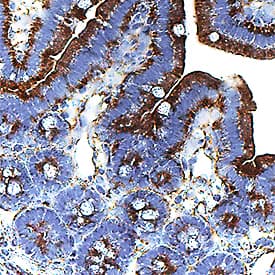
Gas6 in Mouse Intestine.
Gas6 was detected in perfusion fixed paraffin-embedded sections of mouse intestine using Goat Anti-Mouse Gas6 Antigen Affinity-purified Polyclonal Antibody (Catalog # AF986) at 1 µg/mL for 1 hour at room temperature followed by incubation with the Anti-Goat IgG VisUCyte™ HRP Polymer Antibody (Catalog # VC004). Before incubation with the primary antibody, tissue was subjected to heat-induced epitope retrieval using Antigen Retrieval Reagent-Basic (Catalog # CTS013). Tissue was stained using DAB (brown) and counterstained with hematoxylin (blue). Specific staining was localized to apical plasma membrane. View our protocol for IHC Staining with VisUCyte HRP Polymer Detection Reagents.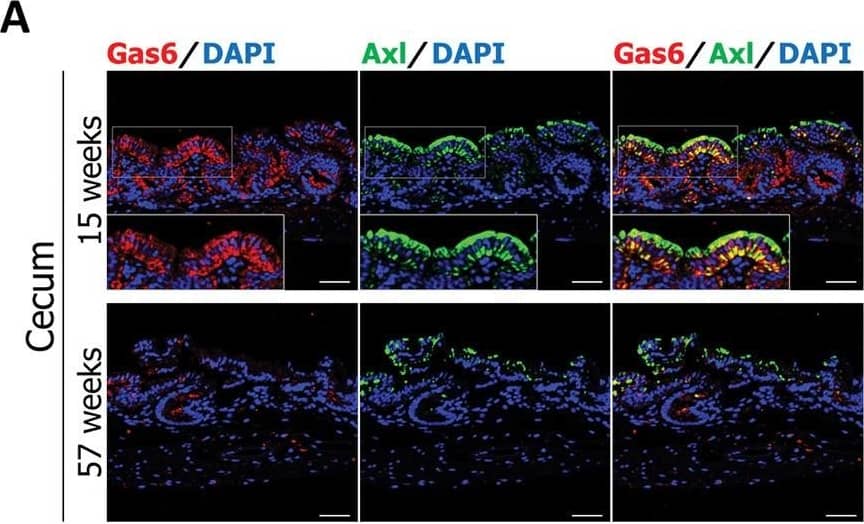
Detection of Gas6 by Immunohistochemistry
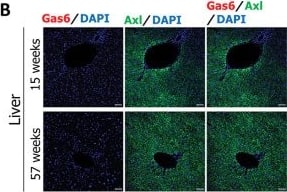
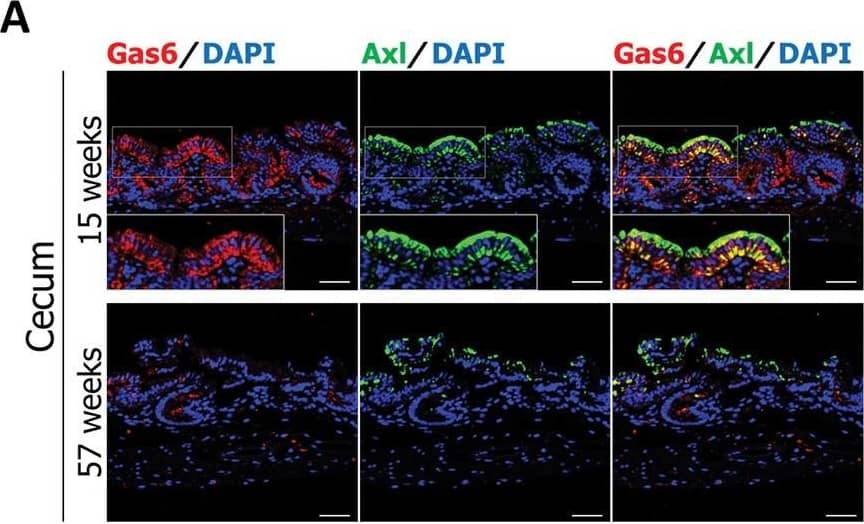
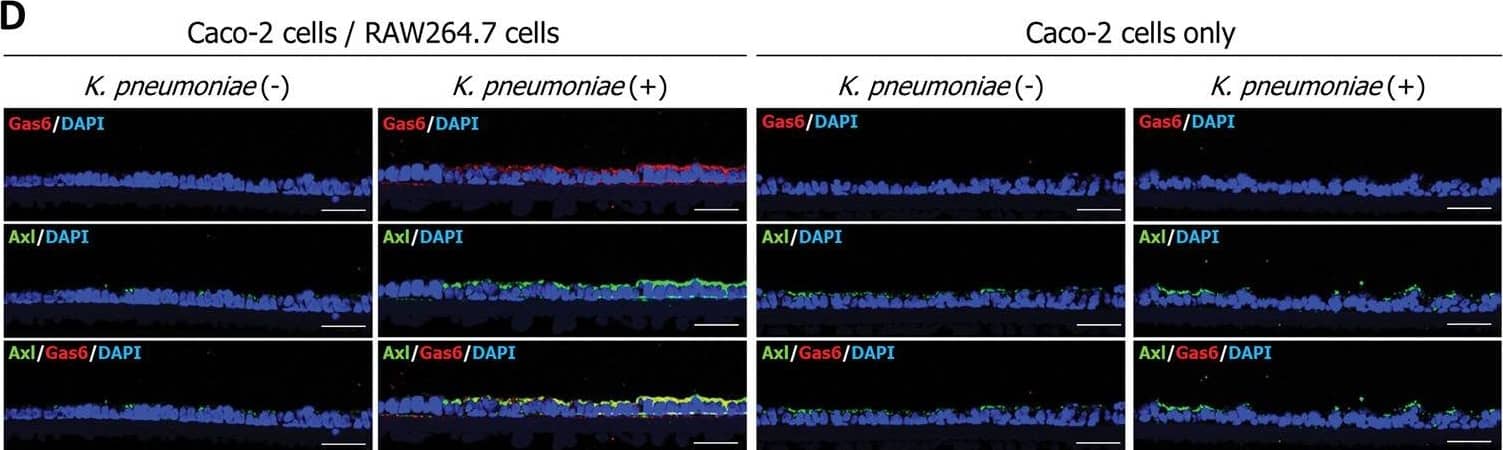
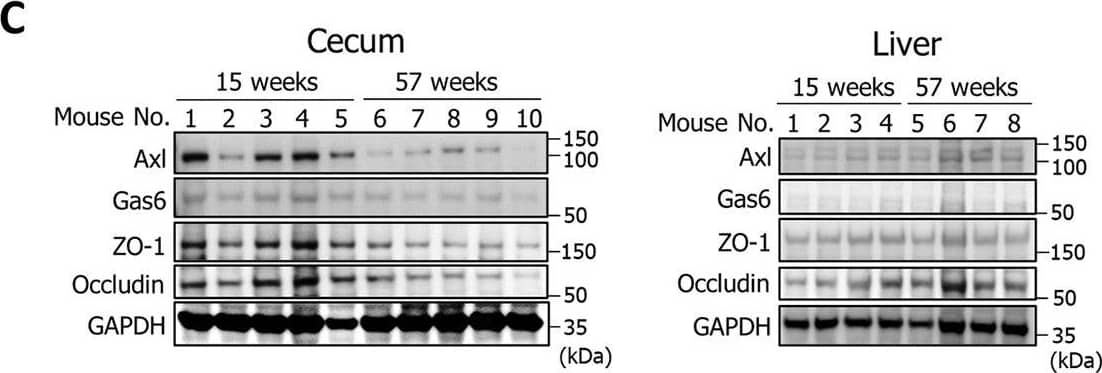
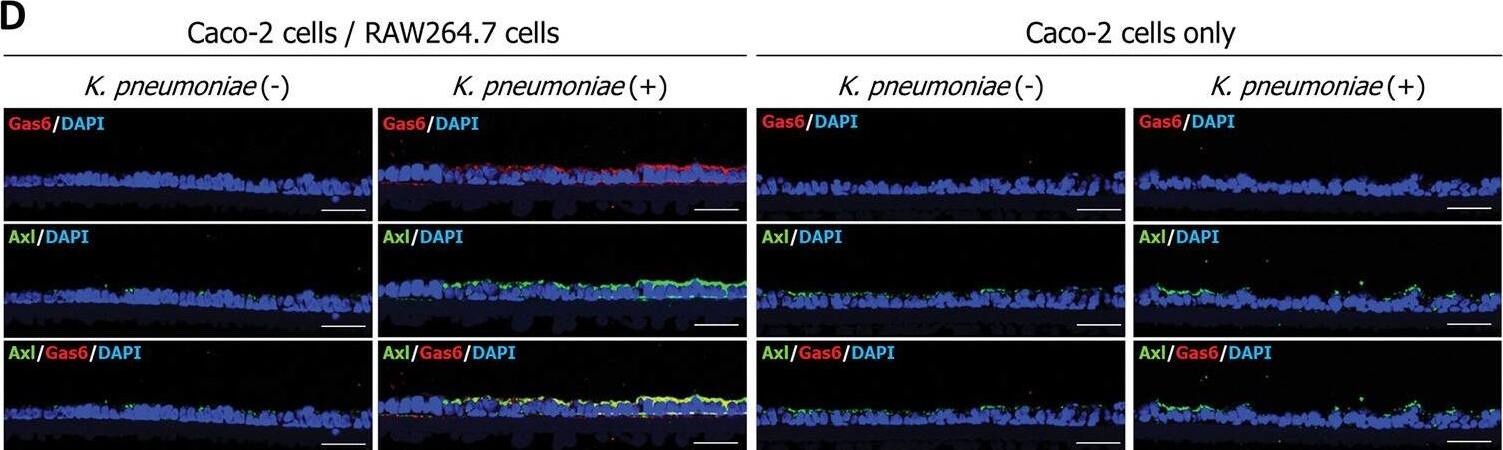
Gas6 & Axl expression in the cecal mucosa during K. pneumoniae infection decreases with aging.(A & B) Sections of cecal mucosa (A) or liver (B) were from mice aged 15 or 57 weeks at 2 days after infection with K. pneumoniae ATCC43816 pmCherry & immunostained with an anti-Gas6 antibody & an anti-Axl antibody. Each image has six independent replicates. Scale bar = 50 μm. (C) Detection of Axl, Gas6, ZO-1, & occludin by WBting. Cecum & liver tissues were collected, homogenized, & analyzed using an anti-Axl antibody, an anti-Gas6 antibody, an anti-ZO-1 antibody, or an anti-occludin antibody. Each lane of WBting images represents the protein from an individual mouse (mouse number = 5 (cecum) or 4 (liver) per group). Western blotting analysis represents three independent replicates. (D) Western blotting signal intensities were analyzed by ImageJ software. Each dot represents the value collected from an individual mouse (mouse number = 5 (cecum) or 4 (liver) per group). Data are presented as the mean ± SD. NS: not significant, *p < 0.05, **p < 0.01. p values were calculated by the Student’s t test. (E) Linear correlation between Gas6 expression & Axl expression in the cecum or liver of mice aged 15 (red circles) or 57 (blue circles) weeks infected with K. pneumoniae ATCC43816 pmCherry. Each dot represents an ELISA measured value of each protein sample collected from an individual mouse (mouse number = 5 per group). r > 0.70 & p < 0.05. (F) The population of CD11b+F4/80+ macrophages in the intestinal mucosa of young (14-week-old) & old (56-week-old) mice was examined by staining with anti-F4/80 & anti-CD11b antibodies. The percentage of F4/80-positive/CX3CR1-negative cells in 14-week-old & 56-week-old mice was 29.5% & 8.87%, respectively. Data are representative of four mice per group. Image collected & cropped by CiteAb from the following open publication (https://pubmed.ncbi.nlm.nih.gov/37289655), licensed under a CC-BY license. Not internally tested by R&D Systems.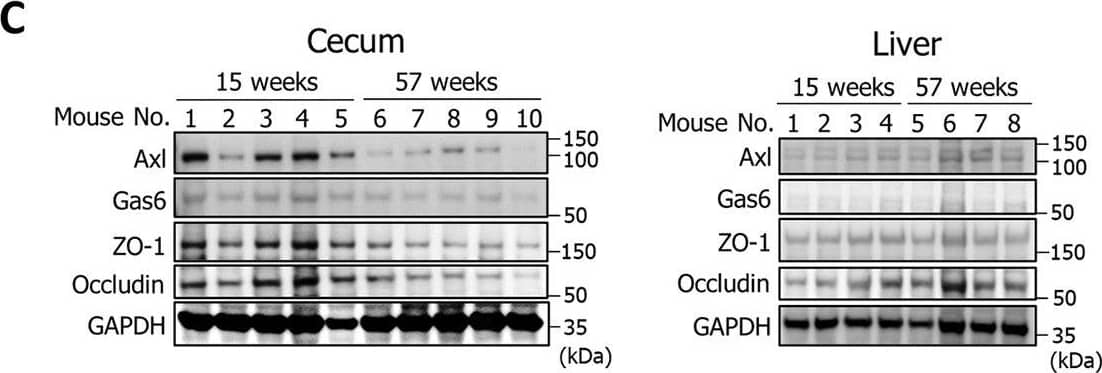
Detection of Gas6 by Western Blot
Gas6 & Axl expression in the cecal mucosa during K. pneumoniae infection decreases with aging.(A & B) Sections of cecal mucosa (A) or liver (B) were from mice aged 15 or 57 weeks at 2 days after infection with K. pneumoniae ATCC43816 pmCherry & immunostained with an anti-Gas6 antibody & an anti-Axl antibody. Each image has six independent replicates. Scale bar = 50 μm. (C) Detection of Axl, Gas6, ZO-1, & occludin by WBting. Cecum & liver tissues were collected, homogenized, & analyzed using an anti-Axl antibody, an anti-Gas6 antibody, an anti-ZO-1 antibody, or an anti-occludin antibody. Each lane of WBting images represents the protein from an individual mouse (mouse number = 5 (cecum) or 4 (liver) per group). Western blotting analysis represents three independent replicates. (D) Western blotting signal intensities were analyzed by ImageJ software. Each dot represents the value collected from an individual mouse (mouse number = 5 (cecum) or 4 (liver) per group). Data are presented as the mean ± SD. NS: not significant, *p < 0.05, **p < 0.01. p values were calculated by the Student’s t test. (E) Linear correlation between Gas6 expression & Axl expression in the cecum or liver of mice aged 15 (red circles) or 57 (blue circles) weeks infected with K. pneumoniae ATCC43816 pmCherry. Each dot represents an ELISA measured value of each protein sample collected from an individual mouse (mouse number = 5 per group). r > 0.70 & p < 0.05. (F) The population of CD11b+F4/80+ macrophages in the intestinal mucosa of young (14-week-old) & old (56-week-old) mice was examined by staining with anti-F4/80 & anti-CD11b antibodies. The percentage of F4/80-positive/CX3CR1-negative cells in 14-week-old & 56-week-old mice was 29.5% & 8.87%, respectively. Data are representative of four mice per group. Image collected & cropped by CiteAb from the following open publication (https://pubmed.ncbi.nlm.nih.gov/37289655), licensed under a CC-BY license. Not internally tested by R&D Systems.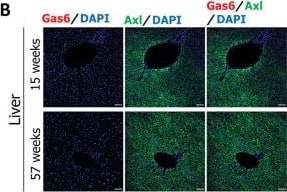


Applications for Mouse Gas6 Antibody
Application
Recommended Usage
Immunohistochemistry
1-15 µg/mL
Sample: Perfusion fixed paraffin-embedded sections of mouse intestine
Sample: Perfusion fixed paraffin-embedded sections of mouse intestine
Mouse Gas6 Sandwich Immunoassay
Please Note: Optimal dilutions of this antibody should be experimentally determined.
Reviewed Applications
Read 1 review rated 4 using AF986 in the following applications:
Formulation, Preparation, and Storage
Purification
Antigen Affinity-purified
Reconstitution
Reconstitute at 0.2 mg/mL in sterile PBS. For liquid material, refer to CoA for concentration.
Formulation
Lyophilized from a 0.2 μm filtered solution in PBS with Trehalose. *Small pack size (SP) is supplied either lyophilized or as a 0.2 µm filtered solution in PBS.
Shipping
Lyophilized product is shipped at ambient temperature. Liquid small pack size (-SP) is shipped with polar packs. Upon receipt, store immediately at the temperature recommended below.
Stability & Storage
Use a manual defrost freezer and avoid repeated freeze-thaw cycles.
- 12 months from date of receipt, -20 to -70 °C as supplied.
- 1 month, 2 to 8 °C under sterile conditions after reconstitution.
- 6 months, -20 to -70 °C under sterile conditions after reconstitution.
Background: Gas6
Growth arrest-specific gene 6 (Gas6) was initially characterized as a gene whose expression was up-regulated in serum starved NIH 3T3 fibroblasts and whose expression is down-regulated during growth induction. Mouse Gas6 is a 673 amino acid protein that shares 81% identity to its human homolog. Gas6 is a member of the vitamin K-dependent family of proteins that includes human protein S, a negative coregulator in the blood coagulation pathway. Gas6 and protein S share structural motifs that characterize this family: an extensively gamma-carboxylated amino terminus (Gla domain), four EGF-like repeats, and a carboxy terminus containing globular (G) domains with homology to steroid hormone-binding globulin. It is a ligand for the Axl (Ufo/Ark), Sky (Dtk/Tyro3/Rse/Brt/Tif), and Mer (Eyk) families of tyrosine kinase receptors. Gas6 binds to these receptors via tandem G domains at its C-terminus. Gas6 is ubiquitously expressed, but most abundantly in lung, intestine, bone marrow and endothelium.
Gas6 has been implicated in a variety of biological processes. It serves as a mitogen for fibroblasts, endothelial cells, neural cells, vascular smooth muscle cells and several tumor-derived cell lines. In addition, Gas6 prevents apoptosis, independent of its mitogenic activity. Gas6 is capable of inducing cell adhesion and chemotaxis in specific cell types. It also supports vitamin K-independent hematopoiesis when expressed by stromal cells. Gas6 signal transduction following Axl/Sky/Mer receptor activation has been reported to occur through such diverse signaling pathways as PI3K, MAP kinase, Src, Ras and beta-catenin.
References
- Manfioletti, G. et al. (1993) Mol. Cell Biol. 13:4976.
- Goruppi, S. et al. (1996) Oncogene 12:471.
- Crosier, K and P. Crosier (1997) Pathology 29:131.
- Dormady, S. et al. (2000) Proc. Natl. Acad. Sci. USA 97:12260.
- Goruppi, S. et al. (2001) Mol. Cell Biol. 21:902.
Long Name
Growth-arrest-specific Protein 6
Alternate Names
AXLLG
Gene Symbol
GAS6
UniProt
Additional Gas6 Products
Product Documents for Mouse Gas6 Antibody
Product Specific Notices for Mouse Gas6 Antibody
For research use only
Loading...
Loading...
Loading...
Loading...
Loading...