TrkA: Proteins and Enzymes

TrkA, the product of the protooncogene trk, is a member of the neurotrophic tyrosine kinase receptor family that has three members. TrkA, TrkB and TrkC preferentially bind NGF, NT-4 and BDNF, and NT-3, respectively. All Trk family proteins share a conserved complex subdomain organization consisting of a signal peptide, two cysteine-rich domains, a cluster of three leucine-rich motifs, and two immunoglobulin-like domains in the extracellular region, as well as an intracellular region that contains the tyrosine kinase domain.

Two distinct TrkA isoforms that differ by virtue of a 6 amino acid insertion in their extracellular domain have been identified. The longer TrkA isoform is the only isoform expressed within neuronal tissues whereas the shorter TrkA is expressed mainly in non neuronal tissues. NGF binds to TrkA with low affinity and activates its cytoplasmic kinase, initiating a signaling cascade that mediates neuronal survival and differentiation. Higher affinity binding of NGF requires the coexpression of TrkA with the p75 NGF receptor (NGFR), a member of the tumor necrosis factor receptor superfamily. NGFR binds all neurotrophins with low affinity and modulates Trk activity as well as alters the specificity of Trk receptors for their ligands. NGFR can also mediate cell death when expressed independent of Trk.

Show More

8 results for "TrkA Proteins and Enzymes" in Products

8 results for "TrkA Proteins and Enzymes" in Products

TrkA: Proteins and Enzymes

TrkA, the product of the protooncogene trk, is a member of the neurotrophic tyrosine kinase receptor family that has three members. TrkA, TrkB and TrkC preferentially bind NGF, NT-4 and BDNF, and NT-3, respectively. All Trk family proteins share a conserved complex subdomain organization consisting of a signal peptide, two cysteine-rich domains, a cluster of three leucine-rich motifs, and two immunoglobulin-like domains in the extracellular region, as well as an intracellular region that contains the tyrosine kinase domain.

Two distinct TrkA isoforms that differ by virtue of a 6 amino acid insertion in their extracellular domain have been identified. The longer TrkA isoform is the only isoform expressed within neuronal tissues whereas the shorter TrkA is expressed mainly in non neuronal tissues. NGF binds to TrkA with low affinity and activates its cytoplasmic kinase, initiating a signaling cascade that mediates neuronal survival and differentiation. Higher affinity binding of NGF requires the coexpression of TrkA with the p75 NGF receptor (NGFR), a member of the tumor necrosis factor receptor superfamily. NGFR binds all neurotrophins with low affinity and modulates Trk activity as well as alters the specificity of Trk receptors for their ligands. NGFR can also mediate cell death when expressed independent of Trk.

Show More
Source: NS0
Accession #: AAA36770
Applications: BA
R&D Systems Recombinant Proteins and Enzymes
Source: NS0
Accession #: P35739
Applications: BA
R&D Systems Recombinant Proteins and Enzymes

Biotinylated

Source: CHO
Accession #: P04629.4
Applications: BA
(2)

Analyzed by SEC-MALS

Source: CHO
Accession #: XP_005541454.3
Applications: BA
(3)
Source: CHO
Accession #: XP_005541454.3
Applications: BA
(2)
Source: NS0
Accession #: Q3UFB7
Applications: BA
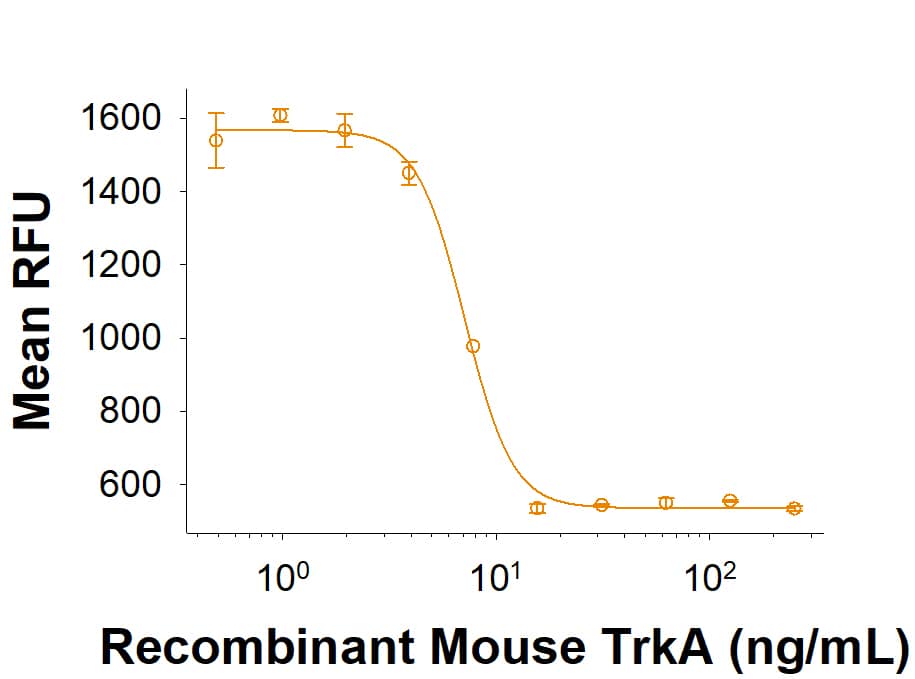
Recombinant Mouse TrkA Fc Chimera Protein Bioactivity
(2)
Source: HEK293
Accession #: P04629-1
Applications: BA
Recombinant Human TrkA His Tagged Protein Bioactivity
(2)
Applications: AC
Results Per Page
5 10 25 50
/ 1