
Normal Goat IgG Control Best Seller
R&D Systems, part of Bio-Techne | Catalog # AB-108-C


Conjugate
Catalog #
Key Product Details
Validated by
Knockout/Knockdown, Biological Validation
Species Reactivity
Goat
Applications
Control
Label
Unconjugated
Antibody Source
Polyclonal Goat IgG
Product Specifications
Immunogen
NA
Specificity
Serum was obtained from naive (non-immunized) goats and purified for use as normal goat IgG.
Clonality
Polyclonal
Host
Goat
Isotype
IgG
Scientific Data Images for Normal Goat IgG Control
Detection of Normal Goat IgG Control by Flow Cytometry
SH-SY5Y human neuroblastoma cell line was stained with Goat Anti-Human/Mouse/Rat Ephrin-B2 Antigen Affinity-purified Polyclonal Antibody (Catalog # AF496, filled histogram) or Normal Goat IgG Isotype Control Antibody (Catalog # AB-108-C, open histogram), followed by Phycoerythrin-conjugated Anti-Goat IgG Secondary Antibody (Catalog # F0107).
Detection of Mouse IgG by Immunocytochemistry/ Immunofluorescence
Decreased macrophage recruitment correlates with decreased angiogenesis.A) Quantification of BrdU incorporation demonstrates that decreased macrophage infiltration does not significantly correlate with a change in epithelial cell proliferation (N.S. = not significant). B) Quantification of VWF staining reveals decreased blood vessels associated with epithelial structures in mammary glands from mice treated with B/B and anti-CX3CR1 blocking antibody compared with mice treated with B/B and IgG control antibody. *p<0.05. C, D) Representative images of VWF stained mammary glands from mice treated with B/B and either control IgG antibody (C) or anti-CX3CR1 (D). Green = VWF staining, blue = DAPI. Arrows indicate VWF-positive structures. Scale bars represent 50 µM. Results in each figure panel are representative of a minimum of three different mice for each treatment group and genotype. Image collected and cropped by CiteAb from the following open publication (https://dx.plos.org/10.1371/journal.pone.0045877), licensed under a CC-BY license. Not internally tested by R&D Systems.
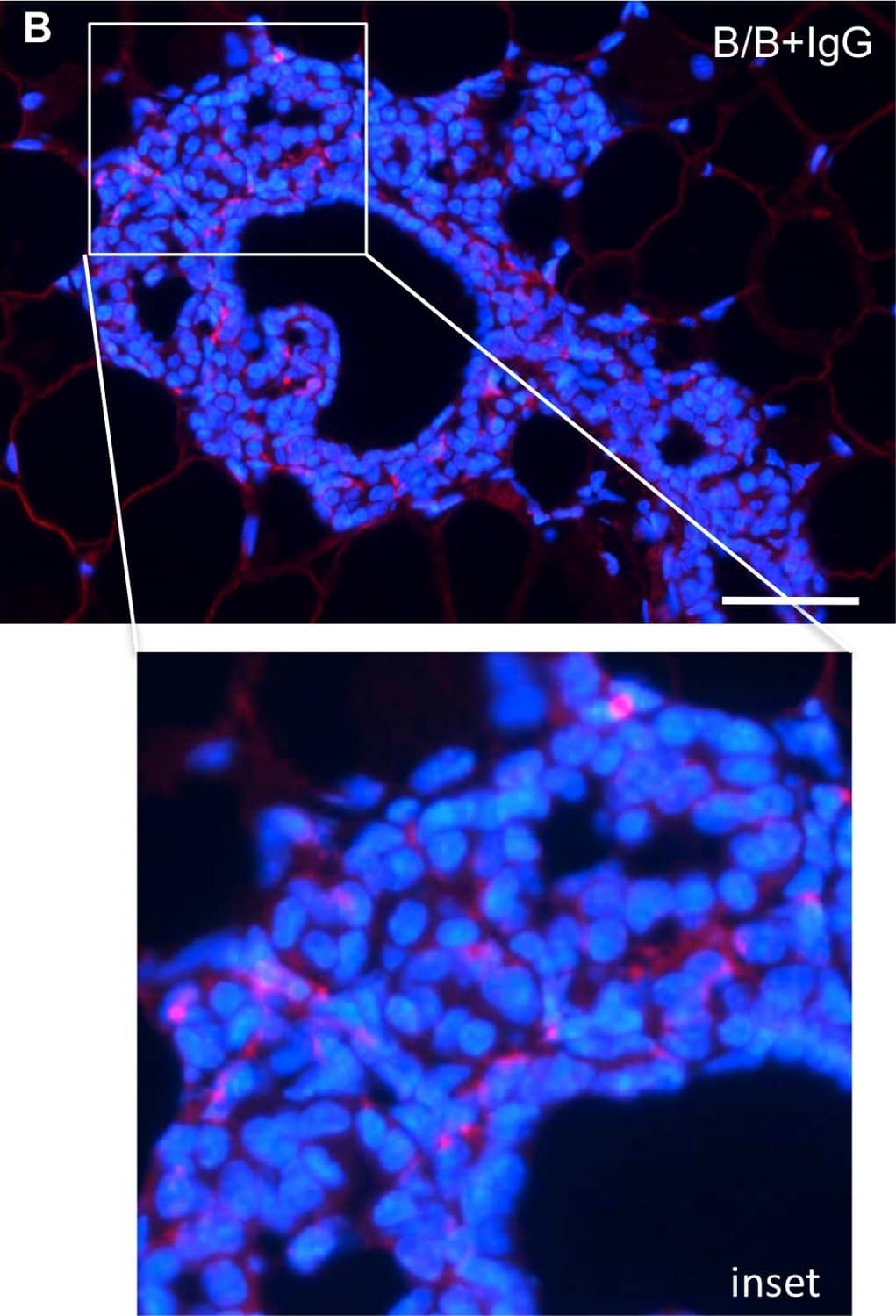
Detection of Mouse IgG by Immunocytochemistry/ Immunofluorescence
iFGFR1 activation in vivo promotes recruitment of CX3CR1-positive macrophages.MMTV-iFGFR1 transgenic mice were treated with B/B in order to analyze the population of macrophages that are recruited to the mammary epithelium during early stages of iFGFR1-induced mammary tumorigenesis. A) MMTV-iFGFR1 mice treated with B/B demonstrated an increase in macrophage recruitment after 10 days as indicated by an increased in the number of F4/80 positive cells. MMTV-iFGFR1 mice treated with anti-CX3CR1 in conjunction with B/B demonstrated a reduction in macrophage recruitment at 10 days indicating that iFGFR1 activation is responsible for recruiting a subset of macrophages that express CX3CR1. ***p<0.0001. Error bars represent SEM. B) Representative image of macrophages associated with budding epithelial structures in mammary glands from mice treated with control IgG antibody. C) Representative image of macrophages associated with budding epithelial structures in mammary glands from mice treated with anti-CX3CR1. Red = F4/80 staining, blue = DAPI. Scale bars represent 50 µM. Results in each figure panel are representative of a minimum of three different mice for each treatment group and genotype. Image collected and cropped by CiteAb from the following open publication (https://dx.plos.org/10.1371/journal.pone.0045877), licensed under a CC-BY license. Not internally tested by R&D Systems.
Applications for Normal Goat IgG Control
Application
Recommended Usage
Control
Negative control for use in conjunction with R&D Systems antibodies. Use at the same concentration as the detection antibody.
Reviewed Applications
Read 22 reviews rated 4.5 using AB-108-C in the following applications:
Formulation, Preparation, and Storage
Purification
Protein A or G purified
Reconstitution
Dissolve the lyophilized goat IgG in sterile PBS, pH 7.4. If 1 mL of PBS is used, the antibody concentration will be 1 mg/mL.
Formulation
Lyophilized from a 0.2 μm filtered solution in PBS with Trehalose.
Shipping
The product is shipped at ambient temperature. Upon receipt, store it immediately at the temperature recommended below.
Stability & Storage
Use a manual defrost freezer and avoid repeated freeze-thaw cycles.
- 12 months from date of receipt, -20 to -70 °C as supplied.
- 1 month, 2 to 8 °C under sterile conditions after reconstitution.
- 6 months, -20 to -70 °C under sterile conditions after reconstitution.
Background: IgG
R&D Systems offers a range of secondary antibodies and controls for flow cytometry, immunohistochemistry, and Western blotting. We provide species-specific secondary antibodies that are available with a variety of conjugated labels.
Our NorthernLights fluorescent secondary antibodies are bright and resistant to photobleaching. We are currently offering secondary antibodies recognizing mouse, rat, goat, sheep, and rabbit IgG as well as chicken IgY. These reagents are available with three distinct excitation and emission maxima, making them ideal for multi-color fluorescence microscopy.
Long Name
Immunoglobulin G
Alternate Names
Immunoglobulin G, ImmunoglobulinG
Additional IgG Products
Product Documents for Normal Goat IgG Control
Product Specific Notices for Normal Goat IgG Control
For research use only
Loading...
Loading...
Loading...
Loading...