
Human TRAIL R2/TNFRSF10B Antibody
R&D Systems, part of Bio-Techne | Catalog # AF631


Conjugate
Catalog #
Key Product Details
Species Reactivity
Validated:
Human
Cited:
Human, Mouse
Applications
Validated:
Western Blot, Agonist Activity
Cited:
Immunohistochemistry, Immunohistochemistry-Paraffin, Western Blot, Neutralization, Flow Cytometry, Immunocytochemistry, Immunoprecipitation, Functional Assay
Label
Unconjugated
Antibody Source
Polyclonal Goat IgG
Product Specifications
Immunogen
Mouse myeloma cell line NS0-derived recombinant human TRAIL R2/TNFRSF10B
Ala54-Glu182
Accession # Q6FH58
Ala54-Glu182
Accession # Q6FH58
Specificity
Detects human TRAIL R2/TNFRSF10B in direct ELISAs and Western blots.
Clonality
Polyclonal
Host
Goat
Isotype
IgG
Endotoxin Level
<0.10 EU per 1 μg of the antibody by the LAL method.
Scientific Data Images for Human TRAIL R2/TNFRSF10B Antibody
Detection of Human TRAIL R2/TNFRSF10B by Western Blot.
Western blot shows lysates of HepG2 human hepatocellular carcinoma cell line. PVDF membrane was probed with 1 µg/mL of Human TRAIL R2/TNFRSF10B Antigen Affinity-purified Polyclonal Antibody (Catalog # AF631) followed by HRP-conjugated Anti-Goat IgG Secondary Antibody (HAF019). A specific band was detected for TRAIL R2/TNFRSF10B at approximately 45 kDa (as indicated). This experiment was conducted under reducing conditions and using Immunoblot Buffer Group 8.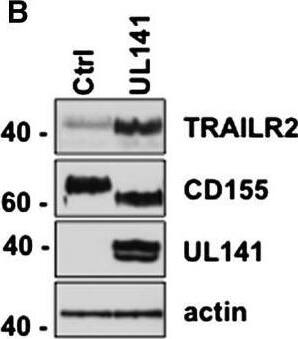
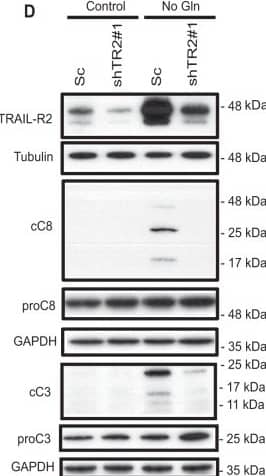
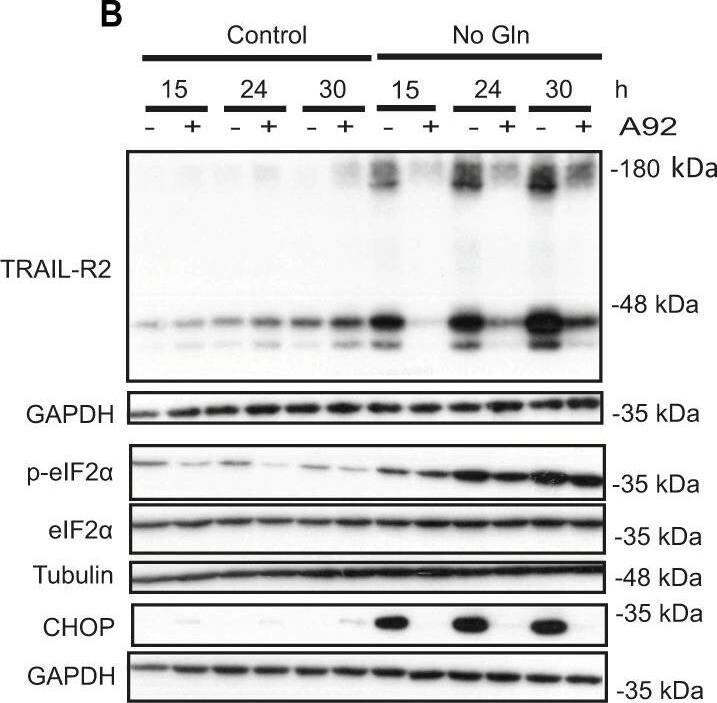
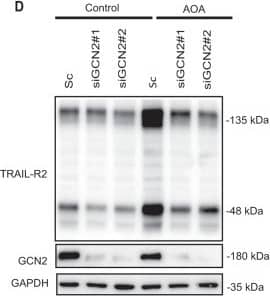
Detection of Human TRAIL R2/TNFRSF10B by Western Blot
UL141 Blockade of Both TRAIL DR and CD155 Contributes to NK Cell Inhibition(A) RAd control or UL141 transduced A549 cells were analyzed for expression of TRAIL-R2, CD155 and CD112 at the time of NK cell addition by flow cytometry.(B) Western blot of RAd-transduced A549 cells.(C) Expression of TRAIL by IFN alpha activated (blue) or unactivated (red) human NK cells assessed by flow cytometry.(D) IFN alpha-activated NK cells were purified from human peripheral blood and added to A549 lung epithelial cells transduced with either control adenovirus vector (Rad-Cntrl) or Rad-UL141 (effector to target [E:T] ratio of 2). Blocking alphaDNAM-1 antibody or blocking soluble TRAIL-R2 (10 μg/ml) was added to cultures where indicated (+), and control mIgG or sCD30 was added as a control to the other cultures. Apoptosis of A549 cells was assessed 4 hr later. Shown are two representative experiments of more than six performed.(E) Summary of NK killing data from eight separate experiments and four different donors. †Data are mean ± SEM from n = 1 to 3 wells. ∗Bonferroni post test shows significance at p < 0.05.See also Figure S5. Image collected and cropped by CiteAb from the following open publication (https://pubmed.ncbi.nlm.nih.gov/23498957), licensed under a CC-BY license. Not internally tested by R&D Systems.
Detection of Human TRAIL R2/TNFRSF10B by Western Blot
TRAIL-R2 Expression in HCMV-Infected Cells Human foreskin fibroblasts (HFFs) were infected (72 hr, MOI = 20) with HCMV Merlin (Mer) or Merlin deltaUL141 (Mer delta141) and analyzed for TRAIL-R2 expression by (A) flow cytometry and (B) Western blot. IgG(–), isotype control antibody staining. Results are representative of six to ten performed experiments. See also Figure S2. Image collected and cropped by CiteAb from the following open publication (https://pubmed.ncbi.nlm.nih.gov/23498957), licensed under a CC-BY license. Not internally tested by R&D Systems.





Applications for Human TRAIL R2/TNFRSF10B Antibody
Application
Recommended Usage
Agonist Activity
Measured by its ability to induce apoptosis on Jurkat human acute T cell leukemia cells. The ED50 for this effect is typically 7.00 - 70.0 ng/mL.
Western Blot
1 µg/mL
Sample: HepG2 human hepatocellular carcinoma cell line
Sample: HepG2 human hepatocellular carcinoma cell line
Formulation, Preparation, and Storage
Purification
Antigen Affinity-purified
Reconstitution
Reconstitute at 0.2 mg/mL in sterile PBS. For liquid material, refer to CoA for concentration.
Formulation
Lyophilized from a 0.2 μm filtered solution in PBS with Trehalose. *Small pack size (SP) is supplied either lyophilized or as a 0.2 µm filtered solution in PBS.
Shipping
Lyophilized product is shipped at ambient temperature. Liquid small pack size (-SP) is shipped with polar packs. Upon receipt, store immediately at the temperature recommended below.
Stability & Storage
Use a manual defrost freezer and avoid repeated freeze-thaw cycles.
- 12 months from date of receipt, -20 to -70 °C as supplied.
- 1 month, 2 to 8 °C under sterile conditions after reconstitution.
- 6 months, -20 to -70 °C under sterile conditions after reconstitution.
Background: TRAIL R2/TNFRSF10B
Human TRAIL R2, also called DR5 and TRICK 2 is a type 1, TNF R family, membrane protein which is a receptor for TRAIL (APO2 ligand). In the new TNF superfamily nomenclature, TRAIL R2 is referred to as TNFRSF10B. TRAIL R2 cDNA encodes a 440 amino acid residue precursor protein containing extracellular cysteine-rich domains, a transmembrane domain and a cytoplasmic death domain. Among TNF receptor family proteins, TRAIL R2 is most closely related to TRAIL R1/DR4, sharing 55% amino acid sequence identity. Binding of trimeric TRAIL to TRAIL R2 induces apoptosis. The induction of apoptosis likely requires oligomerization of the receptor. The human TRAIL R2/Fc chimera neutralizes the ability of TRAIL to induce apoptosis. Besides TRAIL R2, an additional TRAIL R1/DR4, which tranduces apoptosis signaling, and two TRAIL decoy receptors, which antagonize TRAIL-induced apoptosis, have been reported.
References
- Chaudhary, P.M. et al. (1997) Immunity 7:821.
- Walczak, H. et al. (1997) EMBO J. 16:5386.
- Golstein, P. (1997) Curr. Biol. 7:R750.
Long Name
TRAIL Receptor 2
Alternate Names
CD262, DR5, TNFRSF10B, TRAILR2
Gene Symbol
TNFRSF10B
UniProt
Additional TRAIL R2/TNFRSF10B Products
Product Documents for Human TRAIL R2/TNFRSF10B Antibody
Product Specific Notices for Human TRAIL R2/TNFRSF10B Antibody
For research use only
Loading...
Loading...
Loading...
Loading...
Loading...