
Human Plexin B1 Antibody
R&D Systems, part of Bio-Techne | Catalog # MAB37491


Conjugate
Catalog #
Key Product Details
Species Reactivity
Validated:
Human
Cited:
Human, Mouse
Applications
Validated:
Flow Cytometry, CyTOF-ready
Cited:
Immunohistochemistry, Functional Assay
Label
Unconjugated
Antibody Source
Monoclonal Mouse IgG1 Clone # 559830
Product Specifications
Immunogen
NS0 mouse myeloma cell line transfected with human Plexin B1
Accession # O43157
Accession # O43157
Specificity
Detects human Plexin B1 in direct ELISAs.
Clonality
Monoclonal
Host
Mouse
Isotype
IgG1
Scientific Data Images for Human Plexin B1 Antibody
Detection of Plexin B1 in Jurkat Human Cell Line by Flow Cytometry.
Jurkat human acute T cell leukemia cell line was stained with Mouse Anti-Human Plexin B1 Monoclonal Antibody (Catalog # MAB37491, filled histogram) or isotype control antibody (Catalog # MAB002, open histogram), followed by Phycoerythrin-conjugated Anti-Mouse IgG F(ab')2Secondary Antibody (Catalog # F0102B).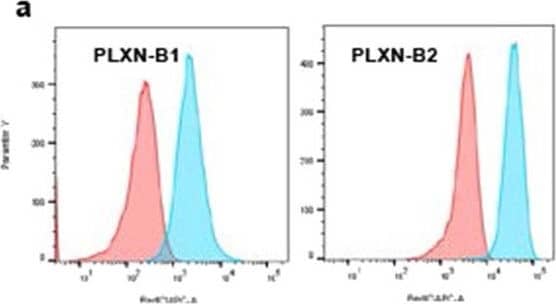
Detection of Plexin B1 by Flow Cytometry
SEMA4D triggers receptor-mediated astrocyte reactivity, including changes in astrocyte morphology, expression of key transporters for glutamate recycling and energy metabolism and impairs astrocyte function of glucose uptake. a Primary human astrocyte cultures were stained for PLXN receptors (blue), compared to isotype control antibodies (red). Antibody blocking effect was determined by incubation with rSEMA4D or control protein, in presence/absence of anti-SEMA4D antibody/VX15 (human IgG4) or isotype-matched control antibodies for 48 h. Cultures were stained for b EAAT-2, and c GLUT-1 and MCT-4 transporters. d In a separate experiment, blocking of receptors was assessed using anti-PLXNB1 (mouse IgG1) and/or anti-PLXNB2 (mouse IgG2a) or isotype-matched control antibodies and the same conditions as above. Quantification is shown as; mean + SEM of replicates for each treatment. e Glucose uptake was measured in human astrocyte cultures treated as above. rSEMA4D was added at time 0 and antibodies were added at t = 0 (solid lines and circles) for inhibition or t = 24 h (dotted lines and triangles) to evaluate reversal of activity. Quantification for each condition is shown as average + SEM from 3 wells/condition/timepoint. f Morphologic changes showing length and number of primary processes. For b to f, multivariate regression analysis was performed to determine the effect treatment conditions and dependent variables with treatment type. The significance levels are reported with Tukey post hoc tests for multivariate analysis Image collected and cropped by CiteAb from the following open publication (https://pubmed.ncbi.nlm.nih.gov/35933420), licensed under a CC-BY license. Not internally tested by R&D Systems.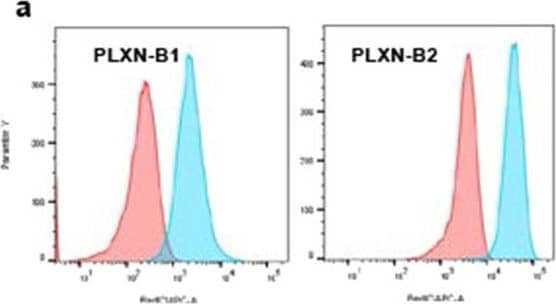
Detection of Plexin B1 by Flow Cytometry
SEMA4D triggers receptor-mediated astrocyte reactivity, including changes in astrocyte morphology, expression of key transporters for glutamate recycling and energy metabolism and impairs astrocyte function of glucose uptake. a Primary human astrocyte cultures were stained for PLXN receptors (blue), compared to isotype control antibodies (red). Antibody blocking effect was determined by incubation with rSEMA4D or control protein, in presence/absence of anti-SEMA4D antibody/VX15 (human IgG4) or isotype-matched control antibodies for 48 h. Cultures were stained for b EAAT-2, and c GLUT-1 and MCT-4 transporters. d In a separate experiment, blocking of receptors was assessed using anti-PLXNB1 (mouse IgG1) and/or anti-PLXNB2 (mouse IgG2a) or isotype-matched control antibodies and the same conditions as above. Quantification is shown as; mean + SEM of replicates for each treatment. e Glucose uptake was measured in human astrocyte cultures treated as above. rSEMA4D was added at time 0 and antibodies were added at t = 0 (solid lines and circles) for inhibition or t = 24 h (dotted lines and triangles) to evaluate reversal of activity. Quantification for each condition is shown as average + SEM from 3 wells/condition/timepoint. f Morphologic changes showing length and number of primary processes. For b to f, multivariate regression analysis was performed to determine the effect treatment conditions and dependent variables with treatment type. The significance levels are reported with Tukey post hoc tests for multivariate analysis Image collected and cropped by CiteAb from the following open publication (https://pubmed.ncbi.nlm.nih.gov/35933420), licensed under a CC-BY license. Not internally tested by R&D Systems.Applications for Human Plexin B1 Antibody
Application
Recommended Usage
CyTOF-ready
Ready to be labeled using established conjugation methods. No BSA or other carrier proteins that could interfere with conjugation.
Flow Cytometry
2.5 µg/106 cells
Sample: Jurkat human acute T cell leukemia cell line
Sample: Jurkat human acute T cell leukemia cell line
Formulation, Preparation, and Storage
Purification
Protein A or G purified from hybridoma culture supernatant
Reconstitution
Reconstitute at 0.5 mg/mL in sterile PBS. For liquid material, refer to CoA for concentration.
Formulation
Lyophilized from a 0.2 μm filtered solution in PBS with Trehalose. *Small pack size (SP) is supplied either lyophilized or as a 0.2 µm filtered solution in PBS.
Shipping
Lyophilized product is shipped at ambient temperature. Liquid small pack size (-SP) is shipped with polar packs. Upon receipt, store immediately at the temperature recommended below.
Stability & Storage
Use a manual defrost freezer and avoid repeated freeze-thaw cycles.
- 12 months from date of receipt, -20 to -70 °C as supplied.
- 1 month, 2 to 8 °C under sterile conditions after reconstitution.
- 6 months, -20 to -70 °C under sterile conditions after reconstitution.
Background: Plexin B1
Alternate Names
PLXN5, PLXNB1, Transmembrane Protein SEP
Gene Symbol
PLXNB1
UniProt
Additional Plexin B1 Products
Product Documents for Human Plexin B1 Antibody
Product Specific Notices for Human Plexin B1 Antibody
For research use only
Loading...
Loading...
Loading...
Loading...
Loading...
Loading...