
Human CXCL9/MIG PE-conjugated Antibody
R&D Systems, part of Bio-Techne | Catalog # IC392P

Conjugate
Catalog #
Key Product Details
Species Reactivity
Validated:
Human
Cited:
Human
Applications
Validated:
Intracellular Staining by Flow Cytometry
Cited:
Chip Cytometry
Label
Phycoerythrin (Excitation = 488 nm, Emission = 565-605 nm)
Antibody Source
Monoclonal Mouse IgG1 Clone # 49106
Product Specifications
Immunogen
E. coli-derived recombinant human CXCL9/MIG
Thr23-Thr125
Accession # Q07325
Thr23-Thr125
Accession # Q07325
Specificity
Detects human CXCL9/MIG in ELISAs and Western blots. In ELISAs, does not cross-react with recombinant mouse (rm) CXCL9 or recombinant human CXCL10.
Clonality
Monoclonal
Host
Mouse
Isotype
IgG1
Scientific Data Images for Human CXCL9/MIG PE-conjugated Antibody
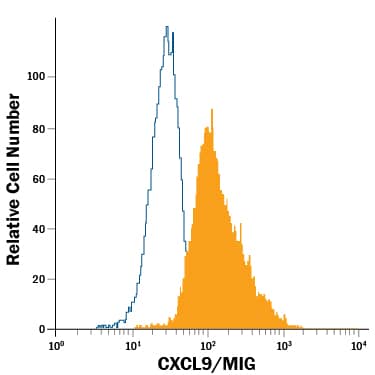
Detection of CXCL9/MIG in rhIFN gamma-treated THP‑1 Human Cell Line by Flow Cytometry.
THP-1 human acute monocytic leukemia cell line was treated for 24 hr with 100 U/mL rhIFN gamma then stained with Mouse Anti-Human CXCL9/MIG PE-conjugated Monoclonal Antibody (Catalog # IC392P, filled histogram) or isotype control antibody (Catalog # IC002P, open histogram). To facilitate intracellular staining, cells were fixed with Flow Cytometry Fixation Buffer (Catalog # FC004) and permeabilized with Flow Cytometry Permeabilization/Wash Buffer I (Catalog # FC005). View our protocol for Staining Intracellular Molecules.Applications for Human CXCL9/MIG PE-conjugated Antibody
Application
Recommended Usage
Intracellular Staining by Flow Cytometry
10 µL/106 cells
Sample: THP‑1 human acute monocytic leukemia cell line treated for 24 hr with 100 U/mL rhIFN gamma fixed with Flow Cytometry Fixation Buffer (Catalog # FC004) and permeabilized with Flow Cytometry Permeabilization/Wash Buffer I (Catalog # FC005)
Sample: THP‑1 human acute monocytic leukemia cell line treated for 24 hr with 100 U/mL rhIFN gamma fixed with Flow Cytometry Fixation Buffer (Catalog # FC004) and permeabilized with Flow Cytometry Permeabilization/Wash Buffer I (Catalog # FC005)
Spectra Viewer
Plan Your Experiments
Use our spectra viewer to interactively plan your experiments, assessing multiplexing options. View the excitation and emission spectra for our fluorescent dye range and other commonly used dyes.
Spectra Viewer
Formulation, Preparation, and Storage
Purification
Protein A or G purified from hybridoma culture supernatant
Formulation
Supplied in a saline solution containing BSA and Sodium Azide.
Shipping
The product is shipped with polar packs. Upon receipt, store it immediately at the temperature recommended below.
Stability & Storage
Store the unopened product at 2 - 8° C. Do not use past expiration date. Protect from light.
Background: CXCL9/MIG
CXCL9, a member of the alpha subfamily of chemokines that lack the ELR domain, was initially identified as a lymphokine-activated gene in mouse macrophages. Human CXCL9 was subsequently cloned using mouse MIG cDNA as a probe. The CXCL9 gene is induced in macrophages and in primary glial cells of the central nervous system specifically in response to IFN-gamma. CXCL9 has been shown to be a chemoattractant for activated T-lymphocytes and TIL but not for neutrophils or monocytes. The human CXCL9 cDNA encodes a 125 amino acid (aa) residue precursor protein with a 22 aa residue signal peptide that is cleaved to yield a 103 aa residue mature protein. CXCL9 has an extended carboxy-terminus containing greater than 50% basic aa residues and is larger than most other chemokines. The carboxy-terminal residues of CXCL9 are prone to proteolytic cleavage resulting in size heterogeneity of natural and recombinant CXCL9. CXCL9 with large carboxy-terminal deletions have been shown to have diminished activity in the calcium flux assay. CXCL9 is a homodimer and will heterodimerize with CXCL12. It is reported to bind to CXCR3, CXCR6 and CCR3. Over amino acids (aa) 23-125, human and mouse CXCl9 share 67% aa sequence identity.
Alternate Names
MIG
Gene Symbol
CXCL9
UniProt
Additional CXCL9/MIG Products
Product Documents for Human CXCL9/MIG PE-conjugated Antibody
Product Specific Notices for Human CXCL9/MIG PE-conjugated Antibody
For research use only
Loading...
Loading...
Loading...
Loading...
Loading...