
Human ACLP Antibody
R&D Systems, part of Bio-Techne | Catalog # MAB6425

Conjugate
Catalog #
Key Product Details
Species Reactivity
Human
Applications
Intracellular Staining by Flow Cytometry, CyTOF-ready
Label
Unconjugated
Antibody Source
Monoclonal Mouse IgG1 Clone # 590831
Product Specifications
Immunogen
Mouse myeloma cell line NS0-derived recombinant human ACLP
Glu345-Phe1158
Accession # Q8IUX7
Glu345-Phe1158
Accession # Q8IUX7
Specificity
Detects human ACLP in direct ELISAs. In direct ELISAs, no cross-reactivity with recombinant mouse ACLP is observed.
Clonality
Monoclonal
Host
Mouse
Isotype
IgG1
Scientific Data Images for Human ACLP Antibody
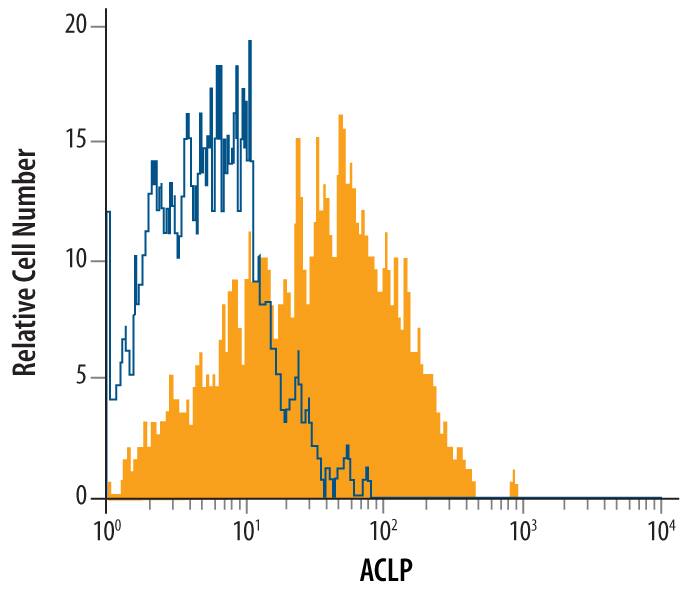
Detection of ACLP in HASMC Human Cells by Flow Cytometry.
HASMC human human aortic smooth muscle cells was stained with Human ACLP Monoclonal Antibody (Catalog # MAB6425, filled histogram) or isotype control antibody (Catalog # MAB002, open histogram), followed by Phycoerythrin-conjugated Anti-Mouse IgG F(ab')2Secondary Antibody (Catalog # F0102B). To facilitate intracellular staining, cells were fixed with paraformaldehyde and permeabilized with saponin.
Detection of ACLP in Molt-4 Human Cells by Flow Cytometry.
Molt-4 human human cell line was stained with Human ACLP Monoclonal Antibody (Catalog # MAB6425, filled histogram) or isotype control antibody (MAB002, open histogram), followed by Phycoerythrin-conjugated Anti-Mouse IgG F(ab')2Secondary Antibody (F0102B). To facilitate intracellular staining, cells were fixed with paraformaldehyde and permeabilized with saponin.Applications for Human ACLP Antibody
Application
Recommended Usage
CyTOF-ready
Ready to be labeled using established conjugation methods. No BSA or other carrier proteins that could interfere with conjugation.
Intracellular Staining by Flow Cytometry
0.25 µg/106 cells
Sample: HASMC human human aortic smooth muscle cells and Molt-4 human cell line
Sample: HASMC human human aortic smooth muscle cells and Molt-4 human cell line
Formulation, Preparation, and Storage
Purification
Protein A or G purified from hybridoma culture supernatant
Reconstitution
Sterile PBS to a final concentration of 0.5 mg/mL. For liquid material, refer to CoA for concentration.
Formulation
Lyophilized from a 0.2 μm filtered solution in PBS with Trehalose. *Small pack size (SP) is supplied either lyophilized or as a 0.2 µm filtered solution in PBS.
Shipping
Lyophilized product is shipped at ambient temperature. Liquid small pack size (-SP) is shipped with polar packs. Upon receipt, store immediately at the temperature recommended below.
Stability & Storage
Use a manual defrost freezer and avoid repeated freeze-thaw cycles.
- 12 months from date of receipt, -20 to -70 °C as supplied.
- 1 month, 2 to 8 °C under sterile conditions after reconstitution.
- 6 months, -20 to -70 °C under sterile conditions after reconstitution.
Background: ACLP
Aortic carboxypeptidase-like protein (ACLP), also known as adipocyte enhancer binding protein (AEBP1), is a 175 kDa molecule that contains a discoidin-like domain (aa 383-540) and a peptidase-like domain (aa 560-942). It is expressed in proliferating adipocytes and represses the transcription of FABP4. ACLP promotes macrophage cholesterol retention, the formation of foam cells, and inflammatory responses. It is also an extracellular matrix-associated protein found in fibrotic tissues including vascular smooth muscle. An alternately spliced isoform lacks aa 1-457 and has an altered sequence at its N-terminus. Over aa 345-1158, human ACLP shares 88% aa sequence identity with mouse and rat ACLP.
Long Name
Aortic Carboxypeptidase-like Protein
Alternate Names
AEBP1
Entrez Gene IDs
165 (Human)
Gene Symbol
AEBP1
UniProt
Additional ACLP Products
Product Documents for Human ACLP Antibody
Product Specific Notices for Human ACLP Antibody
For research use only
Loading...
Loading...
Loading...
Loading...
Loading...
Loading...