
Beyond p16: Direct Detection of High-Risk HPV in OPSCC with RNAscope™ ISH
"I immediately said:… Lets pick up the off the shelf RNAscope, and it just worked"
- John Tadross, MBBChir, PhD, Consultant Histopathologist & Molecular Pathologist | Addenbrooke's Hospital, Cambridge University Hospitals NHS Foundation Trust
For pathologists assessing oropharyngeal squamous cell carcinoma (OPSCC), accurate HPV status classification shapes treatment decisions, and often urgently. RNAscope™ ISH Probe High Risk HPV, a CE-IVD* marked high-risk HPV RNA in situ hybridization (ISH) assay, detects E6/E7 mRNA from 18 high-risk HPV types in FFPE tissue, delivering diagnostic confidence that p16 immunohistochemistry (IHC) alone cannot.
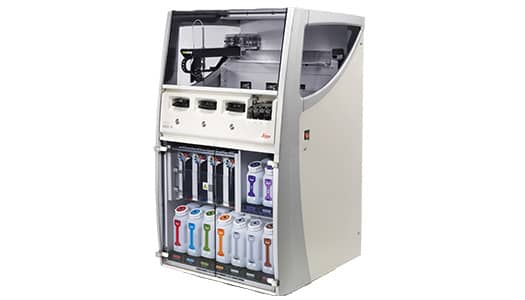
Figure 1: Automated RNAscope ISH fits seamlessly into pathology workflows. BOND-III by Leica Biosystems, a fully automated IHC/ISH stainer
The assay runs on the Leica BOND-III automated staining platform with the BOND RNAscope Brown Detection Kit, integrating directly into existing histopathology workflows. Full intended use conditions are defined in the RNAscope™ ISH Probe High Risk HPV IFU. Here, John Tadross, Consultant Histopathologist and Molecular Pathologist at Addenbrooke's Hospital, Cambridge, explains why his department made the switch, and what it means for patients.
Why p16 IHC Falls Short in OPSCC
p16 IHC is broadly accepted as a clinical marker for OPSCC because it correlates strongly with transcriptionally active HPV in certain well-defined presentations. Outside those settings, however, its limitations are significant. "In my subspecialty, there is a real need for high-risk HPV detection," says Tadross. "p16 is a surrogate, but it's actually not very useful outside very specific clinical settings."
This is because p16 is a marker of cell cycle dysregulation and can be upregulated by mechanisms entirely unrelated to viral infection. RNAscope™ ISH Probe High Risk HPV sidesteps this uncertainty by detecting E6/E7 mRNA directly — the transcriptional output of actively replicating high-risk HPV, and a more reliable indicator of whether infection is present.
When his department needed a robust clinical HPV assay, Tadross drew on his experience with RNAscope to make the call quickly. "I had colleagues who'd spent years working up various DNA ISH options for high-risk HPV," he says. "As the newest consultant tasked with sorting this out, I immediately said: I'm not doing this. Let's pick up the off-the-shelf RNAscope. And it just worked immediately."
That experience reflects a broader conviction about what ISH should deliver. "It turns out it's how ISH should work," says Tadross. "There's no messing around. It just works out-of-the-box."
The assay is also significantly more sensitive than DNA ISH. Even in tumors where the virus has integrated at low copy number, E6/E7 mRNA continues to be transcribed abundantly. "The benefit of RNAscope is that you might only have two integrated copies, but you'll still have a lot of RNA," Tadross explains, "and you've got every one of those to pick up. So it's much, much higher in terms of sensitivity."
That sensitivity also gives the assay strong negative predictive value. Discordant p16-positive, HPV RNA ISH-negative cases sent for confirmatory PCR in Dr. Tadross's department have returned consistently negative. "We are happy that not only is a positive result positive — a negative result means it's negative." See the evidence flyer for comparative E6/E7 mRNA vs. p16 data.
HPV RNA ISH in Practice: Two OPSCC Case Scenarios

Figure 2: RNAscope ISH Probe High Risk HPV (cocktail including HPV types 16, 18, 26, 31, 33, 35, 39, 45, 51, 52, 53, 56, 58, 59, 66, 68, 73, & 82). Tissue: Oropharyngeal squamous cell carcinoma (OPSCC).
Two scenarios illustrate where p16 alone leaves pathologists without a definitive answer.
Lung lesion in a patient with prior HPV-positive OPSCC. p16 positivity can arise in primary lung squamous cell carcinoma independent of HPV, but as Tadross notes, "you'd never see high-risk HPV positive primary lung tumors." For a patient with a prior oropharyngeal primary, that distinction is decisive: distant metastasis means palliative management; a new primary means resection. "If it's a second primary, they will resect the lung," says Tadross. "If it's a metastasis, management is very different — RNAscope has materially impactful consequences for patient care."
Neck node metastasis without an identifiable primary. Oropharyngeal HPV-positive tumors frequently present as cervical lymph node metastases before a primary tumor is found. Direct detection of high-risk HPV E6/E7 mRNA provides critical information that directs the multidisciplinary team (MDT). "P16 positivity alone is not enough in that setting," says Tadross. "That's when you need high-risk HPV to show it absolutely is an HPV-associated metastasis, and they need to look really carefully at the oropharynx because that's probably where it comes from. Sometimes you never find anything — but we can still say it was probably an oropharyngeal primary, because it's HPV positive, not just the p16."
Archival FFPE Performance and Interpretive Controls
Diagnostic questions don't always arise at the time of primary diagnosis. Patients assessed with p16 alone years ago may return with new lesions requiring HPV status reassessment — a scenario that has become routine in Dr. Tadross's department.
They now turn to RNAscope™ ISH Probe High Risk HPV in these situations. "The sensitivity means I can go back to archival blocks from 10 years ago," Tadross explains. "If someone develops a new tumor and we want to know whether it's a metastasis, we'll pull them both out and repeat it on both — and it still works. We've done that on a number of live cases."
Consistent interpretation is supported by a tightly defined controls strategy run on every batch: PPIB (peptidylprolyl isomerase B), a housekeeping gene confirming RNA integrity, serves as the positive control, alongside a dapB negative control and an on-slide HPV-positive and HPV-negative tissue core, in line with the RNAscope™ ISH Probe High Risk HPV IFU. "With that set of internal controls, you can interpret any block," says Tadross. "Where the PPIB has worked and the on-slide HPV controls have worked, I'm confident that positive is positive and negative is negative."
Leica BOND-III Automation: Fit for Clinical Lab Workflows
"From a lab point of view, it now runs out-of-the-box on Leica BOND-III — that is the most important thing," says Tadross. "If you'd asked us to take it offline and do it manually like the other stuff, it would have been a no. It doesn't fit with lab workflows."
Running on Leica BOND-III with the BOND RNAscope Brown Detection Kit, the assay delivers a chromogenic bright-field readout, interpreted by pathologists like IHC, without specialist fluorescence imaging equipment. For labs already on BOND-III, no new instrumentation is required.
On cost, always a real consideration in NHS procurement, Dr. Tadross takes a value-based view. "It's one of those assays that improves care significantly," he says. "We should do better than just bottom-line numbers — it really does make a difference to our service." For full workflow specifications, see the Leica Biosystems BOND-III automation brochure.
*CE-IVD intended use: RNAscope™ ISH Probe High Risk HPV is CE-IVD marked to aid identification of high-risk HPV in patients diagnosed with oropharyngeal squamous cell carcinoma (OPSCC), for use on Leica BOND-III with the BOND RNAscope Brown Detection Kit.
RNAscope™ ISH Probe High‑Risk HPV is a CE‑marked in vitro diagnostic medical device (CE‑IVD) in accordance with Regulation (EU) 2017/746 (IVDR) and is intended for clinical diagnostic use within the European Economic Area and other CE‑mark accepting territories.
This product is not cleared or approved by the U.S. Food and Drug Administration (FDA) and is not for sale, distribution, or use in the United States.
Availability and intended use are limited to regions where CE‑IVD products are legally placed on the market and used in compliance with local regulatory requirements.