
Rat Mesenchymal Stem Cells (1 x 10e6 cells/vial)
R&D Systems, part of Bio-Techne | Catalog # PSC003


Discontinued Product
PSC003 has been discontinued.
View all Mesenchymal Stem Cells products.
Key Product Details
Species
Rat
Product Summary for Rat Mesenchymal Stem Cells (1 x 10e6 cells/vial)
Kit Summary
For the study of rat mesenchymal stem/stromal cells and/or reliable differentiation to adipocytes, chondrocytes, and osteocytes.
Key Benefits
- Ready to use
- High purity reduces experimental variation
- Confirmed phenotype of CD90+, CD45-, CD31-
- Confirmed multipotency
Why use Pre-Isolated Fully Characterized Rat Mesenchymal Stem Cells?
Although there are a number of protocols available to isolate rat mesenchymal stem cells, each isolation can vary in the yield, purity, quality, and the ability of the cells to proliferate.
R&D Systems offers Rat Mesenchymal Stem Cells that are of high purity, isolated at a low passage number, and are free of mycoplasma and microbial contamination.
R&D Systems Rat Mesenchymal Stem Cells:
- Are of high purity.
- Are positive for CD90 expression; negative for CD45 and CD31 expression.
- Have been shown to differentiate into adipocyte, chondrocytes, and osteocytes.
- Are fully characterized to reduce experimental variation.
- Are free of mycoplasma and microbial contamination.
- Were isolated at passage 2.
Mesenchymal Stromal Cells or Mesenchymal Stem Cells?
The term ‘mesenchymal stromal cells’ is commonly used to describe a heterogeneous population of cultured cells that are adherent to plastic, have a distinct morphology, and express a specific set of marker proteins. Within this heterogeneous population are cells referred to as ‘mesenchymal stem cells.
Mesenchymal stem cells are multipotent, self-renewing cells that have the ability to differentiate into adipocytes, chondrocytes, and osteoblasts when cultured in vitro.
2006 Proposed Change to MSC Nomenclature
Although mesenchymal stromal cells were once referred to as ‘mesenchymal stem cells,’ a change to ‘mesenchymal stromal cells’ was proposed by the International Society for Cellular Therapy in 2006.1
The change in nomenclature originates from two important factors:
- Methods used to isolate mesenchymal stem cells yield a heterogeneous population of cells with only a fraction of these cells demonstrating multipotency.
- The absence of direct evidence that mesenchymal stem cells can self-renew and differentiate in vivo.
Use of Mesenchymal Stem and Stromal Cell Terminology
Data supporting MSC self-renewal and multipotency have been obtained using in vitro conditions, which does not adequately reflect the in vivo environment. The lack of in vivo data has led some researchers to question the validity of the term ‘mesenchymal stem cell’ providing further support for the use of ‘mesenchymal stromal cells’ to describe MSCs.2 While ‘mesenchymal stromal cells’ may be the more scientifically accurate term for MSCs, the two terms are often used interchangeably in the literature. R&D Systems recognizes the use of both mesenchymal stem cells and mesenchymal stromal cells and uses ‘MSC’ to indicate mesenchymal stem/stromal cells to account for both designations.
- Mesenchymal Stromal Cells – A heterogeneous population of cultured cells with similar characteristics such as the ability to adhere to plastic and the expression of specific marker proteins.
- Mesenchymal Stem Cells – A subpopulation of mesenchymal stromal cells that have the capacity to self-renew and differentiate into mesodermal lineages when cultured in vitro. The capacity to self-renew and differentiate in vivo has yet to be clearly demonstrated for mesenchymal stem cells.
References
- Dominici, M. et al. (2006) Cytotherapy 8:315.
- Keating, A. (2012) Cell Stem Cell 10:709.
Contents
1 vial of Rat Mesenchymal Stem Cells containing 1 x 10⁶ cells.
Stability and Storage
Store in liquid nitrogen for up to 1 year.
Precautions
This product contains trace amounts of DMSO.
Quality Control
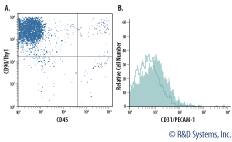
Rat Mesenchymal Stem Cells from this lot have been thawed and tested for their ability to proliferate for up to 5 passages. Stem and progenitor cells (CD90+ CD45- CD31-) expanded from the end of passage 5 have been examined for CD90, CD45, and CD31 expression (see below). They were also tested for their ability to differentiate into adipocytes, chondrocytes, and osteocytes using the Rat Mesenchymal Stem Cell Functional Identification Kit (Catalog ;# SC020).
The cells tested negative for mycoplasma using the MycoProbe™ Mycoplasma Detection Kit (Catalog # CUL001B). The cells also tested negative for microbial contamination.
Data Examples
 View Larger Image |
Rat Mesenchymal Stem Cells Show Positive Expression of CD90/Thy1 and Negative Expression of CD45 and CD31. A. Rat mesenchymal stem cells (Catalog # PSC003) were stained for the indicated markers after passage 5. CD90/Thy1 was detected using an Anti-Rat CD90/Thy1-RPE Antibody, CD45 was detected using an Alexa 687-conjugated Anti-Rat CD45 Antibody. B. CD31 was detected using a Goat Anti-Mouse CD31/PECAM-1 Affinity Purified Polyclonal Antibody (Catalog # AF3628) (filled histogram) or a Normal Goat IgG isotype control (Catalog # AB-108-C, empty histogram) followed by a PE-conjugated Donkey Anti-Goat Secondary Antibody (Catalog # F0107). |
 View Larger Image |
Verification of Rat Mesenchymal Stem Cell Multipotency. Rat Mesenchymal Stem Cells (Catalog # PSC003) were cultured in StemXVivo™ Mesenchymal Stem Cell Expansion Media (Catalog # CCM004) and differentiation was induced as indicated using the media supplements included in the Rat Mesenchymal Stem Cell Functional Identification Kit (Catalog # SC020). The kit also contains a Goat Anti-Mouse FABP4 Antigen Affinity-purified Polyclonal Antibody (adipocytes), a Mouse Anti-Human Osteocalcin Monoclonal Antibody (osteocytes), and a Goat Anti-Human Aggrecan Antigen Affinity-purified Polyclonal Antibody (chondrocytes) for the confirmation of differentiation status. The cells were stained using the NorthernLights 557-conjugated Donkey Anti-Goat (Catalog # NL001; red) or Anti-Mouse (Catalog # NL007; red) Secondary Antibody, and the nuclei were counterstained with DAPI (blue). |
BG01V human embryonic stem cells are licensed from ViaCyte, Inc.
Formulation, Preparation, and Storage
Shipping
The product is shipped with dry ice or equivalent. Upon receipt, store it immediately at the temperature recommended below.
Storage
Store in liquid nitrogen for up to 12 months from the date of receipt.
Background: Mesenchymal Stem Cells
The term 'mesenchymal stem cells' (MSCs) is most commonly used to describe multipotent self-renewing cells that can be differentiated in vitro to generate adipocytes, chondrocytes, and osteoblasts. However, because these biological properties and hierarchical relationships remain to be clearly demonstrated in vivo, the term 'multipotent mesenchymal stromal cells' is often used to distinguish cultured cells from their in vivo precursors. Originally discovered in mouse bone marrow, multipotent mesenchymal stromal cells cultured from a variety of species and tissue types, have been shown to differentiate into progeny of additional lineages including, cardiomyocytes, endothelial cells, hepatocytes, and neural cells. Again, the physiological relevance of these findings remains to be determined.
Alternate Names
AEG1, LYRIC, LYRIC/3D3, metadherin
Additional Mesenchymal Stem Cells Products
Product Documents for Rat Mesenchymal Stem Cells (1 x 10e6 cells/vial)
Product Specific Notices for Rat Mesenchymal Stem Cells (1 x 10e6 cells/vial)
For research use only
Loading...
Loading...
Loading...
Loading...