
UDP-Azido-GalNAc
R&D Systems, part of Bio-Techne | Catalog # ES103
Activated Sugar


Key Product Details
Key Benefits
Learn more about Fluorescent Glycan Labeling and Detection
Species
Multi-Species
Conjugate
Azido
Product Summary for UDP-Azido-GalNAc

|
Formula |
C17H24N6O17P2 |
|
Molecular Weight |
646.35 Da |
|
Formulation |
1 mM provided in 20 mM Tris, pH 8.0 |
|
Stability & Storage |
Store the unopened product at < -20 °C. Good for 12 months from date of receipt. |
Incorporate or detect GalNAc without expensive, specialized equipment!
Applications
- For in vitro enzymatic incorporation of azido-sugars into specific, targeted glycans.
- Detect the presence or absence of GalNAc modifications.
- Monitoring O-glycans.
Key Features and Benefits
- Can be introduced to proteins and lipids via various GalNAc transferases.
- Can be conjugated to desired reporter molecules via click chemistry.
- Can be detected via Western blot, ELISA, and flow cytometry, depending on the type of reporter molecule.
- Contain the smallest possible orthogonal functional group.
- Has minimal side effect on target molecules.
- User-friendly.
For Details: Wu et al., (2015) Carbohydrate Res. 412:1-6
Related Reagents
Click Chemistry
Enzymes and Detection Reagents for UDP-Azido-GalNAc, ES103
|
GalNAc Transferases: All transfer GalNAc to Ser/Thr to initiate mucin-type glycosylation |
|---|
| GALNT2 |
| GALNTL1 |
| Polypeptide GalNAc Transferase 1/GALNT1 |
| Polypeptide GalNAc Transferase 10/GALNT10 |
| Polypeptide GalNAc Transferase 11/GALNT11 |
| Polypeptide GalNAc Transferase 13/GALNT13 |
| Polypeptide GalNAc Transferase 3/GALNT3 |
| Polypeptide GalNAc Transferase 4/GALNT4 |
| Polypeptide GalNAc Transferase 7/GALNT7 |
Schematic
|
Glycans are removed by enzyme treatment. Specific transferases can be used to incorporate Azido-GalNAc at suitable open positions. The incorporation Azido-GalNAc can then be detected using Biotinylated Alkyne in a click chemistry reaction. |

Sample Data
|
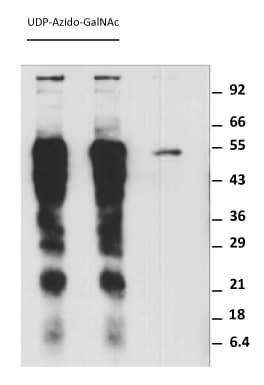
Labeling Asialofetuin with GALNT2. In each reaction, 5 µg of Asialofetuin (Sigma Aldrich), 0.5 nmol of UDP-Azido-GlcNAc, 1 µg rhGALNT2 and 1 µg of rE. faecalis O-Glycosidase was mixed in 50 µL of 25 mM HEPES supplemented with 10 mM of MnCl2 and 150 mM NaCl at pH 7.5. The reactions were incubated at 37°C for 60 minutes. The reactions were then conjugated, at room temperature for 30 minutes, with 1.0 nmol of Biotinylated Alkyne in the presence of 100 nmol of Ascorbic Acid and 5 nmol of CuCl2 for a final volume of 60 µL. The reactions were then separated with 12% SDS-PAGE and blotted to a nitrocellulose paper and detected with Streptavidin-HRP. |
Formulation, Preparation, and Storage
Shipping
The product is shipped with dry ice or equivalent. Upon receipt, store it immediately at the temperature recommended below.
Storage
Store the unopened product at -20 to -70 °C. Use a manual defrost freezer and avoid repeated freeze-thaw cycles. Do not use past expiration date.
Product Documents for UDP-Azido-GalNAc
Product Specific Notices for UDP-Azido-GalNAc
For research use only
Loading...
Loading...
Loading...
Loading...