
GDP-Cy5-Fucose
R&D Systems, part of Bio-Techne | Catalog # ES301
Activated Sugar


Key Product Details
Key Benefits
Learn more about Fluorescent Glycan Labeling and Detection
Species
Multi-Species
Conjugate
Cy5
Product Summary for GDP-Cy5-Fucose

|
Formula |
C53H67N11O25P2S3 |
|
Molecular Weight |
1404.37 |
| >1416.3 Da
Formulation |
Lyophilized with Tris, pH 8.0 |
|
Stability & Storage |
Store the unopened product at < -20 °C. Good for 12 months from date of receipt. |
Applications
- Fluorescent labeling with Cy5 of free glycans as well as glycoproteins and glycolipids.
- Fluorescent detection of specific glycan epitopes on glycoproteins as well as cell surface.
- Quantitation of the fucosylation level of specific glycans.
- Together with CMP-Cy3-Sialic Acid, allows for dual labeling and detection of sialoglycans.
Key Features and Benefits:
- Excitation at 649 nm and emission at 671 nm, exhibits red fluorescent light under microscope.
- The fluorescent dye is conjugated to the C6 position of the fucose.
- Can be directly introduced into glycoproteins and glycolipids via various fucosyltransferases.
- Can be introduced to live cells for glycan imaging.
- Has minimum side-effects on target molecules.
- Very convenient and user-friendly.
For Details:
Wu, ZL. et al., (2020) Glycobiology 30: 970.
Related Reagents
Click Chemistry
- CMP-Cy5-Sialic Acid (ES302)
- GDP-Azido-Fucose (ES101)
- CMP-Azido-Sialic Acid (ES102)
- UDP-Azido-GalNAc (ES103)
- UDP-Azido-GlcNAc (ES104)
- CMP-Biotin-Sialic Acid (ES201)
Enzymes and detection reagents
- Various fucosyltransferases
- Various neuraminidases
- Various fucosidase
Data Examples
|
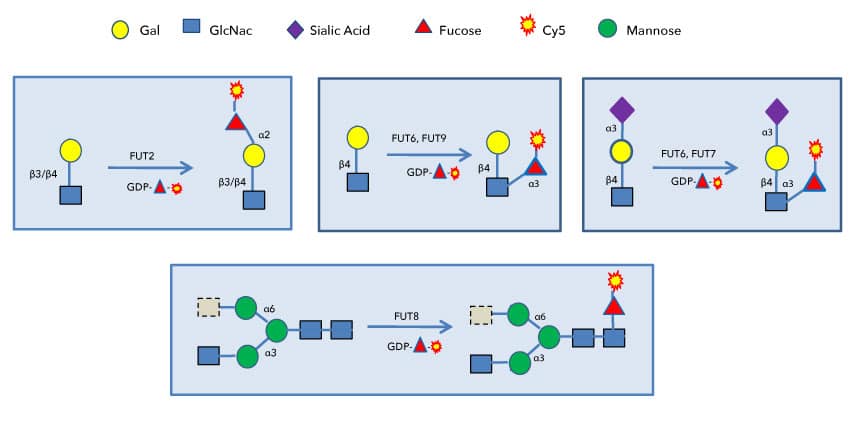
Strategies for Probing and labeling substrate glycans of various fucosyltransferases using GDP-Cy5-Fucose. Depicted here are for FUT2, FUT6, FUT7, FUT8 and FUT9. FUT2 introduces Cy5-Fucose to terminal Gal residues. FUT6, FUT7 and FUT9 introduce Cy5-Fucose to the GlcNAc residue in lactosamine structures that can be found on both N- and O-glycans. FUT8 introduces Cy5-Fucose to the innermost GlcNAc residue on N-glycans where there is an unmodified terminal GlcNAc residue in the α3 branch. |
|
Labeling bovine fetuin (Fet) using GDP-Cy5-Fucose. Bovine fetuin was purified from crude fetuin by gel filtration. Samples of fetuin were labeled with Recombinant Human Fucosyltransferase 9/FUT9 Protein (Catalog # 9347-GT). In control lanes, no fetuin was present, revealing the self-labeling of FUT9 itself. Samples were not labeled in the absence of neuraminidase but labeled strongly in the presence of Recombinant C. perfringens Neuraminidase Protein (Catalog # 5080-NM), suggesting that all lactosamine structures on the samples were sialylated prior to labeling. Samples were separated on 4-20% gradient SDS-PAGE and imaged with silver staining (left panel) and a fluorescent imager (middle and right panels at different contrasts). M, a prestained Western blot molecular marker that is visible under fluorescent imager. |

|
Cellular glycan imaging with GDP-Cy5-Fucose and CMP-Cy3-Sialic Acid. HeLa cells were stained by incorporation GDP-Cy5-Fucose (Catalog # ES301) by Recombinant Human Fucosyltransferase 9/FUT9 Protein (Catalog # 9347-GT) (red) and CMP-Cy3-Sialic Acid (Catalog ES402) by Recombinant Human ST6GAL1 (aa 44-406) Protein (Catalog # 7620-GT) (green). Hela cells on a 96 well plate were briefly treated with Recombinant C. perfringens Neuraminidase Protein (Catalog # 5080-NM) to remove preexisting sialic acids. The treated cells were then labeled by FUT9 and ST6Gal1 simultaneously in the presence of GDP-Cy5-Fucose and CMP-Cy3-Sialic acid for 30 minutes. After the labeling, the solution was quickly removed by aspiration and washing two times with PBS. Afterwards, the cells were fixed and stained with DAIP (purple) in the presence of 0.5% Triton X 100 to reveal the cell nuclei. All three panels were from a same viewing area and imaged under different channels. These images show that FUT9 and ST6Gal1 stained the same regions on HeLa cells. For details on cell imaging with fluorophore-conjugated sugars, please refer to Wu. L. et al., (2020) Glycobiology 30:454-462 |

Table 1. Guideline for using CMP-Cy5-Sialic Acid for sialoglycan labeling and detection
| Fucosyltransferase | Catalog # | Substrate | GDP-Cy5-Fucose Tolerance |
|---|---|---|---|
| FUT1 | Terminal Gal in H antigen | Not determined | |
| FUT2 | 7770-GT | Terminal Gal in H antigen | yes |
| FUT3 | 4950-GT | GlcNAc in type 1 glycan chain | yes |
| FUT4 | GlcNAc in terminal lactosamine | yes | |
| FUT5 | 4949-GT | GlcNAc in terminal lactosamine | yes |
| FUT6 | GlcNAc in terminal lactosamine | yes | |
| FUT7 | 6409-GT | GlcNAc in sialylated lactosamine | yes |
| FUT8 | 5768-GT | Core GlcNAc in N-glycans | yes |
| FUT9 | 9347-GT | GlcNAc in non-sialylated lactosamine | yes |
| FUT10 | Unknown | unknown | |
| FUT11 | 5964-GT | Unknown | unknown |
| POFUT1 | 7409-GT | Notch receptor | Not determined |
Formulation, Preparation, and Storage
Shipping
The product is shipped with dry ice or equivalent. Upon receipt, store it immediately at the temperature recommended below.
Storage
Store the unopened product at -20 to -70 °C. Use a manual defrost freezer and avoid repeated freeze-thaw cycles. Do not use past expiration date.
Product Documents for GDP-Cy5-Fucose
Product Specific Notices for GDP-Cy5-Fucose
For research use only
Loading...
Loading...
Loading...
Loading...