
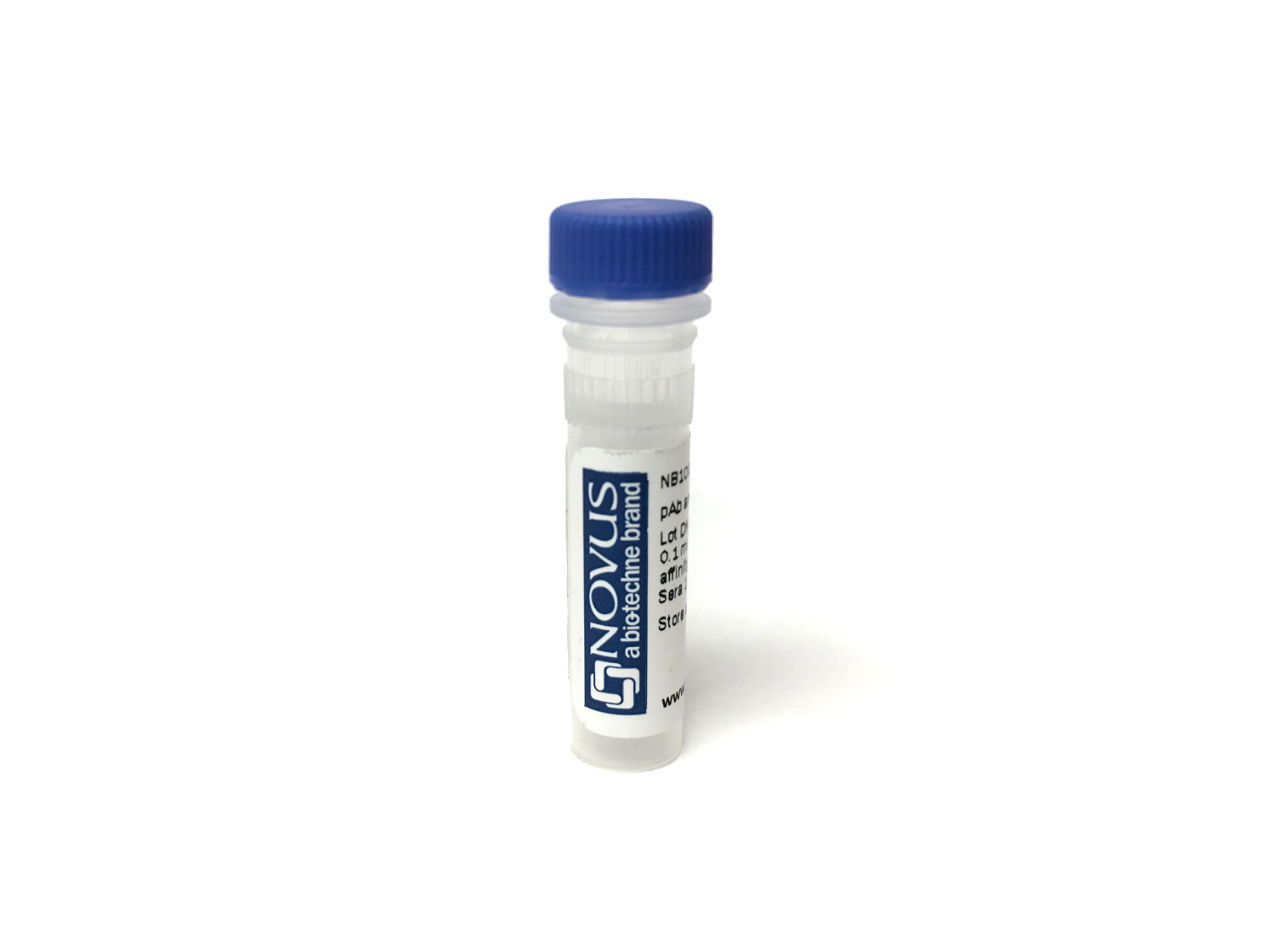
Rabbit anti-Hamster IgG (H+L) Secondary Antibody [DyLight 680]
Novus Biologicals, part of Bio-Techne | Catalog # NBP1-74888FR

Conjugate
Catalog #
Key Product Details
Species Reactivity
Hamster
Applications
Chemiluminescence Immunoassay, ELISA, Flow Cytometry, Immunoassay, Immunocytochemistry/ Immunofluorescence, Immunohistochemistry, Immunomicroscopy, Western Blot
Label
DyLight 680 (Excitation = 692 nm, Emission = 712 nm)
Antibody Source
Polyclonal Rabbit IgG
Concentration
Please see the vial label for concentration. If unlisted please contact technical services.
Product Specifications
Immunogen
This Rabbit anti-Hamster IgG (H+L) Secondary Antibody was developed against purified hamster IgG (H&L).
Specificity
Based on IEP, this Rabbit anti-Hamster IgG (H+L) Secondary Antibody reacts with heavy gamma chains on hamster IgG and light chains on all hamster immunoglobulins.
Clonality
Polyclonal
Host
Rabbit
Isotype
IgG
Description
This conjugate is made on demand and is not held in inventory. Each order represents a unique lot. All conjugates are generated using validated conjugation protocols and meet strict degree of labeling (F/P) specifications; additional information is available upon request. The antibody concentration is provided on the individual product label.
For specialized conjugation needs, like large quantities, specific concentrations, and defined F/P ratios, bulk and custom antibody conjugation services are available.
For specialized conjugation needs, like large quantities, specific concentrations, and defined F/P ratios, bulk and custom antibody conjugation services are available.
Applications for Rabbit anti-Hamster IgG (H+L) Secondary Antibody [DyLight 680]
Application
Recommended Usage
ELISA
1:100-1:2000
Flow Cytometry
1:10-1:1000
Immunocytochemistry/ Immunofluorescence
1:10 - 1:500
Immunohistochemistry
1:10 - 1:500
Immunomicroscopy
1:10 - 1:500
Western Blot
1:100-1:2000
Application Notes
Recommended applications are based on validated applications from the unconjugated base product NBP1-74888. This conjugated antibody is not kept in inventory and is made to order using validated conjugation protocols.
Spectra Viewer
Plan Your Experiments
Use our spectra viewer to interactively plan your experiments, assessing multiplexing options. View the excitation and emission spectra for our fluorescent dye range and other commonly used dyes.
Spectra Viewer
Formulation, Preparation, and Storage
Purification
Affinity purified
Formulation
50mM Sodium Borate
Preservative
0.05% Sodium Azide
Concentration
Please see the vial label for concentration. If unlisted please contact technical services.
Shipping
The product is shipped with polar packs. Upon receipt, store it immediately at the temperature recommended below.
Stability & Storage
Store at 4C in the dark.
Background: IgG (H+L)
The 4 IgG subclasses, sharing 95% amino acid identity, include IgG1, IgG2, IgG3, and IgG4 for humans and IgG1, IgG2a, IgG2b, and IgG3 for mice. The relative abundance of each human subclass is 60% for IgG1, 32% for IgG2, 4% for IgG3, and 4% for IgG4. In an IgG deficiency, there may be a shortage of one or more subclasses (4).
References
1. Painter RH. (1998) Encyclopedia of Immunology (Second Edition). Elsevier. 1208-1211
2. Chapter 9 - Antibodies. (2012) Immunology for Pharmacy. Mosby 70-78
3. Schroeder H, Cavacini, L. (2010) Structure and Function of Immunoglobulins. J Allergy Clin Immunol. 125(2 0 2): S41-S52. PMID: 20176268
4. Vidarsson G, Dekkers G, Rispens T. (2014) IgG subclasses and allotypes: from structure to effector functions. Front Immunol. 5:520. PMID: 25368619
Additional IgG (H+L) Products
Product Documents for Rabbit anti-Hamster IgG (H+L) Secondary Antibody [DyLight 680]
Product Specific Notices for Rabbit anti-Hamster IgG (H+L) Secondary Antibody [DyLight 680]
DyLight (R) is a trademark of Thermo Fisher Scientific Inc. and its subsidiaries.
This product is for research use only and is not approved for use in humans or in clinical diagnosis. Secondary Antibodies are guaranteed for 1 year from date of receipt.
Loading...
Loading...
Loading...
Loading...
Loading...