
Recombinant Human Protein Kinase SRC His-tag, CF New
R&D Systems, part of Bio-Techne | Catalog # 11800-KS

Key Product Details
Product Specifications
Source
Human embryonic kidney cell, HEK293-derived human Src protein
Ala55-Leu536, with an N-terminal Met and 6-His tag
Ala55-Leu536, with an N-terminal Met and 6-His tag
Purity
>90%, by SDS-PAGE visualized with Silver Staining and quantitative densitometry by Coomassie® Blue Staining.
Endotoxin Level
<0.10 EU per 1 μg of the protein by the LAL method.
N-terminal Sequence Analysis
Protein identity confirmed by mass spectrometry
Predicted Molecular Mass
55 kDa
SDS-PAGE
51-57 kDa, under reducing conditions.
Activity
Measured by its ability to transfer a phosphate from adenosine triphosphate (ATP) to a synthetic peptide substrate.
The specific activity is >125 pmol/min/μg, as measured under the described conditions.
Scientific Data Images for Recombinant Human Protein Kinase SRC His-tag, CF
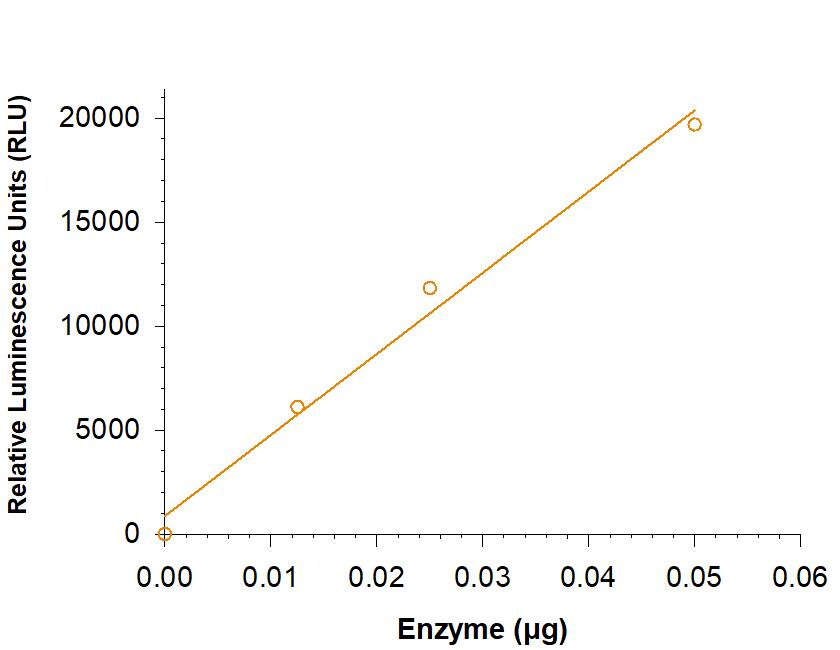
Recombinant Human Protein Kinase SRC His-tag Enzyme Activity.
Recombinant Human Recombinant Human Protein kinase SRC His-tag (Catalog # 11800-KS) is measured by its ability to transfer a phosphate from adenosine triphosphate (ATP) to a synthetic peptide substrate.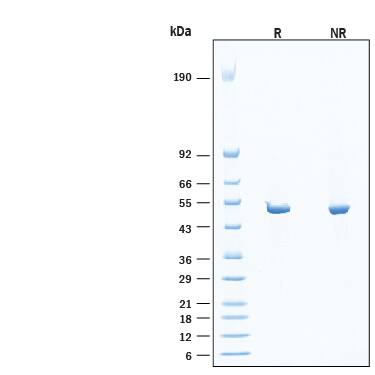
Recombinant Human Protein Kinase SRC His-tag SDS-PAGE.
2 μg/lane of Recombinant Human Protein Kinase SRC His-tag (Catalog # 11800-KS) was resolved with SDS-PAGE under reducing (R) and non-reducing (NR) conditions and visualized by Coomassie® Blue staining, showing bands at 51-57 kDa, under reducing conditions.Formulation, Preparation and Storage
11800-KS
| Formulation | Supplied as a 0.2 μm filtered solution in Tris, NaCl, DTT and Glycerol. |
| Shipping | The product is shipped with polar packs. Upon receipt, store it immediately at the temperature recommended below. |
| Stability & Storage | Use a manual defrost freezer and avoid repeated freeze-thaw cycles.
|
Background: Src
References
- Roskoski, R. Jr. (2004) Biochem. Biophys. Res. Commun. 324: 1155.
- Poh, A.R. and M. Ernst. (2023) Oncogene. 42:1786.
- Su, Y. et al. (2025) Eur. J. Med. Chem. 287:117369.
- Xu, W. et al. (1999) Mol. Cell. 3:629.
- Arter, C. et al. (2022) J. Biol. Chem. 298:102247.
- Reynolds, A.B. et al. (2014) Oncogene. 33:4537.
- Talamonti, M.S. et al. (1993) J. Clin. Investig. 91:53.
- Verbeek, B.S. et al. (1996) J. Pathol. 180:383.
- Egan, C. et al. (1999) Oncogene. 18:1227.
- Zhang, J. et al. (2007) Am. J. Pathol. 170:366.
- Du, J. et al. (2009) Nat. Biotechnol. 27:77.
- Cai, H. et al. (2011) Cancer Res. 71:862.
- Montenegro, R.C. et al. (2020) Oncotarget. 11:535.
- Aligayer, H. et al. (2002) Cancer. 94:344.
- Liu, S.T. et al. (2013) Front. Physiol. 4:416.
- Patel, A. et al. (2016) Life Sci. 157:52.
- Dunker, W., et al. (2023) JCI Insight. 8:e167270.
- Mao, W. et al. (2024) ACS Chem. Biol. 19:110.
Long Name
v-src Sarcoma [Schmidt-Ruppin A-2] Viral Oncogene Homolog
Alternate Names
ASV, c-Src, RSVgp4
Gene Symbol
SRC
UniProt
Additional Src Products
Product Documents for Recombinant Human Protein Kinase SRC His-tag, CF
Product Specific Notices for Recombinant Human Protein Kinase SRC His-tag, CF
For research use only
Loading...
Loading...
Loading...
Loading...