
Recombinant Human KGF/FGF-7 Heat Stable Protein, CF New
R&D Systems, part of Bio-Techne | Catalog # BT-FGF7HS

Key Product Details
Source
E. coli
Conjugate
Unconjugated
Applications
Bioactivity
Product Specifications
Source
E. coli-derived human KGF/FGF-7 protein
Proprietary, engineered based on P21781
Proprietary, engineered based on P21781
Purity
>95%, by SDS-PAGE visualized with Silver Staining and quantitative densitometry by Coomassie® Blue Staining.
Endotoxin Level
<0.10 EU per 1 μg of the protein by the LAL method.
SDS-PAGE
19-23 kDa, under reducing conditions.
Activity
Measured in a cell proliferation assay using Ba/F3 mouse pro B cells transfected with human FGF RIIb.
The ED50 for this effect is 6.00-60.0 ng/mL.
The ED50 for this effect is 6.00-60.0 ng/mL.
Scientific Data Images for Recombinant Human KGF/FGF-7 Heat Stable Protein, CF
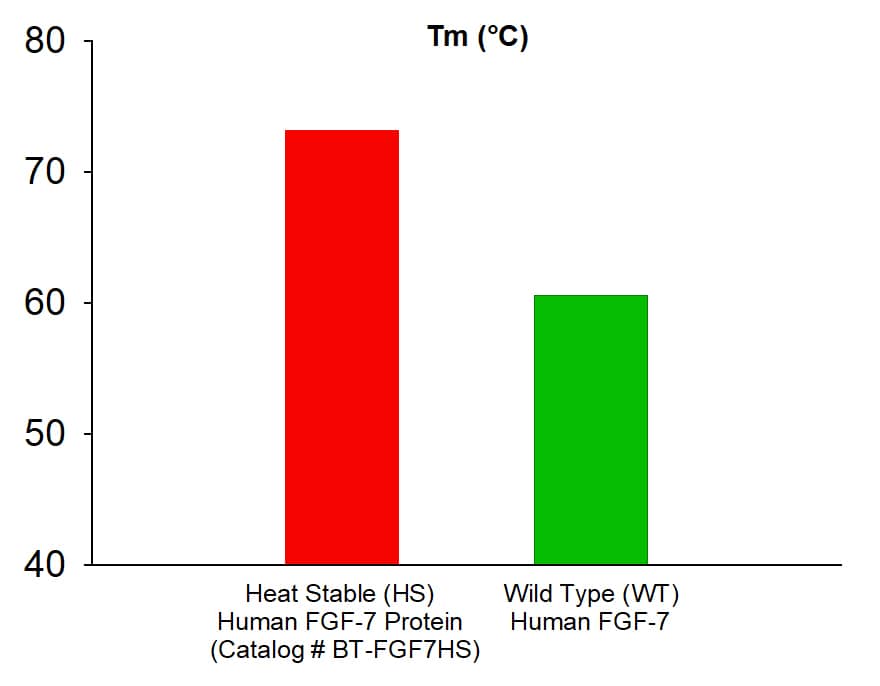
Melting Temperature Comparison of Heat Stable (HS) and Wild-Type (WT) Recombinant Human KGF/FGF-7.
Recombinant Human KGF/FGF-7 Heat Stable Protein (Catalog # BT-FGF7HS) exhibits a higher melting temperature (Tm) than wild-type human KGF/FGF-7. Thermal stability was assessed by Differential Scanning Fluorimetry (DSF).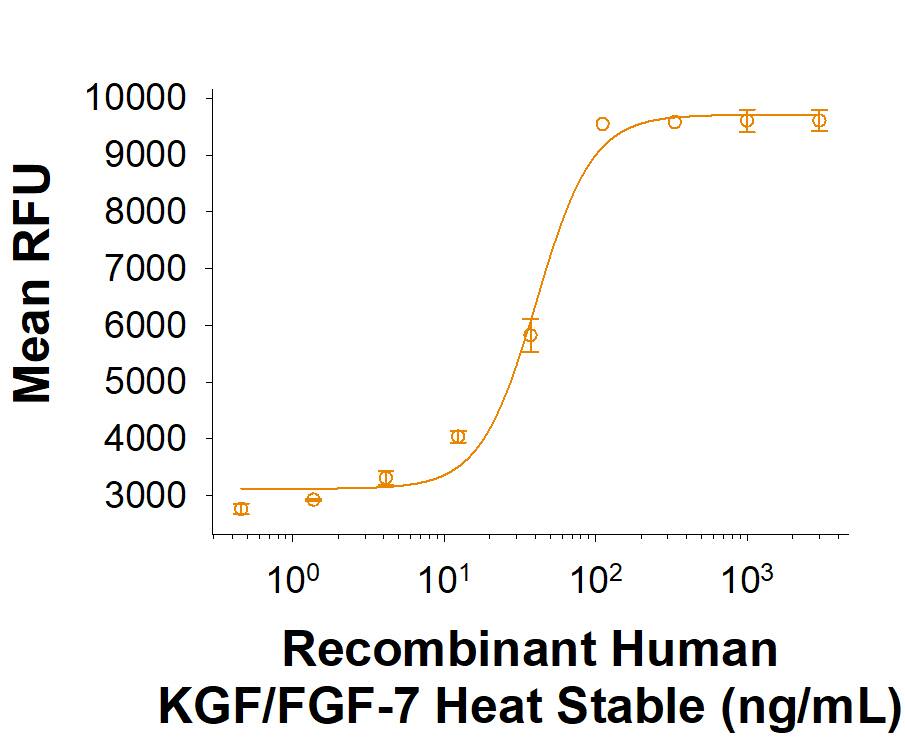
Recombinant Human KGF/FGF‑7 Heat Stable Protein Bioactivity.
Recombinant Human KGF/FGF‑7 Heat Stable Protein (Catalog # BT-FGF7HS) induced cell proliferation in Ba/F3 mouse pro-B cells transfected with human FGF RIIb.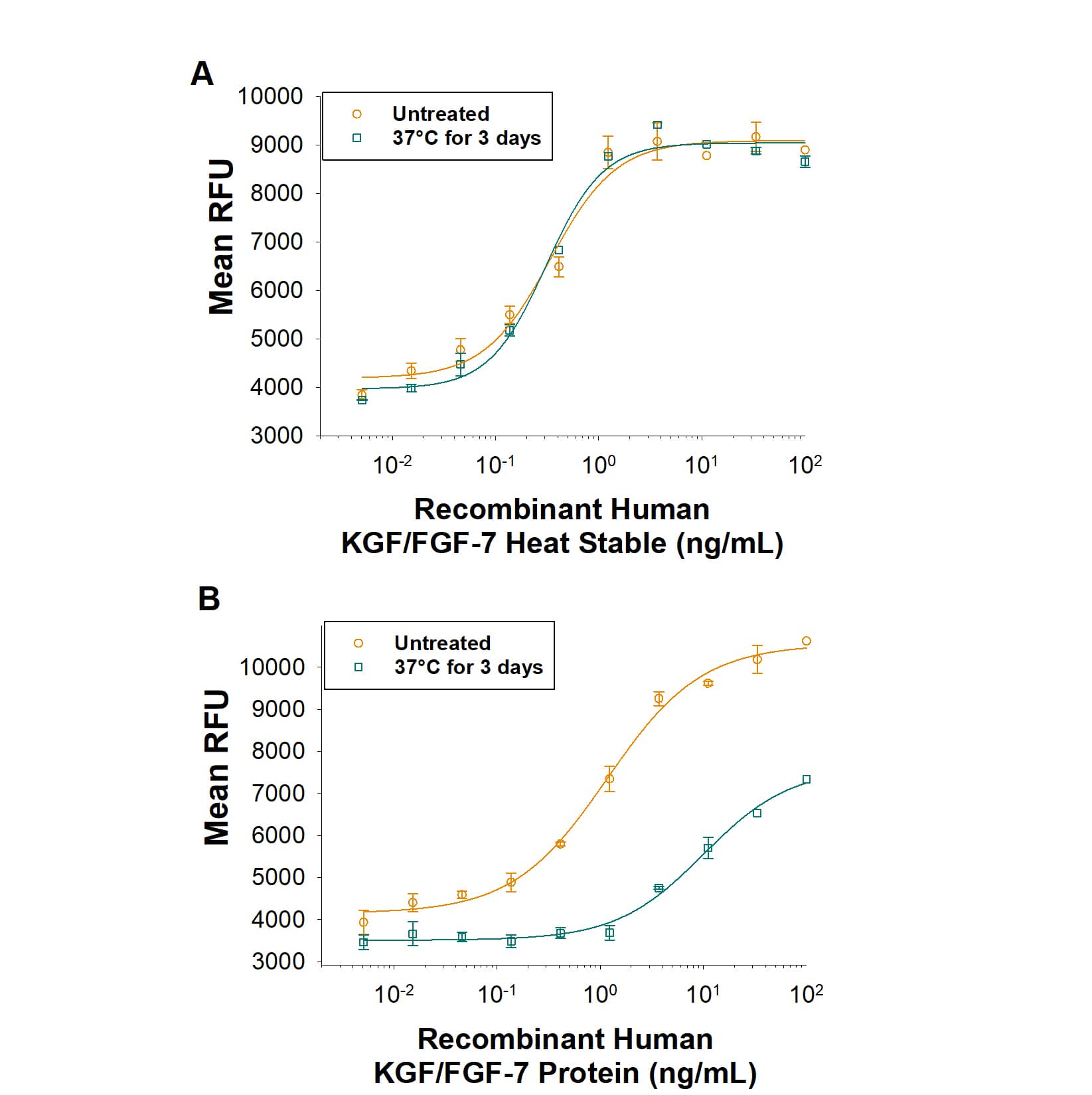
Recombinant Human KGF/FGF 7 Heat Stable Protein Bioactivity.
Recombinant human FGF-7 protein activates SEAP reporter activity in HEK293 human embryonic kidney cells stably transfected with the secreted alkaline phosphatase (SEAP) reporter gene. (A) Recombinant heat-stable human FGF-7 (Catalog # BT-FGF7HS) and (B) recombinant human KGF/FGF-7 protein were either untreated or incubated at 37 °C for 3 days in cell culture media. Heat-stable (HS) FGF-7 retained comparable bioactivity after incubation relative to the untreated control, indicating increased thermal stability. In contrast, wild type (WT) FGF-7 showed a significant loss of activity after 3 days of heat-stress incubation, suggesting lower thermal stability.Formulation, Preparation and Storage
BT-FGF7HS
| Formulation | Lyophilized from a 0.2 μm filtered solution in MOPS, Na2SO4 and EDTA with Trehalose. |
| Reconstitution | Reconstitute at 100 μg/mL in water. |
| Shipping | The product is shipped at ambient temperature. Upon receipt, store it immediately at the temperature recommended below. |
| Stability & Storage | Use a manual defrost freezer and avoid repeated freeze-thaw cycles.
|
Background: KGF/FGF-7
KGF (keratinocyte growth factor), also known as FGF-7 (fibroblast growth factor-7), is one of 22 known members of the mouse FGF family of secreted proteins that plays a key role in development, morphogenesis, angiogenesis, wound healing, and tumorigenesis (1-4). KGF expression is restricted to cells of mesenchymal origin. When secreted, it acts as a paracrine growth factor for nearby epithelial cells (1). KGF speeds wound healing by being dramatically upregulated in response to damage to skin or internal structures that results in high local concentrations of inflammatory mediators such as IL-1 and TNF-alpha. (2, 5). KGF promotes cell migration and invasion, and mediates melanocyte transfer to keratinocytes upon UVB radiation (6, 7). It has been used ectopically to avoid chemotherapy-induced oral mucositis in patients with hematological malignancies (1). Deletion of KGF affects kidney development, producing abnormally small ureteric buds and fewer nephrons (8). It also impedes hair follicle differentiation (9). The 194 amino acid (aa) KGF precursor contains a 31 aa signal sequence and, like all other FGFs, an ~120 aa beta-trefoil scaffold that includes receptor- and heparin-binding sites. KGF signals only through the IIIb splice form of the tyrosine kinase receptor, FGF R2 (FGF R2-IIIb/KGF R) (10). Receptor dimerization requires an octameric or larger heparin or heparin sulfate proteoglycan (11). FGF-10, also called KGF2, shares 51% aa identity and similar function to KGF, but shows more limited expression than KGF and uses an additional receptor, FGF R2-IIIc (12). Following receptor engagement, KGF is typically degraded, while FGF-10 is recycled (12). Mature human KGF, which is active across species, shares 98% aa sequence identity with bovine, equine, ovine and canine, 96% with mouse and porcine, and 92% with rat KGF, respectively. Our proprietary Heat Stable FGF-7 (HS) is engineered for superior thermostability compared to the wild-type protein. Additionally, FGF-7 HS retains full bioactivity under heat-challenge conditions in a functional reporter assay.
References
- Finch, P.W. and J.S. Rubin (2006) J. Natl. Cancer Inst. 98:812.
- Werner, S. et al. (2007) J. Invest. Dermatol. 127:998.
- Werner, S. (1998) Cytokine Growth Factor Rev. 9:153.
- Mason, I.J. et al. (1994) Mech. Dev. 45:15.
- Geer, D.J. et al. (2005) Am. J. Pathol. 167:1575.
- Niu, J. et al. (2007) J. Biol. Chem. 282:6001.
- Cardinali, G. et al. (2005) J. Invest. Dermatol. 125:1190.
- Qiao, J. et al. (1999) Development 126:547.
- Guo, L. et al. (1996) Genes Dev. 10:165.
- de Georgi, V. et al. (2007) Dermatol. Clin. 25:477.
- Hsu, Y-R. et al. (1999) Biochemistry 38:2523.
- Belleudi, F. et al. (2007) Traffic 8:1854.
Long Name
Keratinocyte Growth Factor
Alternate Names
FGF-7, FGF7, HBGF-7, HBGF7
Gene Symbol
FGF7
Additional KGF/FGF-7 Products
Product Documents for Recombinant Human KGF/FGF-7 Heat Stable Protein, CF
Product Specific Notices for Recombinant Human KGF/FGF-7 Heat Stable Protein, CF
For research use only
Loading...
Loading...
Loading...
Loading...