
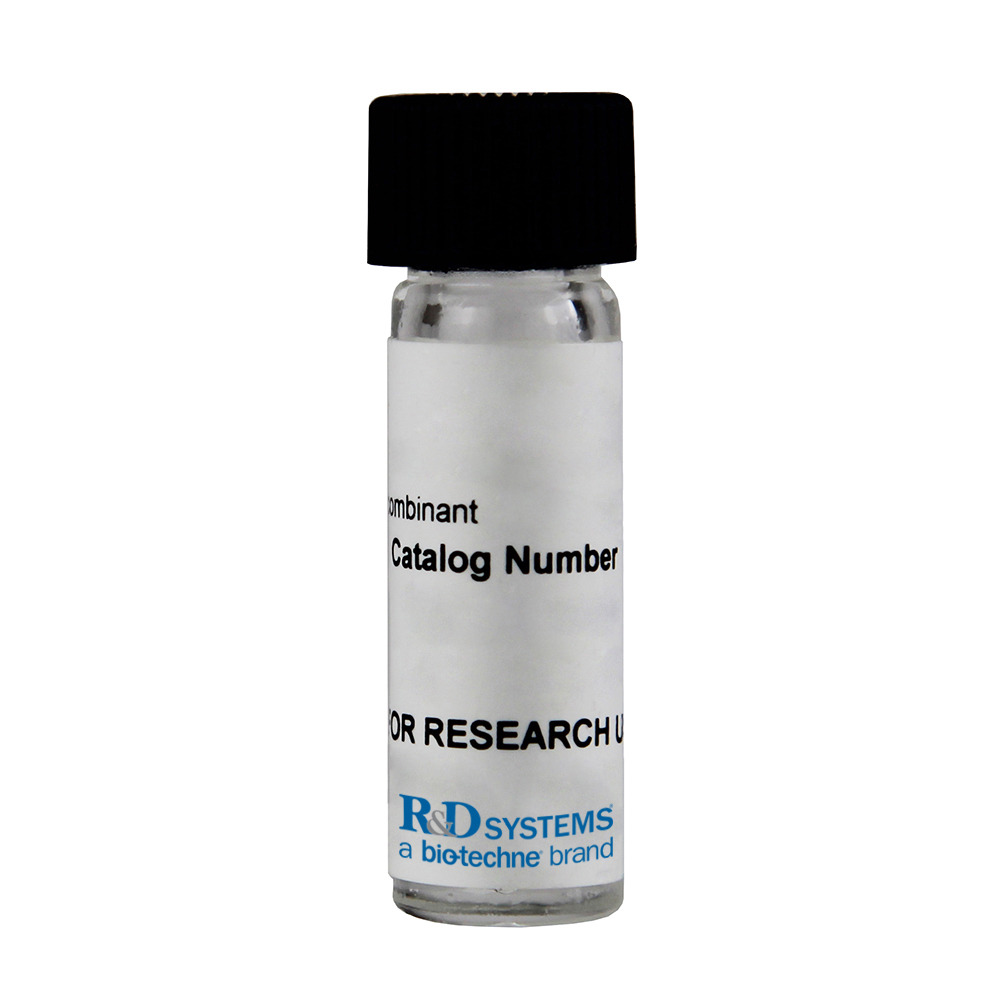
Recombinant Drosophila Decapentaplegic (Dpp) Protein
R&D Systems, part of Bio-Techne | Catalog # 159-DP

Key Product Details
- R&D Systems E. coli-derived Recombinant Drosophila Decapentaplegic (Dpp) Protein (159-DP)
- Quality control testing to verify active proteins with lot specific assays by in-house scientists
- All R&D Systems proteins are covered with a 100% guarantee
Source
E. coli
Accession #
Structure / Form
Disulfide-linked homodimer
Conjugate
Unconjugated
Applications
Bioactivity
Product Specifications
Source
E. coli-derived drosophila Decapentaplegic/DPP protein
Asp457-Arg588 (Gln473His) & (Pro474Ala), with an N-terminal Met
Asp457-Arg588 (Gln473His) & (Pro474Ala), with an N-terminal Met
Purity
>97%, by SDS-PAGE under reducing conditions and visualized by silver stain.
Endotoxin Level
<0.01 EU per 1 μg of the protein by the LAL method.
N-terminal Sequence Analysis
Met
Predicted Molecular Mass
14.8 kDa (monomer)
Activity
Measured by its ability to induce Mad phosphorylation in S2 Drosophila cells transfected with Mad.
Approximately 3 µg/mL of recombinant Drosophila DPP and higher can effectively induce Mad phosphorylation.
Measured by its ability to induce alkaline phosphatase production by ATDC5 mouse chondrogenic cells. Nakamura, K. et al. (1999) Exp. Cell Res. 250:351.
The ED50 for this effect is 0.5-2 µg/mL.
Approximately 3 µg/mL of recombinant Drosophila DPP and higher can effectively induce Mad phosphorylation.
Measured by its ability to induce alkaline phosphatase production by ATDC5 mouse chondrogenic cells. Nakamura, K. et al. (1999) Exp. Cell Res. 250:351.
The ED50 for this effect is 0.5-2 µg/mL.
Formulation, Preparation and Storage
Carrier Free
What does CF mean?CF stands for Carrier Free (CF). We typically add Bovine Serum Albumin (BSA) as a carrier protein to our recombinant proteins. Adding a carrier protein enhances protein stability, increases shelf-life, and allows the recombinant protein to be stored at a more dilute concentration. The carrier free version does not contain BSA.
What formulation is right for me?In general, we advise purchasing the recombinant protein with BSA for use in cell or tissue culture, or as an ELISA standard. In contrast, the carrier free protein is recommended for applications, in which the presence of BSA could interfere.
Carrier: 159-DP
| Formulation | Lyophilized from a 0.2 μm filtered solution in Acetonitrile and TFA with BSA as a carrier protein. |
| Reconstitution | Reconstitute at 100 μg/mL in sterile 4 mM HCl containing at least 0.1% human or bovine serum albumin. |
| Shipping | The product is shipped at ambient temperature. Upon receipt, store it immediately at the temperature recommended below. |
| Stability & Storage | Use a manual defrost freezer and avoid repeated freeze-thaw cycles.
|
Carrier Free: 159-DP/CF
| Formulation | Lyophilized from a 0.2 μm filtered solution in Acetonitrile and TFA. |
| Reconstitution | Reconstitute at 100 μg/mL in sterile 4 mM HCl. |
| Shipping | The product is shipped at ambient temperature. Upon receipt, store it immediately at the temperature recommended below. |
| Stability & Storage | Use a manual defrost freezer and avoid repeated freeze-thaw cycles.
|
Background: Decapentaplegic/DPP
Decapentaplegic (Dpp) is one of at least five TGF-beta superfamily ligands identified in the Drosophila genome. Dpp, a functional orthologue of mammalian BMP-2 and BMP-4, is a morphogen and plays an essential role in Drosophila development. Dpp regulates embryonic dorsal-ventral polarity and is required for gut morphogenesis and outgrowth and patterning of imaginal disks. Similar to other TGF-beta family ligands, Dpp is synthesized as a large proprotein which is proteolytically processed at the dibasic cleavage site to release the carboxy-terminal domain. Biologically active Dpp is a disulfide-linked homodimer of the carboxy-terminal 132 amino acid residues that contains the characteristic conserved cysteine residues involved in the formation of the cysteine knot and the interchain disulfide bond. Cellular responses to Dpp have been shown to be mediated by the ligand-induced formation of heteromeric complexes of the Drosophila type I, Thick Veins (Tkv), and type II, Punt, serine/threonine kinases. The activated receptor complex induces the phosphorylation of the prototypical Smad, Mad, and subsequent translocation of the Mad-Medea complex to the nucleus where they regulate the transcription of target genes. Secreted extracellular Dpp antagonists, including the short-gastrulation (Sog) and twisted gastrulation (TSG), which bind Dpp and regulate its availability, have been identified.
References
- Raftery, L.A. and D.J. Sutherland (1999) Dev. Biol. 210:251.
- Ruberte, E. et al. (1995) Cell 80:890.
Alternate Names
DPP
Entrez Gene IDs
33432 (Drosophila)
Gene Symbol
33432
UniProt
Additional Decapentaplegic/DPP Products
Product Documents for Recombinant Drosophila Decapentaplegic (Dpp) Protein
Product Specific Notices for Recombinant Drosophila Decapentaplegic (Dpp) Protein
For research use only
Loading...
Loading...
Loading...
Loading...