
TLR7 Antibody [FITC]
Novus Biologicals, part of Bio-Techne | Catalog # NBP2-24777

Conjugate
Catalog #
Key Product Details
Species Reactivity
Validated:
Human, Mouse, Rat
Cited:
Human, Mouse
Applications
Validated:
Western Blot, Flow Cytometry, Immunocytochemistry/ Immunofluorescence, Immunoprecipitation
Cited:
Western Blot, Flow Cytometry, Immunocytochemistry/ Immunofluorescence, Immunoprecipitation
Label
FITC (Excitation = 495 nm, Emission = 519 nm)
Antibody Source
Polyclonal Rabbit IgG
Concentration
Please see the vial label for concentration. If unlisted please contact technical services.
Product Specifications
Immunogen
This antibody was developed against KLH-conjugated synthetic peptide corresponding to amino acids 706-749 of human TLR7; GenBank no. gb|AAF78035.1|AF245702_1. It will cross-react with mouse TLR7. In human Ramos cells, additional bands are seen.
Clonality
Polyclonal
Host
Rabbit
Isotype
IgG
Description
This conjugate is made on demand and is not held in inventory. Each order represents a unique lot. All conjugates are generated using validated conjugation protocols and meet strict degree of labeling (F/P) specifications; additional information is available upon request. The antibody concentration is provided on the individual product label.
For specialized conjugation needs, like large quantities, specific concentrations, and defined F/P ratios, bulk and custom antibody conjugation services are available.
For specialized conjugation needs, like large quantities, specific concentrations, and defined F/P ratios, bulk and custom antibody conjugation services are available.
Scientific Data Images for TLR7 Antibody [FITC]
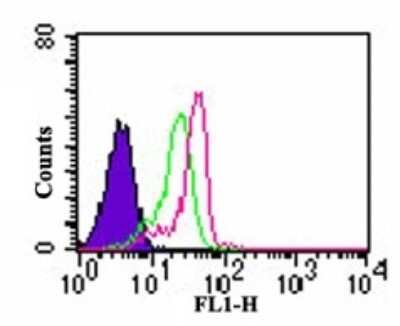
Flow Cytometry: TLR7 Antibody [FITC] [NBP2-24777] - Intracellular staining by analysis of TLR7 in human monocytes using this antibody at 0.5 ug/10^6 cells. Shaded histogram represents cells alone, green represents rabbit IgG isotype control, red represents anti-TLR7 antibody.
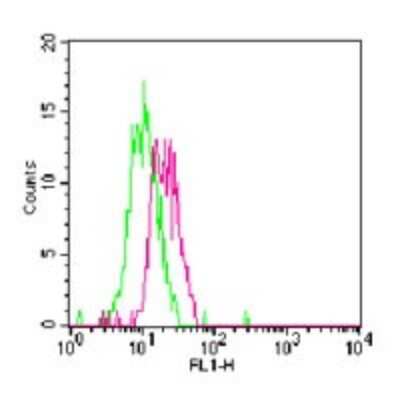
Flow Cytometry: TLR7 Antibody [FITC] [NBP2-24777] - Analysis of TLR7 in Balb/c mouse splenocytes using this antibody. Green represents rabbit IgG isotype control ; red represents anti-TLR7 antibody.

Flow Cytometry: TLR7 Antibody [FITC] [NBP2-24777] - Intracellular flow analysis of TLR7 in TLR7/HEK 293 cells using NBP2-24777 at 1 ug/10^6 cells. Green represents Vector/HEK 293 cells; red represents TLR7/HEK 293 .
Applications for TLR7 Antibody [FITC]
Application
Recommended Usage
Flow Cytometry
1ul/1 million cells
Application Notes
Recommended applications are based on validated applications from the unconjugated base product NBP2-24906. This conjugated antibody is not kept in inventory and is made to order using validated conjugation protocols.
Spectra Viewer
Plan Your Experiments
Use our spectra viewer to interactively plan your experiments, assessing multiplexing options. View the excitation and emission spectra for our fluorescent dye range and other commonly used dyes.
Spectra Viewer
Formulation, Preparation, and Storage
Purification
Protein G purified
Formulation
50mM Sodium Borate
Preservative
0.05% Sodium Azide
Concentration
Please see the vial label for concentration. If unlisted please contact technical services.
Shipping
The product is shipped with polar packs. Upon receipt, store it immediately at the temperature recommended below.
Stability & Storage
Store at 4C in the dark.
Background: TLR7
While TLRs play an important role in innate immune response, dysfunction in the TLR-MyD88 signaling cascade has also been reported in various autoimmune disorders (5,6). Elevated expression of TLR7 is associated with increased risk of system lupus erythematosus (SLE), an autoimmune disease involving B cell hyperactivity (6,7). Studies involving mouse models has also found that increased TLR7 expression predisposes mice to a lupus-like disease (7). Therapeutics targeting TLR7 have been developed to either enhance or inhibit its activity depending on the circumstance. For example, TLR7 agonists such as imiquimod, resiquimod, and 852A are used to increase TLR7 activity for treatment of cancers and to fight viral infections (7,8). On the other hand, TLR7 antagonists inhibit its activation and have been developed to combat chronic immune stimulation as seen in inflammatory and autoimmune diseases (8).
References
1. Petes C, Odoardi N, Gee K. The Toll for Trafficking: Toll-Like Receptor 7 Delivery to the Endosome. Front Immunol. 2017;8:1075. https://doi.org/10.3389/fimmu.2017.01075
2. Maeda K, Akira S. TLR7 Structure: Cut in Z-Loop. Immunity. 2016;45(4):705-707. https://doi.org/10.1016/j.immuni.2016.10.003
3. Krieg AM, Vollmer J. Toll-like receptors 7, 8, and 9: linking innate immunity to autoimmunity. Immunol Rev. 2007;220:251-269. https://doi.org/10.1111/j.1600-065X.2007.00572.x
4. Uniprot (Q9NYK1)
5. Zheng C, Chen J, Chu F, Zhu J, Jin T. Inflammatory Role of TLR-MyD88 Signaling in Multiple Sclerosis. Front Mol Neurosci. 2020;12:314. https://doi.org/10.3389/fnmol.2019.00314
6. Chi H, Li C, Zhao FS, et al. Anti-tumor Activity of Toll-Like Receptor 7 Agonists. Front Pharmacol. 2017;8:304. https://doi.org/10.3389/fphar.2017.00304
7. Fillatreau S, Manfroi B, Dorner T. Toll-like receptor signalling in B cells during systemic lupus erythematosus. Nat Rev Rheumatol. 2021;17(2):98-108. https://doi.org/10.1038/s41584-020-00544-4
8. Patinote C, Karroum NB, Moarbess G, et al. Agonist and antagonist ligands of toll-like receptors 7 and 8: Ingenious tools for therapeutic purposes. Eur J Med Chem. 2020;193:112238. https://doi.org/10.1016/j.ejmech.2020.112238
Long Name
Toll-like Receptor 7
Alternate Names
toll-like receptor 7
Gene Symbol
TLR7
Additional TLR7 Products
Product Documents for TLR7 Antibody [FITC]
Product Specific Notices for TLR7 Antibody [FITC]
This product is for research use only and is not approved for use in humans or in clinical diagnosis. Primary Antibodies are guaranteed for 1 year from date of receipt.
Loading...
Loading...
Loading...
Loading...
Loading...