
Tau Antibody - BSA Free
Novus Biologicals, part of Bio-Techne | Catalog # NB100-82247

Key Product Details
Species Reactivity
Human, Mouse, Rat
Applications
Immunohistochemistry, Immunohistochemistry-Paraffin, Western Blot
Label
Unconjugated
Antibody Source
Polyclonal Rabbit IgG
Format
BSA Free
Concentration
1.0 mg/ml
Product Specifications
Immunogen
The antiserum was produced against synthesized non-phosphopeptide derived from human Tau around amino acids 229~233 (V-R-T-P-P)
Specificity
Detects endogenous levels of total Tau protein.
Marker
pan-Neuronal Marker
Clonality
Polyclonal
Host
Rabbit
Isotype
IgG
Scientific Data Images for Tau Antibody - BSA Free
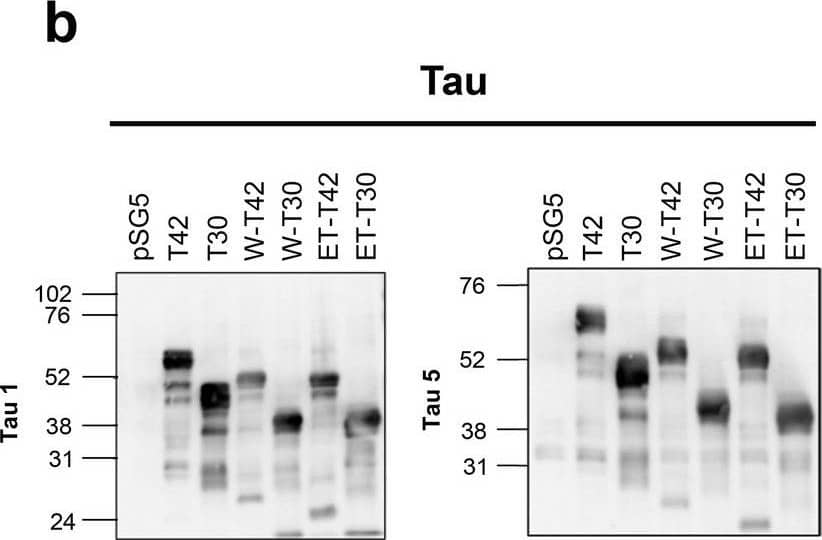
![Western Blot: Tau Antibody [NB100-82247]](https://resources.bio-techne.com/images/products/Tau-Antibody-Western-Blot-NB100-82247-img0005.jpg "Western Blot: Tau Antibody [NB100-82247]")
Western Blot: Tau Antibody [NB100-82247]
Western Blot: Tau Antibody [NB100-82247] - Analysis of extracts from mouse brain tissue.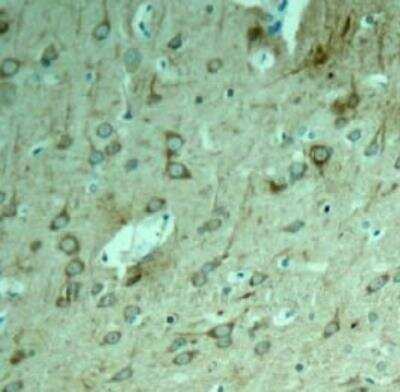
Immunohistochemistry-Paraffin: Tau Antibody [NB100-82247] -
Immunohistochemistry-Paraffin: Tau Antibody [NB100-82247] - Analysis of paraffin-embedded rat hippocampal region tissue from a model with Alzheimer's Disease using NB100-82247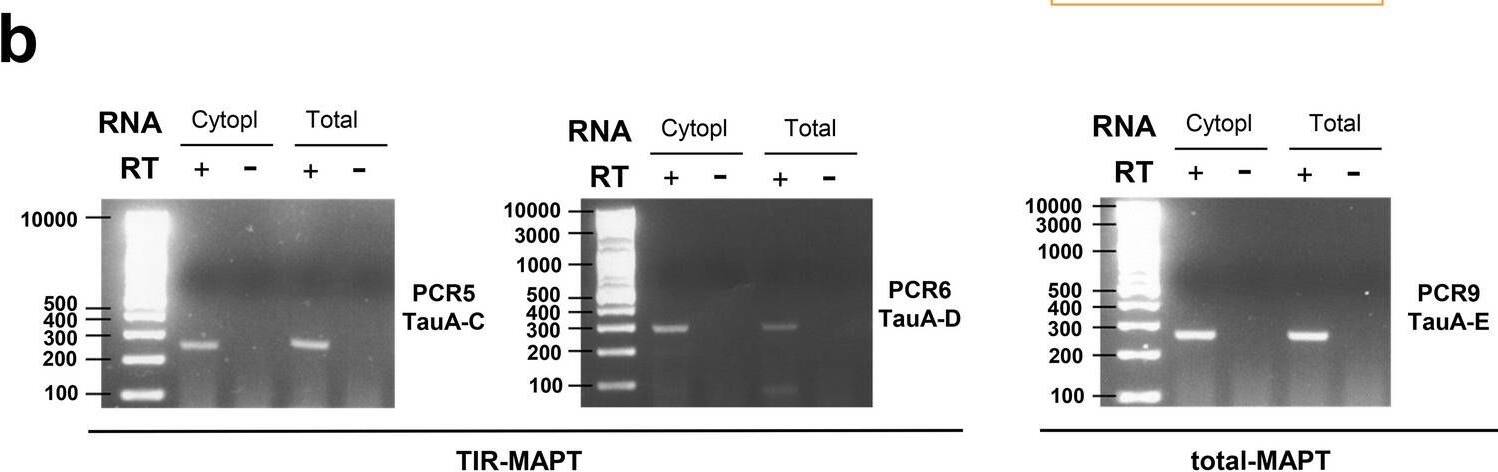
Western Blot: Tau Antibody - BSA Free [NB100-82247] -
TIR-MAPT RNA expression. a Schematic representation of the MAPT gene and MAPT and TIR-MAPT mRNAs generated from it. A, C, D and E represent the hybridization sites of the primers designed for semi-quantitative PCR employed for the PCRs in b (Supplementary Table 2, online resource). The fragment of intron 12 that would remain upon retention is represented with colored stripes. b Representative images of agarose gels showing of semi-quantitative PCR results using total or cytoplasmic-enriched RNA of SH-SY5Y cells. Results showed the existence of RNA species from exon 11 to intron 12 where intron 11 was spliced out (PCR 5 and 6). Controls of the addition (RT+) or no addition of retrotranscriptase (RT−) were included. PCR 9 shows MAPT in which both intron 11 and 12 are spliced out. Detailed information of all semi-quantitative PCR combinations and amplicon sizes is provided in Supplementary Table 5, online resource. c Schematic representation of the MAPT gene including the hybridization sites of the oligos used for quantitative PCR. dTIR-MAPT RNA levels by qPCR in cytoplasmic-enriched fraction or whole extracts (total) of SH-SY5Y cells. e Comparison of TIR-MAPT level in SH-SY5Y cells and hippocampus and frontal lateral cortex of human brain. Graphs show means and SE of technical triplicates. f Percentage of brain samples having expression of MAPT or TIR-MAPT genes. Data are shown for three different regions within brains (see Supplementary Table 3, online resource). g Scatter dot blot of expression values of MAPT and TIR-MAPT genes in brain regions having TPM (transcripts per kilobase million) > 0. Number of samples f, g: cortex = 122; frontal cortex = 113; hippocampus = 98. Graphs represent mean and SEM. p values were calculated using a T test, ****p value ≤ 0.0001 Image collected and cropped by CiteAb from the following open publication (https://pubmed.ncbi.nlm.nih.gov/33934221), licensed under a CC-BY license. Not internally tested by Novus Biologicals.Applications for Tau Antibody - BSA Free
Application
Recommended Usage
Immunohistochemistry
1:50-1:100
Immunohistochemistry-Paraffin
1:50-1:100
Western Blot
1:500-1:1000
Formulation, Preparation, and Storage
Purification
Immunogen affinity purified
Formulation
PBS (without Mg2+ and Ca2+), pH 7.4, 150 mM NaCl, 50% glycerol
Format
BSA Free
Preservative
0.02% Sodium Azide
Concentration
1.0 mg/ml
Shipping
The product is shipped with polar packs. Upon receipt, store it immediately at the temperature recommended below.
Stability & Storage
Store at 4C short term. Aliquot and store at -20C long term. Avoid freeze-thaw cycles.
Background: Tau
Long Name
Microtubule-Associated Protein Tau
Alternate Names
MAPT, MSTD, MTBT1, Neurofibrillary tangle protein, PPND
Gene Symbol
MAPT
UniProt
Additional Tau Products
Product Documents for Tau Antibody - BSA Free
Product Specific Notices for Tau Antibody - BSA Free
This product is for research use only and is not approved for use in humans or in clinical diagnosis. Primary Antibodies are guaranteed for 1 year from date of receipt.
Loading...
Loading...
Loading...
Loading...