
RB1CC1 Antibody
Novus Biologicals, part of Bio-Techne | Catalog # NB100-77279

![Western Blot: RB1CC1 Antibody [NB100-77279]](https://resources.bio-techne.com/images/products/RB1CC1-Antibody-Western-Blot-NB100-77279-img0001.jpg "Western Blot: RB1CC1 Antibody [NB100-77279]")
Key Product Details
Validated by
Independent Antibodies, Biological Validation
Species Reactivity
Validated:
Human, Mouse
Cited:
Human
Applications
Validated:
Western Blot, Immunoprecipitation
Cited:
Western Blot
Label
Unconjugated
Antibody Source
Polyclonal Rabbit IgG
Concentration
0.2 mg/ml
Product Specifications
Immunogen
The immunogen recognized by this antibody maps to a region between residue 1544 and 1594 of human 200 kDa FAK family kinase-interacting protein (RB1-inducible coiled-coil 1) using the numbering given in entry NP_055596.2 (GeneID 9821).
Clonality
Polyclonal
Host
Rabbit
Isotype
IgG
Theoretical MW
183 kDa.
Disclaimer note: The observed molecular weight of the protein may vary from the listed predicted molecular weight due to post translational modifications, post translation cleavages, relative charges, and other experimental factors.
Disclaimer note: The observed molecular weight of the protein may vary from the listed predicted molecular weight due to post translational modifications, post translation cleavages, relative charges, and other experimental factors.
Scientific Data Images for RB1CC1 Antibody
![Western Blot: RB1CC1 Antibody [NB100-77279]](https://resources.bio-techne.com/images/products/RB1CC1-Antibody-Western-Blot-NB100-77279-img0005.jpg "Western Blot: RB1CC1 Antibody [NB100-77279]")
Western Blot: RB1CC1 Antibody [NB100-77279]
Western Blot: RB1CC1 Antibody [NB100-77279] - Detection of Mouse FIP200/RB1CC1 by Western Blot. Samples: Whole cell lysate from TCMK-1 (15 and 50 ug) cells. Antibodies: Affinity purified rabbit anti-FIP200/RB1CC1 antibody NB100-77279 used for WB at 0.2 ug/ml. Detection: Chemiluminescence with an exposure time of 3 minutes.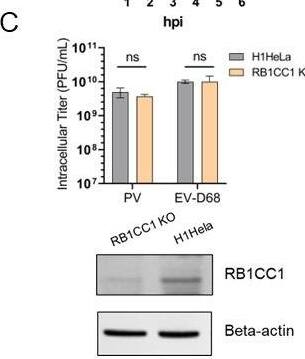
Western Blot: RB1CC1 Antibody [NB100-77279] -
EV-D68 and PV display similarities in virus production kinetics and interaction with canonical autophagy players. (A) Titers of both cell-associated and extracellular PV and EV-D68 from a time course of infection. H1HeLa cells were infected at an MOI of 20. Intracellular and extracellular virus samples were collected at each hour post-infection. Viral titers were analyzed by plaque assay. (B) Impact of enterovirus D68 and poliovirus on host autophagy markers. H1HeLa cells were either untreated/mock (M) or infected with PV or EV-D68 at an MOI of 20 for 6 h, and samples were collected every hour during infection. Samples were subjected to western blot analysis for traditional autophagy markers: LC3B, p62(SQSTM1), and its Cp (cleavage product). Viral marker: VP3 (virus structural capsid protein 3). Beta-actin served as a loading control. (C–E) Intracellular EV-D68 and PV titers produced in parental H1HeLa versus KO cell lines. H1HeLa WT or KOs were infected with PV or EV-D68 at an MOI of 20 for 6 h. Viral titers were analyzed by plaque assay. KO cell lines represented: RB1CC1 KO (C), PI3K3 KO (D), and ATG7 KO(E), respectively. Unpaired Student’s t test was used for the statistical analysis (***P < 0.001; **P < 0.01; *P ≤ 0.05; ns = not significant). The efficiency of KOs was assessed by western blot and the parental H1HeLa cell line (WT) was used as a control. Image collected and cropped by CiteAb from the following open publication (https://pubmed.ncbi.nlm.nih.gov/37819109), licensed under a CC-BY license. Not internally tested by Novus Biologicals.Applications for RB1CC1 Antibody
Application
Recommended Usage
Immunoprecipitation
2-5 ug/mg lysate
Western Blot
1:2000-1:10000
Formulation, Preparation, and Storage
Purification
Immunogen affinity purified
Formulation
TBS and 0.1% BSA
Preservative
0.09% Sodium Azide
Concentration
0.2 mg/ml
Shipping
The product is shipped with polar packs. Upon receipt, store it immediately at the temperature recommended below.
Stability & Storage
Store at 4C. Do not freeze.
Background: RB1CC1
Alternate Names
Cc1, DRAGOU14, FIP200, KIAA0203200 kDa FAK family kinase-interacting protein, RB1-inducible coiled-coil 1, RB1-inducible coiled-coil protein 1, RBICC
Entrez Gene IDs
9821 (Human)
Gene Symbol
RB1CC1
UniProt
Additional RB1CC1 Products
Product Documents for RB1CC1 Antibody
Product Specific Notices for RB1CC1 Antibody
This product is for research use only and is not approved for use in humans or in clinical diagnosis. Primary Antibodies are guaranteed for 1 year from date of receipt.
Loading...
Loading...
Loading...
Loading...