
Oxidized PTP Active Site Antibody
R&D Systems, part of Bio-Techne | Catalog # MAB2844


Conjugate
Catalog #
Key Product Details
Validated by
Biological Validation
Species Reactivity
Validated:
Multi-Species
Cited:
Human, Mouse, Fish - Danio rerio (Zebrafish)
Applications
Validated:
Western Blot
Cited:
Western Blot, Neutralization, Immunoprecipitation
Label
Unconjugated
Antibody Source
Monoclonal Mouse IgG1 Clone # 335636
Product Specifications
Immunogen
KLH-coupled perfomic acid oxidized synthetic peptide
VHCSAG
VHCSAG
Specificity
Detects Oxidized PTP Active Site. Will react with any oxidized phosphatase containing the consensus sequence. Detects oxidized but not unoxidized DEP-1, PTP1B, TC-PTP, and SHP-2. Other phosphatases have not been tested.
Clonality
Monoclonal
Host
Mouse
Isotype
IgG1
Scientific Data Images for Oxidized PTP Active Site Antibody
Detection of Oxidized PTP by Western Blot.
Western blot shows oxidized PTP immunoprecipitated from lysates of HepG2 human hepatocellular carcinoma cell line using Rat Anti-SHP-2 antibody. PVDF membrane was probed with 1 µg/mL Mouse Anti-Oxidized PTP Active Site Monoclonal Antibody (Catalog # MAB2844) followed by HRP-conjugated Anti-Mouse IgG Secondary Antibody (Catalog # HAF007). A specific band for Oxidized SHP-2 was detected at approximately 70 kDa (as indicated). This experiment was conducted under reducing conditions and using Immunoblot Buffer Group 2.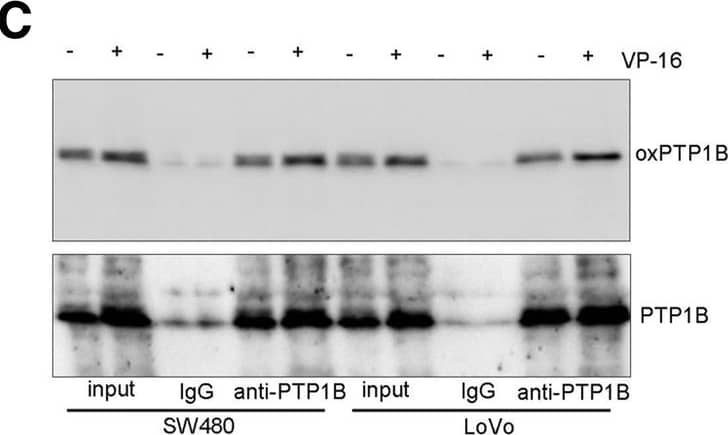
Detection of Human Oxidized PTP Active Site by Western Blot
Topoisomerase inhibitors induce JAK2-STAT1-CXCL1 and migration through ROS. a Relative DCFH-DA levels in SW480 and SW620 cells treated with VP-16 (V, 20 μM), ADM (A, 0.2 μg/ml), or CPT-11 (C, 80 μg/ml) for 0.5 h. P, a positive control with Rosup H2O2 (50 μg/ml, 0.5 h). (B) Western blot of oxidized PTPs after treatement with VP-16 (20 μM), ADM (0.2 μg/ml), or CPT-11 (80 μg/ml) for 0.5 h. c Confirmation of VP-16-induced PTP1B oxidization. After treatment with VP-16 (20 μM, 0.5 h), cell lysates (200 μg per sample) were immunoprecipitated with 1 μg anti-PTP1B or pre-immune IgG for 12 h. Precipitates and cell lysates (input, 50 μg per sample) were analyzed by Western blot with anti-oxPTP and anti-PTP1B. d Western blot of JAK2 and STAT1 phosphorylation and CXCL1 expression in cells pretreated with GSH (10 mM) for 2 h and subsequently treated with VP-16 (20 μM) or CPT-11 (80 μg/ml) for 0.5 h. e Migration assay of cells treated with GSH (10 mM) plus VP-16 (20 μM) or CPT-11 for 24 h Image collected and cropped by CiteAb from the following publication (https://pubmed.ncbi.nlm.nih.gov/31438997), licensed under a CC-BY license. Not internally tested by R&D Systems.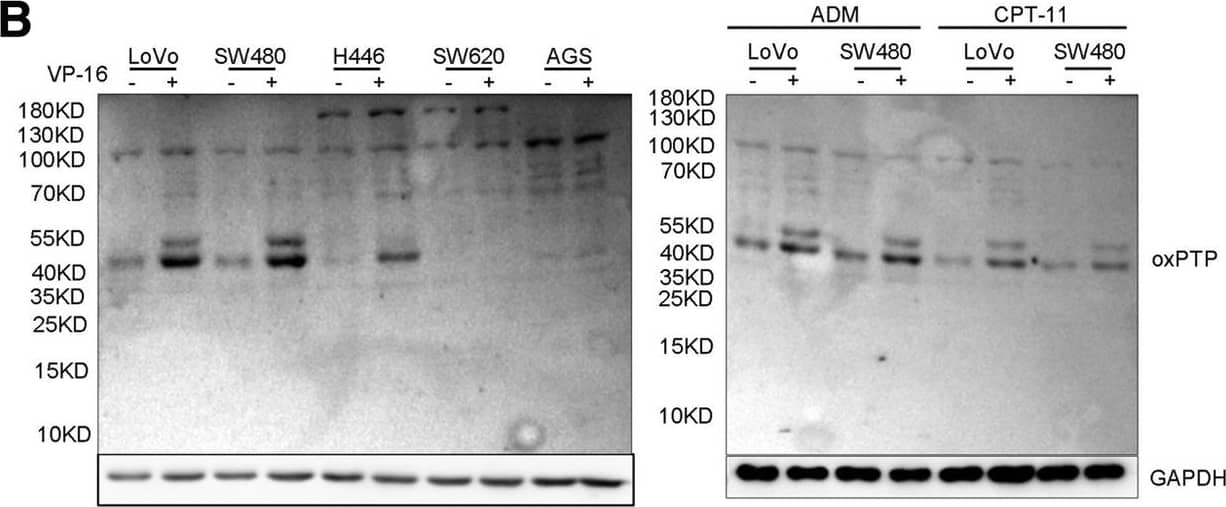
Detection of Human Oxidized PTP Active Site by Western Blot
Topoisomerase inhibitors induce JAK2-STAT1-CXCL1 and migration through ROS. a Relative DCFH-DA levels in SW480 and SW620 cells treated with VP-16 (V, 20 μM), ADM (A, 0.2 μg/ml), or CPT-11 (C, 80 μg/ml) for 0.5 h. P, a positive control with Rosup H2O2 (50 μg/ml, 0.5 h). (B) Western blot of oxidized PTPs after treatement with VP-16 (20 μM), ADM (0.2 μg/ml), or CPT-11 (80 μg/ml) for 0.5 h. c Confirmation of VP-16-induced PTP1B oxidization. After treatment with VP-16 (20 μM, 0.5 h), cell lysates (200 μg per sample) were immunoprecipitated with 1 μg anti-PTP1B or pre-immune IgG for 12 h. Precipitates and cell lysates (input, 50 μg per sample) were analyzed by Western blot with anti-oxPTP and anti-PTP1B. d Western blot of JAK2 and STAT1 phosphorylation and CXCL1 expression in cells pretreated with GSH (10 mM) for 2 h and subsequently treated with VP-16 (20 μM) or CPT-11 (80 μg/ml) for 0.5 h. e Migration assay of cells treated with GSH (10 mM) plus VP-16 (20 μM) or CPT-11 for 24 h Image collected and cropped by CiteAb from the following publication (https://pubmed.ncbi.nlm.nih.gov/31438997), licensed under a CC-BY license. Not internally tested by R&D Systems.Applications for Oxidized PTP Active Site Antibody
Application
Recommended Usage
Western Blot
1 µg/mL
Sample: Oxidized PTP immunoprecipitated from lysates of HepG2 human hepatocellular carcinoma cell line using Rat Anti-SHP-2 Antibody
Sample: Oxidized PTP immunoprecipitated from lysates of HepG2 human hepatocellular carcinoma cell line using Rat Anti-SHP-2 Antibody
Formulation, Preparation, and Storage
Purification
Protein A or G purified from hybridoma culture supernatant
Reconstitution
Reconstitute at 0.5 mg/mL in sterile PBS. For liquid material, refer to CoA for concentration.
Formulation
Lyophilized from a 0.2 μm filtered solution in PBS with Trehalose. *Small pack size (SP) is supplied either lyophilized or as a 0.2 µm filtered solution in PBS.
Shipping
Lyophilized product is shipped at ambient temperature. Liquid small pack size (-SP) is shipped with polar packs. Upon receipt, store immediately at the temperature recommended below.
Stability & Storage
Use a manual defrost freezer and avoid repeated freeze-thaw cycles.
- 12 months from date of receipt, -20 to -70 °C as supplied.
- 1 month, 2 to 8 °C under sterile conditions after reconstitution.
- 6 months, -20 to -70 °C under sterile conditions after reconstitution.
Background: Oxidized PTP Active Site
Oxidation of the essential cysteine in the active site of protein tyrosine phosphatases (PTPs) by exogenous or intracellular oxidants such as hydrogen peroxide is believed to play an important role in regulating the activity of these enzymes. The initial oxidation to a sulfenic acid (-SOH) is reversible, but the oxidation often progresses to an irreversible sulfonic acid (-SO3H) that can be detected by modification-specific antibodies. The active sites of PTPs contain the consensus amino acid sequence (V/I)HCSXG, a sequence essential for catalytic activity.
Long Name
Oxidized Protein Tyrosine Phosphatase Active Site
Additional Oxidized PTP Active Site Products
Product Documents for Oxidized PTP Active Site Antibody
Product Specific Notices for Oxidized PTP Active Site Antibody
For research use only
Loading...
Loading...
Loading...
Loading...
Loading...