
OCRL Antibody - BSA Free
Novus Biologicals, part of Bio-Techne | Catalog # NBP2-19621

Key Product Details
Species Reactivity
Human
Applications
Immunohistochemistry, Immunohistochemistry-Paraffin, Western Blot, Immunocytochemistry/ Immunofluorescence
Label
Unconjugated
Antibody Source
Polyclonal Rabbit IgG
Format
BSA Free
Concentration
Concentrations vary lot to lot. See vial label for concentration. If unlisted please contact technical services.
Product Specifications
Immunogen
Recombinant protein encompassing a sequence within the C-terminus region of human OCRL. The exact sequence is proprietary.
Reactivity Notes
Immunogen displays the following percentage of sequence identity for non-tested species: Rhesus Macaque, Mouse, Rat (80%).
Clonality
Polyclonal
Host
Rabbit
Isotype
IgG
Theoretical MW
104 kDa.
Disclaimer note: The observed molecular weight of the protein may vary from the listed predicted molecular weight due to post translational modifications, post translation cleavages, relative charges, and other experimental factors.
Disclaimer note: The observed molecular weight of the protein may vary from the listed predicted molecular weight due to post translational modifications, post translation cleavages, relative charges, and other experimental factors.
Scientific Data Images for OCRL Antibody - BSA Free
![Western Blot: OCRL Antibody [NBP2-19621]](https://resources.bio-techne.com/images/products/OCRL-Antibody-Western-Blot-NBP2-19621-img0001.jpg "Western Blot: OCRL Antibody [NBP2-19621]")
Western Blot: OCRL Antibody [NBP2-19621]
Western Blot: OCRL Antibody [NBP2-19621] - Sample (30 ug of whole cell lysate) A: 293T B: A431 5% SDS PAGE gel, diluted at 1:500.![Immunohistochemistry-Paraffin: OCRL Antibody [NBP2-19621]](https://resources.bio-techne.com/images/products/OCRL-Antibody-Immunohistochemistry-Paraffin-NBP2-19621-img0002.jpg "Immunohistochemistry-Paraffin: OCRL Antibody [NBP2-19621]")
Immunohistochemistry-Paraffin: OCRL Antibody [NBP2-19621]
Immunohistochemistry-Paraffin: OCRL Antibody [NBP2-19621] - Human breast cancer, using OCRL antibody at 1:250 dilution. Antigen Retrieval: Trilogy™ (EDTA based, pH 8.0) buffer, 15min.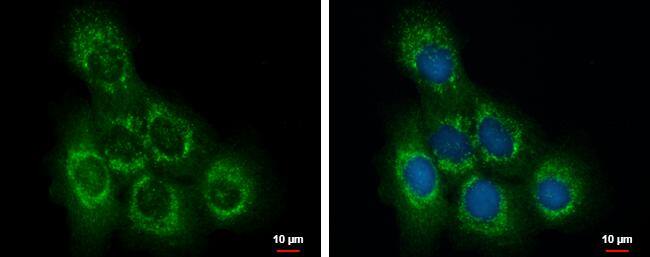
Immunocytochemistry/ Immunofluorescence: OCRL Antibody [NBP2-19621] -
OCRL antibody detects OCRL protein at cytoplasm by immunofluorescent analysis.Sample: A431 cells were fixed in ice-cold MeOH for 5 min.
Green: OCRL protein stained by OCRL antibody (NBP2-19621) diluted at 1:500.
Blue: Hoechst 33342 staining.
Applications for OCRL Antibody - BSA Free
Application
Recommended Usage
Immunocytochemistry/ Immunofluorescence
1:100-1:1000
Immunohistochemistry
1:100-1:1000
Immunohistochemistry-Paraffin
1:100-1:1000
Western Blot
1:500-1:3000
Formulation, Preparation, and Storage
Purification
Antigen Affinity-purified
Formulation
0.1M Tris, 0.1M Glycine, 20% Glycerol
Format
BSA Free
Preservative
0.01% Thimerosal
Concentration
Concentrations vary lot to lot. See vial label for concentration. If unlisted please contact technical services.
Shipping
The product is shipped with polar packs. Upon receipt, store it immediately at the temperature recommended below.
Stability & Storage
Aliquot and store at -20C or -80C. Avoid freeze-thaw cycles.
Background: OCRL
Alternate Names
EC 3.1.3.36, INPP5F, LOCR, Lowe oculocerebrorenal syndrome protein, NPHL2, OCRL1inositol polyphosphate 5-phosphatase OCRL-1, oculocerebrorenal syndrome of Lowe, phosphatidylinositol polyphosphate 5-phosphatase
Gene Symbol
OCRL
UniProt
Additional OCRL Products
Product Documents for OCRL Antibody - BSA Free
Product Specific Notices for OCRL Antibody - BSA Free
This product is for research use only and is not approved for use in humans or in clinical diagnosis. Primary Antibodies are guaranteed for 1 year from date of receipt.
Loading...
Loading...
Loading...
Loading...
⚠ WARNING: This product can expose you to chemicals including mercury, which is known to the State of California to cause reproductive toxicity with developmental effects. For more information go to www.P65Warnings.ca.gov.